Wellness fatigue is defined as the mental and physical exhaustion caused by the relentless pressure to pursue, maintain, and optimize personal health routines. It is not laziness or a lack of motivation. It is what happens when self-care stops feeling restorative and starts feeling like another obligation you are failing to meet. As of Q2 2026, 45% of people report experiencing wellbeing burnout driven by pressure to perform and optimize their wellness routines. That number tells you this is not a personal failing. It is a widespread response to a culture that has turned rest into a productivity project.
What is wellness fatigue explained: the core definition
Wellness fatigue is the point where self-care becomes self-defeating. The clinical term closest to this experience is “wellbeing burnout,” and it sits at the intersection of chronic stress, decision overload, and identity pressure. Understanding wellness fatigue means recognizing that the problem is not your commitment to health. The problem is the volume and intensity of demands the wellness industry places on you.
Wellness culture imports achievement logic from the workplace directly into personal care. The same drive to hit targets, track metrics, and outperform yesterday’s numbers now governs your sleep score, step count, and supplement stack. Experts describe the antidote as building an “inner reservoir” of rest that exists independently of any optimization goal. That shift in framing is where recovery begins.
Researchers in 2026 formally identified “digital health fatigue” as a distinct contributor to wellness burnout. Constant notifications from fitness trackers, sleep apps, and health monitors create anxiety rather than awareness. The data meant to help you ends up working against you.
What causes wellness fatigue and how does wellness culture contribute?
Several forces combine to produce wellness fatigue, and most of them are structural rather than personal.
- Achievement logic in self-care. Wellness routines now follow the same performance model as work. You track, measure, and grade yourself. Rest becomes a metric rather than a state.
- Digital health fatigue. Fitness trackers and health apps generate a constant stream of data and alerts. That volume creates decision pressure rather than clarity.
- Information overload. New studies, conflicting advice, and trend cycles mean you are constantly recalibrating what “healthy” looks like. The mental load of staying current is exhausting.
- Social comparison. Wellness performance is now public on social media. Seeing curated routines from others turns your personal care into a competition you did not sign up for.
- Optimization bias. The belief that more effort, more tools, and more discipline will eventually produce the right result keeps you pushing when rest is what you actually need.
- Performative wellness. When routines become a measure of personal worth, wellness shifts from support to identity, fostering comparison and anxiety rather than genuine well-being.
Decision fatigue from excessive wellness choices causes mental exhaustion that prevents consistency. The irony is that the more options you add to your routine, the harder it becomes to maintain any of them. Simplicity is not a compromise. It is the mechanism.
Pro Tip: Cut your wellness routine to three non-negotiable habits. Sleep, movement, and one form of stress relief. Add complexity only after those three feel effortless.

What are the symptoms and signs of wellness fatigue?
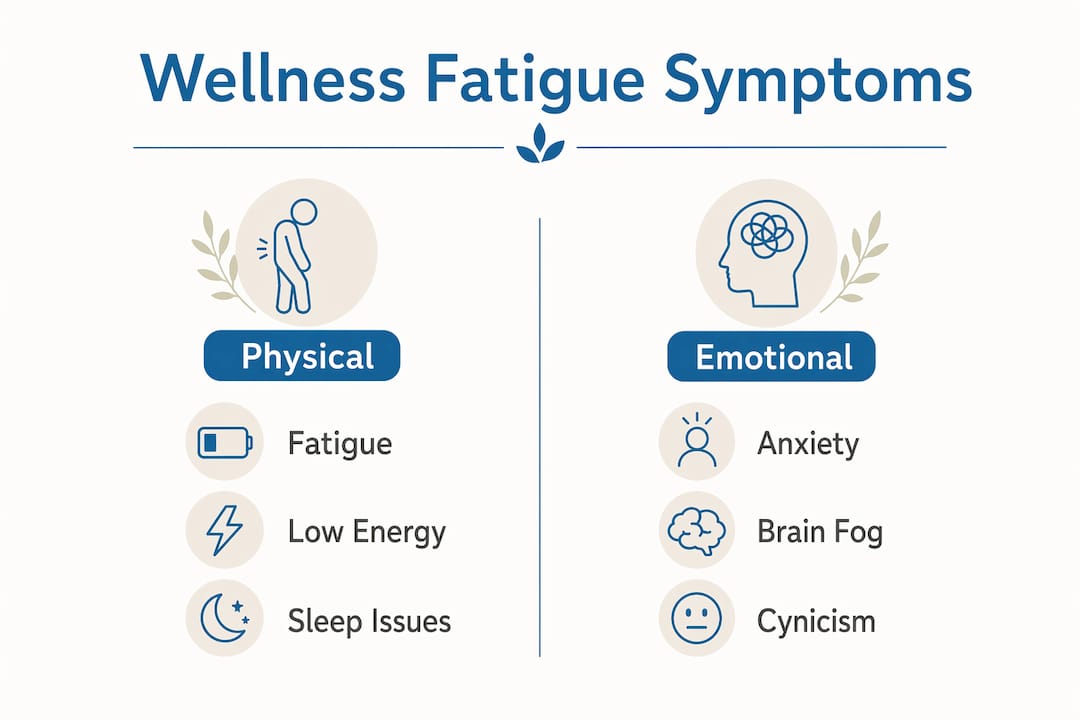
Wellness fatigue shows up across three categories: physical, emotional, and behavioral. Recognizing these signs early prevents the condition from deepening into full burnout.
Physical symptoms
Fatigue and low energy appear in about 95% of burnout cases, signaling chronic stress rather than a need for more rest. That statistic matters because it confirms that the tiredness you feel is not fixed by sleeping more or adding a recovery supplement. The nervous system is dysregulated, and the body is running on stress hormones rather than genuine energy.
Emotional and mental symptoms
Brain fog, persistent anxiety, and a growing cynicism toward wellness practices are the clearest emotional markers. You may find yourself feeling guilty for skipping a workout and resentful for doing it. That contradiction is a reliable signal. When wellness routines leave you feeling less confident and more overwhelmed than before you started, the routine itself has become the stressor.
Behavioral symptoms
Behavioral signs are often the first to appear and the easiest to dismiss. Watch for these:
- Hobbies and self-care practices that once felt enjoyable now feel like chores
- Withdrawing from wellness communities or social accountability groups
- Skipping routines entirely and then overcorrecting with extreme measures
- Feeling relief when plans fall through rather than disappointment
The table below separates wellness fatigue from general fatigue and burnout by their primary drivers and typical responses.
| Symptom category | Wellness fatigue | General fatigue | Burnout |
|---|---|---|---|
| Primary cause | Overload from self-care demands | Physical exertion or poor sleep | Chronic workplace or life stress |
| Emotional tone | Guilt, resentment, cynicism toward wellness | Low energy, desire for rest | Detachment, hopelessness |
| Response to rest | Minimal relief without routine changes | Significant improvement | Partial improvement |
| Behavioral pattern | Abandoning or overcorrecting routines | Reduced activity | Withdrawal from responsibilities |
| Recovery approach | Simplify and remove, not add | Sleep and physical recovery | Professional support often needed |
How is wellness fatigue different from general fatigue and burnout?
General fatigue resolves with rest. Burnout resolves with sustained recovery and often professional support. Wellness fatigue resolves when you remove the source of the pressure, which is the wellness routine itself.
The distinction matters because the wrong response makes things worse. If you treat wellness fatigue as general fatigue, you add more recovery tools. If you treat it as burnout, you may seek clinical support prematurely. Wellness fatigue sits in its own category because the stressor is the self-care behavior, not the absence of it.
Chronic stress elevates cortisol over time. Elevated cortisol disrupts sleep, impairs memory, and creates the physical symptoms that look identical to illness. This is why stress directly impacts sleep quality in ways that no sleep supplement fully corrects until the underlying stress load drops. The body cannot distinguish between work stress and wellness stress. Both activate the same physiological response.
Typical wellness hacks do not resolve wellness fatigue because they add to the cognitive load rather than reducing it. A new supplement protocol, a different sleep schedule, or a stricter diet all require decisions, tracking, and self-evaluation. That is more of what caused the problem in the first place.
Persistent symptoms that do not improve with routine changes signal a need for clinical evaluation rather than more self-directed troubleshooting. Medical professionals advise that when explanations for fatigue keep shifting from hormones to stress to nutrition without resolution, a clinical workup replaces the guessing cycle.
Pro Tip: If you have simplified your routine, reduced your tracking, and rested consistently for four weeks with no improvement, book an appointment with your primary care provider. Wellness fatigue and medical fatigue can look identical.
What practical strategies help overcome wellness fatigue and regain balance?
Recovery from wellness fatigue follows a specific sequence. Adding more is not the answer. Removing excess is.
- Audit your current routine. List every wellness habit, app, supplement, and practice you maintain. Identify which ones you do from genuine desire versus guilt or social pressure. Remove the guilt-driven ones first.
- Set hard limits on health data. Turn off non-essential notifications from fitness trackers and health apps. Check metrics once per day at most, or pause tracking entirely for two weeks. Digital health fatigue worsens when data is always visible.
- Prioritize foundational habits before complex optimizations. Consistent sleep, daily movement, and adequate hydration produce more measurable benefit than any advanced protocol. Build the foundation before adding layers.
- Shift from performance to function. Ask “Does this make me feel better?” instead of “Am I doing this correctly?” Functional self-care is sustainable. Performative self-care is exhausting.
- Build rest that requires no justification. Rest is not a reward for completing your wellness checklist. Schedule unstructured time that has no health outcome attached to it. Reading, walking without tracking, or sitting quietly all count.
- Set technology boundaries. Designate phone-free periods, especially in the morning and before bed. Stress relief techniques that require no device or data input tend to produce the most consistent results for people recovering from wellness fatigue.
- Seek professional help when self-management stalls. When wellness resets fail repeatedly, professional evaluation replaces self-directed troubleshooting. A therapist, physician, or registered dietitian provides structured support that no app can replicate.
Sustainable wellness requires realistic habits and boundaries rather than perfection and constant optimization. The goal is a routine you can maintain without counting down to the end of it.
Pro Tip: Pick one wellness habit to stop this week. Not pause. Stop. Notice whether you feel worse or whether you feel relieved. Relief is data.
Key Takeaways
Wellness fatigue is the direct result of treating self-care as a performance metric, and recovery requires removing pressure rather than adding more tools, tracking, or discipline.
| Point | Details |
|---|---|
| Core definition | Wellness fatigue is exhaustion caused by the pressure to optimize and maintain wellness routines. |
| Primary cause | Achievement logic and digital health tracking create stress rather than support. |
| Key symptom signal | When wellness routines feel like chores or leave you less confident, the routine is the stressor. |
| Recovery method | Remove excess habits, limit health data, and prioritize foundational sleep and movement. |
| When to get help | Seek clinical evaluation if symptoms persist after four weeks of simplified self-care. |
The trap nobody warns you about in wellness culture
The wellness industry sells the idea that exhaustion means you need more. More supplements, more tracking, more discipline, more commitment. After years of watching people cycle through this pattern, I am convinced the opposite is true. Exhaustion from wellness is almost always a signal to remove, not add.
What I find most telling is how rarely anyone gives you permission to stop. Every article, every app, every coach frames rest as a phase before the next protocol. The “inner reservoir” concept, the idea that rest exists independently of any optimization goal, is treated as a nice thought rather than a clinical necessity. It is a clinical necessity.
The people I have seen recover from wellness fatigue fastest are the ones who got comfortable with imperfection first. They stopped measuring sleep quality and started sleeping. They stopped tracking steps and started walking. The metrics came back later, if at all, and by then they were optional rather than obligatory.
Internal validation is the only kind that sustains a wellness practice long-term. If your routine depends on a score, a streak, or someone else’s approval to feel worth doing, it will eventually collapse under its own weight. Build something quieter. It will last longer.
— Cadence
Evergreenbliss tools that support a simpler self-care routine
Recovery from wellness fatigue does not require a new protocol. It requires fewer, better choices that actually feel good.

Evergreenbliss carries a focused selection of personal care and hygiene gadgets designed to simplify daily routines rather than complicate them. For people rebuilding rest as a foundation, the sleep and relaxation aids collection offers practical tools that support restorative sleep without requiring tracking or data input. The mental wellness and stress-relief products range includes massage devices and acupressure tools that deliver real physical relief. Every product ships free with easy returns, so trying something new carries no pressure.
FAQ
What is wellness fatigue?
Wellness fatigue is the mental and physical exhaustion caused by the pressure to constantly maintain and optimize personal health routines. It differs from general tiredness because the source of the stress is the self-care behavior itself.
What are the most common symptoms of wellness fatigue?
The most common symptoms include persistent tiredness that rest does not fix, brain fog, anxiety, guilt around skipping routines, and a growing sense that wellness habits feel like chores rather than choices.
How do I know if I have wellness fatigue or burnout?
Wellness fatigue is specifically linked to self-care demands, while burnout typically stems from chronic work or life stress. If your exhaustion worsens when you think about your wellness routine rather than your workload, wellness fatigue is the more likely cause.
How do I overcome wellness fatigue?
Start by removing habits rather than adding new ones. Cut your routine to three foundational habits, limit health app notifications, and schedule rest that has no health outcome attached to it.
When should I see a doctor about wellness fatigue?
Seek clinical evaluation if your symptoms do not improve after four weeks of simplified self-care. Persistent fatigue with shifting explanations, from hormones to stress to nutrition, signals a need for professional assessment rather than another self-directed reset.