Wellness habits are defined as automatic behaviors triggered by consistent cues rather than conscious decisions. Understanding how wellness habits form means understanding how your brain rewires itself through repetition. Research shows the median time to automaticity is 66 days, with a range of 18–254 days depending on the behavior and the person. That range matters because it tells you habit formation is not a fixed schedule. It is a biological process shaped by context, consistency, and reward.
How wellness habits form in the brain
The brain builds habits through four stages: initiation, learning, stability, and automaticity. Each stage reflects a shift in which brain region controls the behavior. The prefrontal cortex handles new, deliberate actions. The basal ganglia takes over once a behavior becomes automatic. That handoff is the goal of every wellness habit you try to build.
Repetition in a stable context is what drives that handoff. When you perform the same behavior in the same setting, your brain encodes a pattern. Over time, the cue alone triggers the behavior without conscious effort.
The cue-craving-response-reward loop is the core mechanism. A cue signals the brain that a reward is available. A craving motivates action. The response is the behavior itself. The reward reinforces the loop. Remove any one of these four components and the habit weakens.
Here is what each component looks like in a wellness context:
- Cue: Your alarm goes off at 7:00 AM.
- Craving: You want to feel calm before the day starts.
- Response: You do five minutes of focused breathing.
- Reward: You feel noticeably less tense within two minutes.
Pro Tip: Make your reward immediate and physical. Checking a box on a habit tracker or feeling calm right after breathing exercises works. Telling yourself “this will improve my lung capacity in six months” does not wire the habit effectively.
The 21-day habit rule is a myth. Automaticity depends on repetition in a stable context, not on elapsed time. Individual variability is enormous. A simple habit like drinking a glass of water after waking may take three weeks. A complex habit like a 30-minute morning workout may take four months.
Which wellness habits have the strongest impact?
The three core pillars of wellness habit formation are nutrition, movement, and mindfulness. Each one produces measurable biological effects. Together, they reinforce each other through shared pathways.
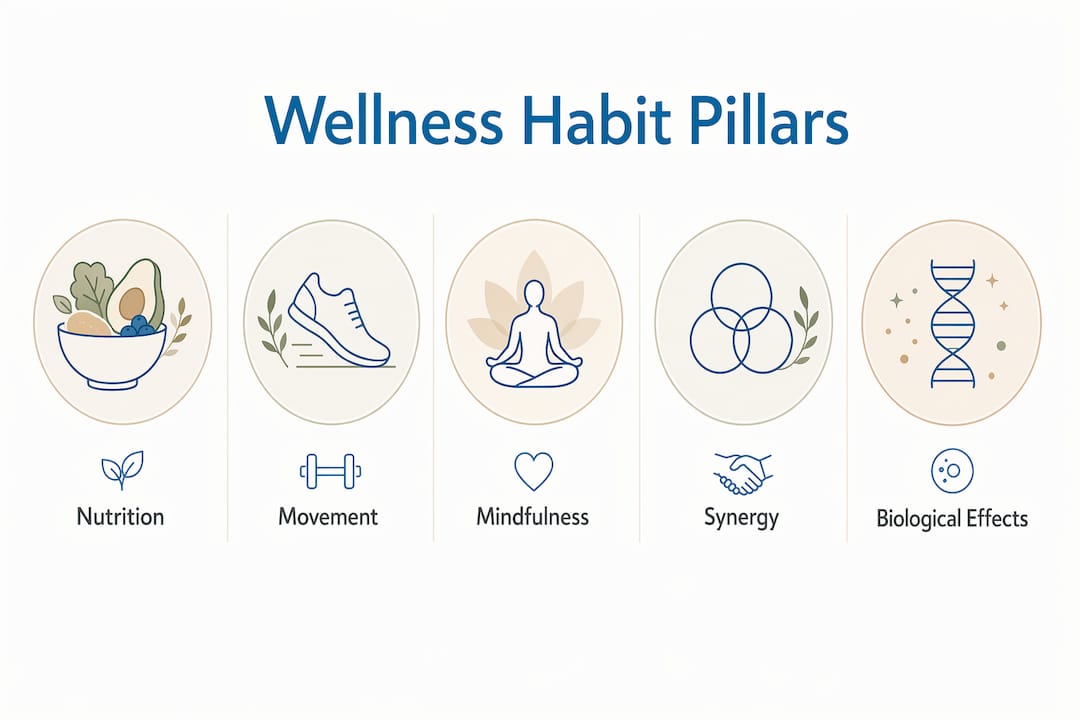
Nutrition shapes the gut-brain axis. The gut produces roughly 90% of the body’s serotonin, which means what you eat directly affects your mood and stress response. Consuming 30+ different plants per week benefits gut microbiome diversity, according to a meta-analysis of 3,284 participants. More diverse gut bacteria correlates with lower inflammation and better mental resilience.
Movement regulates cortisol. A 2019 study published in the British Journal of Sports Medicine found that just 11 minutes of moderate daily exercise reduces the risk of early death by 23%. That finding reframes the entire conversation about exercise. You do not need an hour at the gym. You need consistency at a manageable level.
Mindfulness closes the loop. A 2025 systematic review in Frontiers in Psychology found that mindfulness combined with lifestyle changes produces stronger stress reductions than mindfulness practiced in isolation. Breathing exercises practiced for five minutes, three to five times daily, reduce cortisol and improve stress resilience. The science on deep breathing and cortisol confirms this pathway clearly.
| Wellness Pillar | Key Habit Example | Primary Biological Effect |
|---|---|---|
| Nutrition | 30+ plant varieties per week | Gut microbiome diversity, lower inflammation |
| Movement | 11 minutes of moderate daily exercise | Cortisol regulation, reduced mortality risk |
| Mindfulness | 5-minute focused breathing, 3–5x daily | Cortisol reduction, improved stress resilience |
Wellness is a synergistic system where these three pillars connect through shared biological pathways. A person who exercises regularly sleeps better. Better sleep improves food choices. Better food choices support mood stability. Mood stability makes mindfulness easier to sustain. The habits feed each other.
What are the best strategies to build wellness habits?
Building a wellness habit successfully requires more than motivation. Motivation fades. Structure does not.

1. Use habit stacking
Habit stacking means pairing a new behavior with an existing automatic one. You already brush your teeth every morning. Attach a new habit directly to that cue. “After I brush my teeth, I do two minutes of stretching.” Building new habits to compete with old ones creates new neural pathways more effectively than trying to suppress bad behaviors through willpower alone.
2. Design your environment
Your environment shapes your behavior more than your intentions do. Reducing friction between you and a desired habit increases follow-through. Put your yoga mat where you will see it. Keep your water bottle on your desk. Remove the triggers that pull you toward habits you want to replace. A well-designed sleep environment is one of the clearest examples: cooler temperature, less light, and fewer screens all reduce friction for the habit of sleeping well.
3. Start smaller than feels necessary
Starting small is not a compromise. It is the strategy. Starting with a single small daily practice for 30 days builds a foundation that makes layering additional habits far more sustainable. A five-minute walk is not too small. It is the right size for week one. Scale up only after the behavior feels automatic.
4. Make rewards immediate
Delayed rewards do not effectively reinforce habits. The brain needs a signal right now that the behavior was worth doing. That signal can be as simple as marking a habit tracker, making a cup of tea after your workout, or taking one slow breath after meditation to notice how you feel. The reward does not need to be large. It needs to be immediate.
5. Plan for setbacks with if-then thinking
Implementation intentions are explicit if-then plans that prepare your response before a tempting situation arrives. “If I miss my morning walk, then I will do ten minutes of stretching after lunch.” This technique removes the need for in-the-moment decision-making. Missing a single day does not break a habit. What breaks habits is having no plan for when disruption happens.
Pro Tip: Write your if-then plan down the night before. The act of writing it encodes the intention more firmly than just thinking it.
How do you sustain a wellness routine long term?
Long-term habit sustainability comes from fit, not force. A routine that matches your energy patterns and lifestyle will outlast any routine built on willpower alone.
“Designing a wellness routine that fits your energy, lifestyle, and natural rhythms is more sustainable than forcing high intensity or willpower.” The research on sustainable wellness routines consistently points to rhythmic, steady habits as the key variable, not effort level.
Start by assessing your actual schedule, not your ideal one. When do you have reliable pockets of time? When is your energy naturally higher? A person who is alert at 6:00 AM will build morning habits more easily than someone whose cortisol peaks at noon. Neither pattern is wrong. Both require honest self-assessment.
Seasonal and lifestyle adjustments are normal, not failures. A walking habit that works in summer may need to shift indoors in winter. A meditation practice that fits a slow morning may need to compress during a high-travel period. The habit survives if the core behavior persists, even in a modified form.
Tracking supports long-term adherence. Use both objective measures (a habit tracker, a step count, a sleep score) and subjective ones (a one-sentence journal entry about how you felt). Objective data shows patterns. Subjective data shows meaning. Both matter for staying connected to why the habit exists.
Layer habits over 8–12 weeks rather than building a full routine at once. Week one: one breathing practice. Week three: add a daily walk. Week six: add a plant-rich meal each day. This pacing gives each habit time to reach stability before the next one demands attention. The goal is a routine that runs mostly on autopilot, not one that requires daily discipline to maintain.
Key Takeaways
Wellness habits form through consistent repetition in stable contexts, and the process takes far longer than popular culture suggests, with a median of 66 days and wide individual variation.
| Point | Details |
|---|---|
| Habit formation timeline | Median automaticity takes 66 days, ranging from 18 to 254 days depending on behavior. |
| Four-component loop | Every habit needs a cue, craving, response, and immediate reward to wire effectively. |
| Synergy of wellness pillars | Nutrition, movement, and mindfulness reinforce each other through shared biological pathways. |
| Environment over willpower | Reducing friction and designing your space drives habit adherence more reliably than motivation. |
| Layer habits gradually | Build one habit at a time over 8–12 weeks; scaling too fast undermines long-term consistency. |
What I have learned from years of watching habits succeed and fail
The biggest mistake people make with wellness habits is treating them like a sprint. They overhaul their diet, start a daily workout, and add a meditation practice all in the same week. By week three, everything collapses. Not because they lacked discipline, but because they skipped the foundation.
What actually works is almost embarrassingly small at first. One habit. One cue. One immediate reward. Repeated until it feels boring. That boredom is the signal that the basal ganglia has taken over. That is when you add the next habit.
The environment piece surprises people the most. I have seen readers completely transform their follow-through rate just by moving their running shoes from the closet to beside the bed. The habit did not change. The friction did. Removing even one small obstacle between you and a desired behavior has an outsized effect on whether it actually happens.
The synergy across nutrition, movement, and mindfulness is real, and it compounds. Once you start sleeping better because you added a wind-down breathing practice, your food choices improve without effort. Once your food choices improve, your energy during workouts increases. The habits do not just coexist. They amplify each other. Patience is not a soft skill here. It is the mechanism.
— Cadence
Tools that support your wellness habits from day one
Building wellness habits is easier when your environment works with you, not against you. Evergreenbliss offers a curated range of wellness and recovery products designed to reduce friction at every stage of your routine.

Whether you are building a sleep habit with the help of sleep and relaxation aids, managing stress through mental wellness tools, or recovering from movement with home fitness recovery equipment, Evergreenbliss has products matched to each wellness pillar. Free shipping, easy returns, and a straightforward checkout make it simple to get the right tools without adding friction to the process.
FAQ
How long does it take to form a wellness habit?
The median time for a behavior to become automatic is 66 days, with a range of 18–254 days. The timeline varies based on the complexity of the habit and how consistently it is practiced.
What is the most effective way to start building wellness habits?
Start with one small, low-friction behavior attached to an existing routine. Habit stacking, immediate rewards, and a consistent cue are the three factors most strongly linked to successful habit formation.
Does missing a day ruin a wellness habit?
Missing one day does not break a habit. Research confirms that consistency over time matters more than perfection, and a single missed day has no meaningful effect on long-term automaticity.
Why do wellness habits feel hard to maintain?
Habits feel hard when the reward is delayed, the cue is inconsistent, or the behavior requires too much effort. Fixing the environment and making rewards immediate resolves most maintenance problems.
How do nutrition, movement, and mindfulness work together as habits?
These three pillars connect through the gut-brain axis and cortisol regulation pathways. Each habit supports the others biologically, which means building one makes the others easier to sustain over time.
Recommended
- Sleep Tips: Recover Faster with Effective Wellness Gear | Evergreen Bliss
- How Relaxation Devices Work: A Science-Based Guide | Evergreen Bliss
- Why Comfort Tools Improve Mood: Science and Practice | Evergreen Bliss
- The Role of Touch in Stress Relief: Science and Practice | Evergreen Bliss
Sources and further reading
- How are habits formed: Modelling habit formation in the real world – Lally et al., European Journal of Social Psychology (2010)
- Relaxation Techniques: What You Need To Know – National Center for Complementary and Integrative Health (NIH)