Physical self-care is the intentional set of habits and daily actions you take to keep your body healthy, functional, and resilient. The World Health Organization defines self-care as the ability of individuals to promote and maintain their own health, prevent disease, and cope with illness — with or without a health worker’s support. Physical self-care is the body-focused dimension of that practice.
The core elements you’ll build from:
- Movement and exercise (walking, stretching, strength training)
- Balanced nutrition (whole foods, portion awareness, meal timing)
- Sleep (7–9 hours of consistent, restorative rest)
- Hydration (adequate daily water intake)
- Routine health monitoring (check-ups, self-monitoring, hygiene)
One thing worth stating plainly: physical self-care complements professional medical care. It does not replace it.
Table of Contents
- What does physical self-care actually include?
- Why physical self-care benefits your whole health
- How to build a simple at-home physical self-care routine
- Which home products genuinely support physical self-care?
- How to choose safe, effective self-care products
- When do results show up, and what does it cost?
- When self-care isn’t enough: knowing when to see a clinician
- Key Takeaways
- The part most people get backwards
- Evergreenbliss makes it easier to start
What does physical self-care actually include?
Physical self-care covers every deliberate habit that keeps your body working well. Think of it as the daily maintenance your body needs, not a luxury.
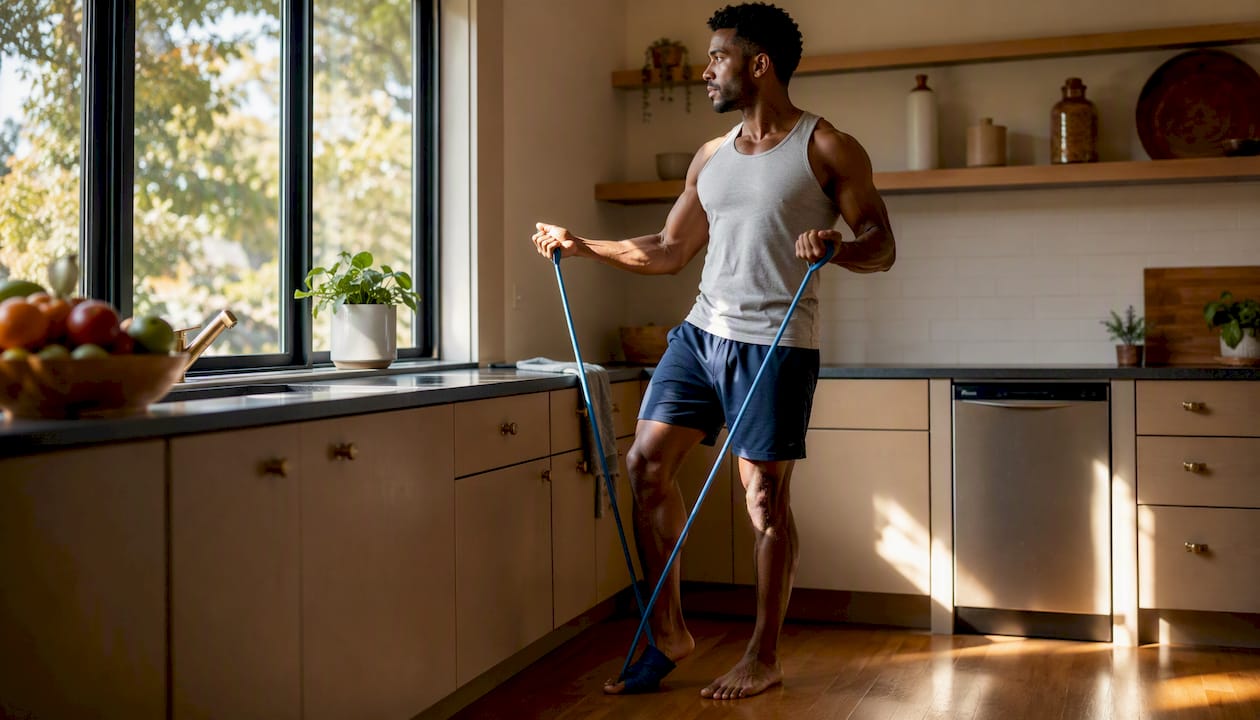
Movement is the most visible piece. A 20–30 minute brisk walk, a resistance band session at home, or a yoga flow all count. Harvard T.H. Chan School of Public Health links regular exercise, a balanced diet, healthy body weight, tobacco avoidance, and moderate alcohol intake to meaningfully lower risks for heart disease and cancer.
Nutrition means building meals around vegetables, lean proteins, whole grains, and healthy fats — not perfection, but consistency. Hydration sits right alongside it. Most adults function better with steady water intake throughout the day rather than catching up in the evening.
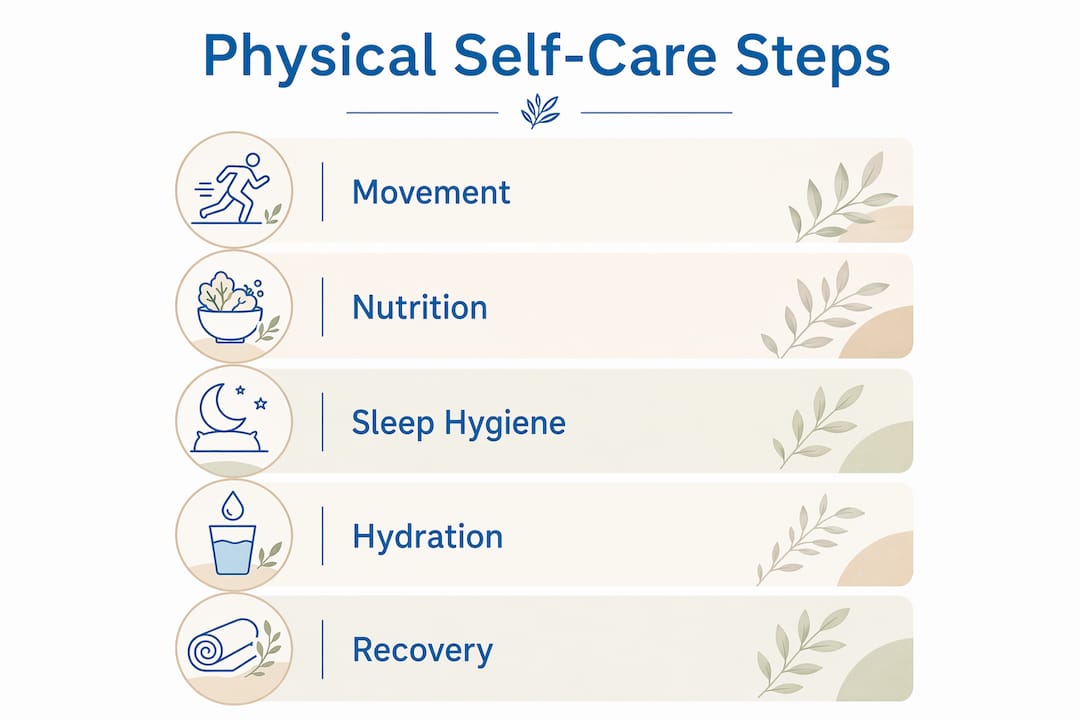
Sleep hygiene is where many people quietly lose ground. Keeping a consistent bedtime, limiting screens before bed, and making your room dark and cool are all examples of physical self-care that cost nothing but pay off quickly.
Personal hygiene and recovery round out the picture. Skin care, dental care, and post-exercise recovery (stretching, foam rolling, rest days) are all legitimate physical self-care practices.
Why physical self-care benefits your whole health
The benefits of physical self-care extend well beyond the body. Research on the mind-body connection shows that managing physical stress lowers cortisol levels, which directly improves anxiety and depression symptoms. Your body and mental state are not separate systems.
On the disease-prevention side, the lifestyle medicine evidence is consistent: the five core habits (diet, exercise, healthy BMI, no tobacco, moderate alcohol) reduce long-term chronic disease risk. Six out of every ten Americans currently live with at least one chronic condition, according to the CDC — and lifestyle habits are among the most modifiable risk factors.
Pro Tip: Don’t expect a complete transformation in two weeks. Mood and sleep often improve within days of starting new habits, but measurable fitness and recovery changes typically take 4–12 weeks of consistency. That gap is normal, not a sign the routine isn’t working.
How to build a simple at-home physical self-care routine
A structured checklist approach separates daily tasks from longer-term habits, which makes the whole thing far less daunting. Here’s a five-step routine you can start this week.
- Move for at least 20 minutes. Walk, stretch, or do a short resistance band circuit. Consistency matters more than intensity at the start.
- Hydrate before you caffeinate. Drink a full glass of water before your first coffee. It’s a small habit that compounds.
- Set a sleep anchor. Pick one consistent wake time and protect it, even on weekends. Your body’s circadian rhythm responds to regularity faster than to any supplement.
- Add one targeted recovery practice. Five minutes of stretching, an acupressure mat session, or a brief massage device use after a long day counts.
- Schedule a weekly check-in. Note energy levels, sleep quality, and any new physical symptoms. This keeps you honest and helps you spot patterns early.
For a practical 7-day micro-plan: do steps 1–3 every day, rotate step 4 on alternating days, and do step 5 on Sunday. That’s it. The science of wellness habit formation confirms that small, repeatable actions build more durable routines than ambitious overhauls.
Pro Tip: Practitioners recommend starting with just 2–3 manageable habits rather than changing everything at once. Habit-stacking — attaching a new behavior to an existing one, like stretching right after brushing your teeth — dramatically improves follow-through.
Which home products genuinely support physical self-care?
Home-based recovery tools remove the biggest barrier to consistent self-care: access. You don’t need a gym or a clinic visit to maintain most physical habits. Here’s how the main product categories map to specific needs.
| Product Category | Primary Benefit | Best-Use Scenario |
|---|---|---|
| Sleep aids (masks, supplements) | Faster sleep onset, better consistency | Shift workers, light sleepers, travel recovery |
| White-noise machines | Reduced sleep disruption | Urban environments, shared spaces |
| Massage devices (neck, back) | Muscle tension relief, circulation | Post-work tension, desk job recovery |
| Acupressure mats | Stress reduction, relaxation | Evening wind-down, lower back tension |
| Posture supports / braces | Spinal alignment, pain prevention | Long desk hours, post-injury maintenance |
| Resistance bands | Strength, mobility, rehab | Home workouts, physical therapy support |
| Hydration tools | Consistent daily intake | Active individuals, habit-building |
Sensory relaxation tools like white-noise machines and weighted accessories work through the same physiological pathway as physical exercise: they lower cortisol and signal the nervous system to downshift. That’s not marketing language — it’s the same mind-body mechanism the research describes.
How to choose safe, effective self-care products
Not every wellness gadget delivers what it promises. A few clear criteria separate useful tools from expensive clutter.
Look for:
- Clear usage instructions and contraindications listed on the product
- Safety certifications where applicable (UL, CE, FDA-cleared for medical devices)
- A real return policy and warranty (30 days minimum for most home devices)
- Verified customer reviews with specific use-case detail, not just star ratings
- Features tied to a specific habit or outcome, not vague “wellness” claims
Red flags to avoid:
- Unsupported medical claims (“cures,” “eliminates,” “clinically proven” with no citation)
- No usage limits or contraindications listed
- No returns or warranty
- High-pressure upsells at checkout
Typical price ranges by category:
- Under $30: Sleep masks, resistance bands, basic hydration bottles, acupressure mats
- $30–$100: Entry-level massage devices, posture braces, white-noise machines
- $100–$250: Mid-range percussion massagers, advanced sleep aids, multi-function recovery tools
Pro Tip: Check whether a device has a specific contraindication for your health condition before buying — pregnancy, pacemakers, and certain skin conditions are common exclusions for massage and electrical stimulation devices. When in doubt, ask your doctor first.
When do results show up, and what does it cost?
Timing varies by habit and baseline health, but the general pattern holds:
- Days 1–7: Better mood, slightly improved sleep onset, reduced daily tension
- Weeks 2–4: More consistent energy, noticeable hydration and digestion improvements
- Weeks 4–12: Measurable fitness gains, reduced muscle soreness, improved posture awareness
- 3+ months: Lower resting heart rate, sustained stress resilience, habit automaticity
| Budget Tier | Product Examples | Typical Range |
|---|---|---|
| Starter | Sleep mask, resistance bands, acupressure mat | Under $50 |
| Mid-range | Massage device, white-noise machine, posture brace | $30–$100 |
| Advanced | Percussion massager, multi-function recovery tools | $100–$250 |
Environmental sleep aids like white-noise machines and sleep masks often produce measurable improvements in sleep quality within days to a few weeks — one of the fastest returns in the home self-care category.
Pro Tip: Start with the under-$50 tier for 4–8 weeks. If you’re using the tools consistently, that’s the signal to upgrade. Buying advanced equipment before you’ve built the habit is the most common waste in home wellness spending.
When self-care isn’t enough: knowing when to see a clinician
WHO guidance is clear: self-care complements formal healthcare, it does not replace it. Home tools and habits are appropriate for maintenance, prevention, and recovery from minor strain — not for diagnosing or treating medical conditions.
See a clinician promptly if you experience:
- New or worsening chest pain or pressure
- Unexplained shortness of breath at rest
- Sudden neurological symptoms (numbness, vision changes, confusion)
- Abrupt severe pain with no clear cause
- Signs of infection (fever, swelling, redness that spreads)
When you do see a provider, bring notes: what symptoms you’ve noticed, when they started, and which home tools or habits you’ve been using. That context helps clinicians give you better guidance and avoids duplicate recommendations.
This article is general wellness information, not medical advice. Confirm any health concern or new self-care practice with a qualified healthcare provider for your specific situation.
Key Takeaways
Physical self-care is a set of daily, evidence-backed habits — movement, nutrition, sleep, hydration, and recovery — that reduce chronic disease risk and improve mental health when practiced consistently.
| Point | Details |
|---|---|
| Core definition | Physical self-care = intentional daily habits that maintain body function and prevent disease. |
| Evidence base | Harvard and WHO both link diet, exercise, healthy weight, tobacco avoidance, and moderate alcohol to lower chronic disease risk. |
| Start small | Begin with 2–3 habits; measurable fitness changes typically appear in 4–12 weeks. |
| Know the limits | Self-care complements medical care — red-flag symptoms always need a clinician, not a gadget. |
| Evergreenbliss | Evergreenbliss offers curated sleep aids, massage devices, posture supports, and recovery tools designed for at-home physical self-care routines. |
The part most people get backwards
Most people treat physical self-care as something they’ll start when life slows down. That’s the wrong frame entirely. The habits that protect your health long-term — consistent movement, decent sleep, basic recovery — are precisely what make busy periods survivable. They’re not a reward for having free time; they’re what creates the capacity to handle the demands on your time.
The product side of this gets misread too. A massage device or an acupressure mat isn’t a shortcut around the habits. It’s a friction-reducer. When your lower back is tight at 9 PM and the alternative is doing nothing, having a tool within reach is what makes the difference between a recovery practice and a skipped one. The research on home recovery tools supports exactly this: accessibility drives consistency, and consistency is the whole game.
If you’re choosing your first device, pick the one that addresses your most consistent physical complaint — not the most impressive-looking gadget. A $25 resistance band used three times a week beats a $200 device that sits in a drawer.
Evergreenbliss makes it easier to start
Getting the habits right matters more than the gear — but the right tools do remove real friction. Evergreenbliss carries a curated selection of home self-care products across the categories covered in this article: sleep aids and relaxation tools, home fitness and recovery equipment, and personal care gadgets built for everyday use, not clinical settings.
Every product ships free, with easy returns — so if something doesn’t fit your routine, you’re not stuck with it. Whether you’re building a starter kit around sleep and stress relief or upgrading a recovery setup you’ve already been using, the product pages include specifications and use-case guidance to help you match the right tool to the right habit. Browse the full wellness and recovery collection and find what fits where you are right now.