Stress impairs sleep quality by triggering a surge of cortisol and adrenaline that keeps your brain in high-alert mode long after the stressor has passed. This hormonal interference is the core mechanism behind stress-induced insomnia, the clinical term for sleep disruption driven by psychological pressure. Understanding how stress impacts sleep quality is not just reassuring. It is the first step toward doing something about it. Nearly one-third of U.S. adults report insufficient sleep, with stress identified as the primary driver. That number reflects a public health problem hiding in plain sight.
How does stress impact sleep quality at a biological level?
Stress disrupts sleep through a direct hormonal chain reaction. When your brain perceives a threat, the hypothalamic-pituitary-adrenal (HPA) axis activates and releases cortisol. Cortisol is your body’s primary stress hormone, and its job is to keep you alert. That alertness is useful during a crisis. At 11 p.m. when you are trying to fall asleep, it is the enemy.
Here is what happens inside your body when stress is elevated:
- Cortisol delays sleep onset. High evening cortisol suppresses melatonin, the hormone that signals your brain it is time to sleep.
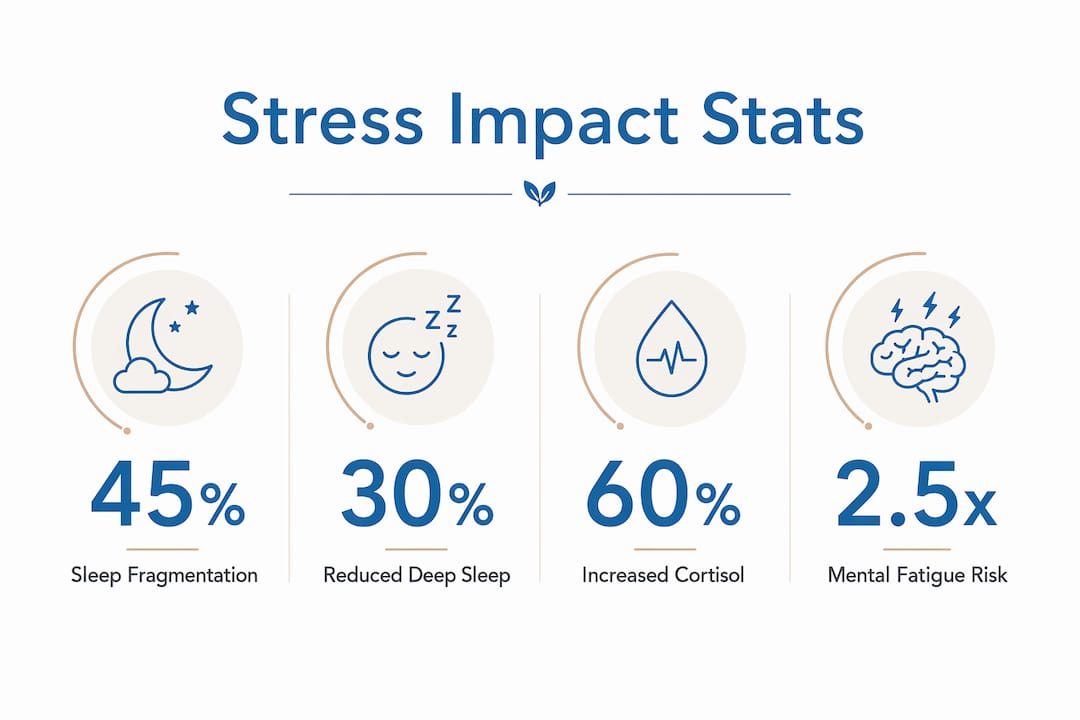
- Sleep architecture fractures. Stress physically alters sleep architecture by causing earlier than normal REM onset, which shrinks the slow-wave (deep) sleep your body needs for physical and cognitive recovery.
- REM sleep shifts out of sequence. Normally, deep sleep dominates the first half of the night. Under stress, REM sleep arrives earlier, crowding out the restorative stages.
- Nighttime cortisol spikes fragment sleep. You wake up more often, sleep lighter, and spend less time in the stages that actually repair tissue and consolidate memory.
A 2024 study of 426 university students confirmed that higher stress leads to fragmented, shallow sleep and elevated nighttime cortisol. The finding matters because it shows this is not just a feeling. Stress measurably changes the structure of your sleep, not just how long it takes to fall asleep.
Pro Tip: Track your sleep stages for one week using a wearable like a Fitbit or Garmin device. If your deep sleep is consistently under 15% of total sleep time during high-stress periods, that is a signal your cortisol levels are interfering with your sleep architecture.

Understanding sleep pressure mechanics also helps here. Sleep pressure builds naturally throughout the day, but chronic stress can override it, leaving you exhausted but unable to sleep.
Why does the stress-sleep cycle keep feeding itself?
The stress and sleep connection is bidirectional, and that is what makes it so hard to break. Elevated cortisol from stress disrupts sleep cycles, and poor sleep increases cortisol further. You are not just stressed and then tired. You are stressed, then sleep-deprived, then more stressed because you are sleep-deprived.
Here is how the cycle typically unfolds:
- Stress activates the HPA axis. Cortisol rises, melatonin drops, and sleep onset is delayed.
- Sleep becomes fragmented. You get less deep sleep and wake more often through the night.
- Sleep deprivation impairs emotional regulation. Your prefrontal cortex, which governs rational thinking, becomes less effective. You react to stressors more intensely.
- Stress reactivity increases. Small problems feel bigger. The brain stays in threat-detection mode longer.
- Behavioral coping kicks in. Unhelpful coping behaviors like late-night smartphone use and rumination worsen sleep fragmentation further.
Research from Current Psychology adds a critical nuance to this picture:
“Prolonged stress reactivity predicts poor sleep quality more strongly than other stress forms in young adults.”
This means it is not just how stressed you get. It is how long it takes you to recover from stress that determines how badly your sleep suffers. Someone who bounces back from a difficult meeting in an hour will sleep better than someone who replays it until midnight, even if both experienced the same stressor.
Subjective perception of sleep quality also plays a role. How you think you slept influences your stress levels the next day almost as much as how you actually slept. That psychological layer makes the cycle even stickier.
What are the symptoms of stress-related sleep problems?
Stress-induced insomnia shows up in predictable patterns. Recognizing them is the first step toward addressing the effects of stress on sleep before they become chronic.
Common symptoms include:
- Difficulty falling asleep. Your mind races through tomorrow’s tasks, past conversations, or worst-case scenarios.
- Frequent nighttime waking. You fall asleep but wake at 2 or 3 a.m. and cannot get back to sleep.
- Unrefreshing sleep. You sleep a full eight hours but wake up feeling like you barely rested.
- Daytime fatigue and irritability. Concentration drops, patience shortens, and small frustrations feel outsized.
- Physical tension. Tight shoulders, jaw clenching, and headaches often accompany stress-related sleep disruption.
The prevalence data is striking. Adults sleeping 6 or fewer hours are 2.5 times more likely to experience frequent mental distress. Short sleep does not just leave you tired. It amplifies the psychological symptoms that made you stressed in the first place.
| Symptom | What it signals |
|---|---|
| Racing thoughts at bedtime | High evening cortisol blocking melatonin release |
| Waking between 2–4 a.m. | Cortisol spike during the early morning hours |
| Unrefreshing sleep | Insufficient slow-wave sleep due to early REM onset |
| Daytime irritability | Impaired emotional regulation from sleep deprivation |
| Difficulty concentrating | Reduced memory consolidation from fragmented sleep |
Individual responses to stress vary significantly. Some people fall asleep easily but wake repeatedly. Others cannot fall asleep at all. A study of 1,250 medical university employees found that 61% experienced job stress that negatively impacted sleep quality, which then reduced their overall quality of life. The stress impact on rest is not a niche problem. It is a majority experience among working adults.
What strategies actually improve sleep when stress is the cause?
Improving sleep with stress management requires addressing both sides of the equation simultaneously. Treating only the sleep problem without reducing stress is like mopping the floor while the faucet is still running.
Behavioral and cognitive changes
Mindfulness-based stress reduction (MBSR), developed at the University of Massachusetts Medical School, has strong evidence behind it. Practicing 10–20 minutes of mindfulness meditation before bed lowers cortisol and reduces the cognitive arousal that delays sleep onset. Apps like Calm and Headspace make this accessible without any prior meditation experience.
Cognitive behavioral therapy for insomnia (CBT-I) is the gold standard treatment for stress-related sleep problems. It targets the thought patterns and behaviors that perpetuate insomnia, not just the symptoms. CBT-I consistently outperforms sleep medication in long-term outcomes.
Pro Tip: Write down your three biggest worries for tomorrow on paper before you get into bed. This “cognitive offloading” technique reduces nighttime rumination by giving your brain permission to stop rehearsing problems it has already acknowledged.
Sleep hygiene tailored to stress
Good sleep hygiene practices matter more, not less, when stress is high. The basics carry real weight:
- Keep a consistent wake time, even on weekends. This anchors your circadian rhythm when stress is destabilizing it.
- Dim lights and stop screen use 60 minutes before bed. Blue light suppresses melatonin and keeps cortisol elevated.
- Keep your bedroom cool (around 65–68°F). Core body temperature drops naturally as part of sleep onset, and a cool room supports that process.
- Avoid alcohol as a sleep aid. It may help you fall asleep faster but fragments sleep in the second half of the night.
Physical and sensory interventions
Exercise reduces cortisol and increases slow-wave sleep. Even 30 minutes of moderate activity, like a brisk walk, produces measurable improvements in sleep quality. Morning or afternoon exercise works best. Evening workouts can delay sleep onset for some people.
Sensory relaxation tools like acupressure mats, weighted blankets, and neck massagers activate the parasympathetic nervous system. That shift from “fight or flight” to “rest and digest” is exactly what your body needs before sleep. Supplements like melatonin and magnesium glycinate can support this transition when used correctly. Understanding how sleep supplements work helps you use them as tools rather than crutches.
Key takeaways
Stress and poor sleep form a self-reinforcing cycle that requires addressing both the hormonal and behavioral drivers at the same time.
| Point | Details |
|---|---|
| Cortisol is the core disruptor | Elevated cortisol delays sleep onset and fragments restorative slow-wave sleep. |
| The cycle is bidirectional | Poor sleep raises cortisol, which worsens stress, which further degrades sleep. |
| Recovery speed matters most | How long stress lingers after a trigger predicts sleep quality more than stress intensity. |
| Perception shapes outcomes | Improving how you think about your sleep reduces stress as effectively as improving sleep duration. |
| Combined interventions work best | Addressing stress management and sleep hygiene together breaks the cycle faster than either alone. |
What I’ve learned after years of watching people fight this cycle
Most people approach the stress-sleep problem backwards. They focus entirely on sleep: better pillows, blackout curtains, melatonin gummies. Those things help at the margins. But if the cortisol tap is still running at full pressure, no amount of sleep optimization will fix the underlying problem.
The insight that changed how I think about this comes from the research on prolonged stress reactivity. The person who lies awake replaying a difficult conversation is not suffering from insomnia. They are suffering from an inability to disengage from stress. The sleep problem is a symptom. The recovery failure is the disease.
What I have also noticed is that people dramatically underestimate the role of daytime behavior in nighttime sleep. The hour before bed gets all the attention. But what you do from 3 p.m. onward, whether you take a real break, whether you exercise, whether you eat a heavy meal at 9 p.m., shapes your sleep just as much as your bedtime routine.
The other overlooked factor is the perception piece. Research from Sleep Science shows that improving sleep perception reduces stress as effectively as improving actual sleep duration. That is not a trick. It means that catastrophizing about bad sleep makes the stress worse, which makes the sleep worse. Breaking that mental pattern is as therapeutic as any supplement or device.
My honest recommendation: start with the stress, not the sleep. Build one recovery habit, whether that is a 10-minute walk after dinner, a consistent wind-down routine, or a journaling practice, and give it three weeks before judging results. Sleep responds slowly to behavioral change. Patience is not optional here.
— Cadence
Rest better starting tonight with Evergreenbliss
If you are ready to take the stress-sleep connection seriously, Evergreenbliss has built a product range specifically around this problem. The tools are designed to work alongside the behavioral strategies in this article, not replace them.

The sleep and relaxation aids collection includes products like the Deep Sleep Neck Massager, which activates the parasympathetic nervous system before bed, and stress relief sleep supplements formulated with melatonin to support natural sleep onset. For broader stress management, the mental wellness products collection covers sensory tools, acupressure aids, and recovery devices that help your body shift out of high-alert mode. Free shipping and easy returns mean there is no barrier to trying what works for you.
FAQ
What hormones does stress release that disrupt sleep?
Stress triggers cortisol and adrenaline through the HPA axis. Cortisol suppresses melatonin production, which delays sleep onset and fragments the sleep cycle throughout the night.
How long does stress-related sleep disruption last?
Duration depends on how long the stressor persists and how quickly you recover from it. Research shows that prolonged stress reactivity predicts poor sleep quality more strongly than the stress level itself, meaning recovery speed matters more than stress intensity.
Can improving sleep reduce stress levels?
Yes. The stress and sleep connection runs both ways. Better sleep lowers cortisol, improves emotional regulation, and reduces stress reactivity the following day. Even improving your perception of sleep quality produces measurable stress reduction.
What is the fastest way to fall asleep when stressed?
Diaphragmatic breathing, specifically the 4-7-8 technique developed by Dr. Andrew Weil, activates the parasympathetic nervous system within minutes. Pair it with a cool room and no screen exposure for 60 minutes before bed for the best results.
Is stress-induced insomnia the same as chronic insomnia?
Not exactly. Stress-induced insomnia is situational and typically resolves when the stressor is removed or managed. Chronic insomnia persists for three or more months and often requires CBT-I treatment regardless of whether the original stressor is still present.