Start with a 10-minute shutdown ritual tonight. That single habit, done consistently, does more to stop work from bleeding into your personal life than any productivity app or weekend detox. If you’re working from home and running on empty, you don’t need a complete overhaul. You need a few targeted changes you can start in the next 15 minutes.
Here are five things to do right now:
- Set a hard stop time and write it on a sticky note next to your screen.
- Do a 10-minute shutdown ritual: close all tabs, write tomorrow’s top three tasks, and physically close your laptop.
- Take a brief walk or do four slow box-breath cycles (inhale 4, hold 4, exhale 4, hold 4).
- Block one nonnegotiable offline hour on your calendar for this evening — no Slack, no email.
- Reach out immediately if you’re experiencing thoughts of self-harm, inability to get out of bed for days, or a complete inability to function. Call or text 988 (the Suicide and Crisis Lifeline) or go to your nearest emergency room.
Key Takeaways
Managing work burnout at home requires consistent behavioral changes, structural fixes to your work conditions, and physical recovery habits that compound over days and weeks.
| Point | Details |
|---|---|
| Start with a shutdown ritual | A 10- to 15-minute end-of-day ritual is the single fastest way to stop work from bleeding into home life, such as a brief walk, changing into non-work clothes, or packing away your work tools after sign-off. |
| Protect sleep and movement | Consistent sleep hours and daily gentle movement are the two highest-leverage recovery habits available at home. |
| Address the structure, not just the symptoms | A manager conversation about workload is as important as any self-care habit for lasting recovery. |
| Seek help early | If symptoms persist beyond two to three months or crisis signs appear, teletherapy, EAP, or a PCP visit is the right next step. |
| Evergreenbliss supports your recovery | Evergreenbliss offers white-noise machines, neck massagers, acupressure mats, and sleep aids to reinforce the daily habits that prevent relapse. |
Table of Contents
- What burnout actually is — and how it differs from stress and depression
- Signs you may be burning out: a self-assessment checklist
- What causes remote work burnout — and why home makes it worse
- 12 evidence-based strategies to manage and recover from burnout at home
- How to talk to your manager about burnout without derailing your career
- When self-care isn’t enough: how to find professional help from home
- What recovery from burnout actually looks like
- At-home tools that support your recovery routine
- Long-term prevention habits to keep burnout from coming back
- The thing most burnout advice gets wrong
- Recovery tools that fit your home routine
- Sources
What burnout actually is — and how it differs from stress and depression
Burnout is classified by the World Health Organization’s ICD-11 as an occupational phenomenon, not a medical condition. That distinction matters practically: burnout is tied to your work context and is often reversible with behavioral changes, whereas clinical depression is a diagnosable mental health condition that typically requires clinical treatment regardless of job circumstances.
The three core features of burnout are exhaustion, depersonalization (cynicism or emotional distance from your work), and a reduced sense of professional efficacy. Stress, by contrast, is a state of overload that still feels urgent and emotionally charged. Burnout is what happens after prolonged, unmanaged stress strips away that urgency and replaces it with numbness.
| Feature | Stress | Burnout | Depression |
|---|---|---|---|
| Primary driver | Overload, pressure | Chronic workplace demands | Biological, psychological, situational |
| Emotional tone | Anxious, urgent | Numb, cynical, detached | Sad, hopeless, empty |
| Time course | Acute or episodic | Gradual, cumulative | Persistent (weeks to months+) |
| Energy | Hyperactivated | Depleted, flat | Low, anhedonic |
| Improves with rest? | Often yes | Partially, temporarily | Rarely without treatment |
| Treatment focus | Stress management | Behavioral + workplace change | Clinical care (therapy, medication) |
Burnout is frequently reversible with the right behavioral and structural changes, and sometimes with short-term clinical support. Depression requires professional diagnosis and treatment. If you’re unsure which you’re dealing with, a primary care physician or therapist can help you sort it out quickly.
Signs you may be burning out: a self-assessment checklist
Mayo Clinic identifies several consistent symptom clusters across physical, emotional, and behavioral categories. Scan the list below and mark any that apply to you right now.
Physical symptoms
- Persistent fatigue that doesn’t improve after a full night’s sleep
- Frequent headaches or muscle tension, especially in the neck and shoulders
- Getting sick more often than usual
- Disrupted sleep: trouble falling asleep, waking at 3 AM, or sleeping far more than normal
- Low appetite or stress eating
Emotional symptoms
- Cynicism or resentment toward your job, colleagues, or clients
- Feeling detached, numb, or like you’re going through the motions
- Irritability that spills into your personal relationships
- Dread before starting the workday
- A persistent sense that nothing you do makes a difference
Behavioral symptoms
- Withdrawing from coworkers, friends, or family
- Missing deadlines or making more errors than usual
- Procrastinating on tasks you used to handle easily
- Difficulty concentrating for more than a short period
- Skipping breaks, meals, or exercise because work feels endless
How to score it: Count your checked items. Five or fewer suggests elevated stress worth monitoring. Six to ten points to moderate burnout — start the practical steps in the next section today. More than ten, or any crisis-level symptoms (inability to function, thoughts of self-harm), means professional support should be your first call, not your last resort.
What causes remote work burnout — and why home makes it worse
Burnout at work has well-known drivers: excessive workload, low autonomy, unclear expectations, and poor recognition. Working from home amplifies all of them and adds a few new ones.
Remote-work analyses consistently identify two high-risk drivers in distributed teams: blurred boundaries between work and personal life, and social isolation with fractured communication. When your office is your kitchen table, there is no physical cue that tells your brain the workday is over. Notifications arrive at 9 PM. You check email during dinner because the laptop is right there.
Remote-specific risk factors:
- No commute means no natural transition between work mode and home mode
- Meeting overload: back-to-back video calls with no buffer time
- Constant notifications across email, Slack, and project tools
- Difficulty saying no when your manager can’t see how full your plate is
- Reduced informal social contact (no hallway conversations, no lunch breaks with colleagues)
Household and environmental contributors:
- Childcare or caregiving responsibilities running parallel to work hours
- Shared space with a partner or roommate who is also working from home
- Poor ergonomic setup causing physical tension that compounds mental fatigue
- No dedicated workspace, so the brain never fully associates a location with “work is done”
Healthline recommends transition rituals to replace the psychological function of a commute: a 15-minute walk after sign-off, changing out of work clothes, or putting your laptop in a drawer or bag. These aren’t just feel-good suggestions. They create a sensory boundary your nervous system can actually register.
Pro Tip: Pack your work tools into a bag or bin at the end of every workday, even if you work at the kitchen table. The physical act of putting things away is a tactile signal to your brain that the workday is closed. It takes 90 seconds and works surprisingly well.
12 evidence-based strategies to manage and recover from burnout at home
These steps are sequenced by impact and ease. Start with the first three this week, then layer in the rest over the following two weeks.
Days 1–3: Stabilize the basics
1. Establish a hard stop time and a shutdown ritual
Pick a stop time and treat it like a meeting you cannot cancel. At that time: write tomorrow’s top three tasks, close all browser tabs, and physically close your laptop. Short evening reset routines reduce cognitive load at night and protect sleep quality. The ritual doesn’t need to be elaborate. Ten minutes is enough.
2. Add one micro-break every 90 minutes
Block 10-minute breaks on your calendar at 90-minute intervals. Set them as “busy” so they don’t get scheduled over. Use the time to stand, stretch, look out a window, or do nothing. These breaks aren’t a luxury. Designing small, protected recovery windows is more sustainable than infrequent long breaks, and they prevent the cumulative fatigue that turns a hard week into a month of burnout.
3. Protect your sleep
Sleep is the single most powerful recovery lever available to you at home. Aim for a consistent sleep and wake time, dim screens an hour before bed, and keep your bedroom cool and dark. A bedtime wellness routine doesn’t require a complete lifestyle change — even a 20-minute wind-down sequence makes a measurable difference in sleep quality over a week.
Days 4–7: Add structure and movement
4. Time-block your workday
A simple WFH schedule might look like this: 8:30–10:00 AM deep work, 10:00–10:15 break, 10:15–12:00 meetings or collaborative work, 12:00–1:00 PM protected lunch (offline), 1:00–3:00 PM focused work, 3:00–3:15 break, 3:30–5:00 PM wrap-up and shutdown, with key breaks and offline time protected. The key is protecting the lunch hour and the breaks as firmly as you protect client meetings.
5. Move your body gently every day
Systematic reviews link physical activity to reduced depressive symptoms and improved energy, and the dose doesn’t need to be large. A short walk after lunch, a short yoga session, or even 10 minutes of gentle stretching shifts your nervous system out of stress mode. When energy is very low, gentle movement beats rest-only recovery.
6. Create a transition ritual
As described in the causes section, a transition ritual replaces the commute. Options: a walk around the block, changing clothes, making tea, or sitting outside for five minutes. The specific activity matters less than doing it consistently at the same time every day. Over a week, your brain starts to associate it with “work is done.”
Days 8–14: Rebuild connection and meaning
7. Schedule one social contact per day
Isolation is a major driver of remote burnout. One brief, genuine human connection per day — a five-minute phone call with a friend, a non-work chat with a colleague, a walk with a neighbor — interrupts the isolation loop. It doesn’t need to be long. It needs to be real.
8. Reduce your meeting load
Audit your recurring meetings. Which ones require your presence? Which could be an email or async update? Request to drop or reduce attendance at meetings where you’re not a key contributor. Psychiatry emphasizes boundary-setting and self-efficacy as core prevention tools — and your calendar is one of the most concrete places to exercise both.
9. Use breathwork or a brain dump to interrupt stress mid-day
Short breathwork sessions (4-7-8 breathing or box breathing) and a five-minute “brain dump” journal entry are practical methods to interrupt stress accumulation during the workday. Doing either for five minutes after a difficult call or before a high-stakes task resets your nervous system without requiring you to leave your desk.
Pro Tip: Keep a small notebook next to your keyboard for brain dumps. When your mind is spinning between tasks, spend three minutes writing every open loop, worry, or task floating in your head. Getting it on paper clears working memory and reduces the mental noise that compounds fatigue.
Weeks 2–4: Sustain and deepen recovery
10. Audit your workload and set one boundary per week
Combined behavioral interventions — schedule changes, sleep improvement, movement, and psychological strategies — reduce burnout-related exhaustion over time. But they only work if the underlying workload is also addressed. Each week, identify one task, commitment, or meeting you can reduce, delegate, or eliminate. One per week adds up fast.
11. Design a low-stimulus evening corner
Designate one spot in your home — a chair, a corner of the couch, a spot on the porch — as a no-screens, low-stimulus recovery zone. Use it for 20–30 minutes each evening: reading, stretching, or simply sitting. The physical separation from screens and work tools signals recovery to your nervous system in a way that scrolling on the couch never does.

12. Build a weekly recovery window
Block two to three hours on Saturday or Sunday morning as a protected recovery window. No work email, no planning, no productivity. Use it for something genuinely restorative: a longer walk, a slow breakfast, a creative hobby. This weekly anchor prevents the seven-day grind that turns a temporary overload into chronic burnout.
Pro Tip: For a portable office setup, use a dedicated tote bag or small crate for all your work tools — laptop, charger, headphones, notebook. At sign-off, pack everything into it and put it out of sight. If you work in a studio apartment, this single habit creates the psychological separation that a home office door would otherwise provide.
How to talk to your manager about burnout without derailing your career
Most people wait too long to have this conversation, and then have it badly — either too vague (“I’m just tired”) or too dramatic (“I’m completely burned out and can’t continue”). The goal is a capacity conversation, not a performance conversation. You’re not confessing failure. You’re flagging a workload issue before it becomes a performance issue.
Before the conversation:
- Write down two or three specific examples of where workload or unclear priorities are creating friction (missed deadlines, quality slipping, working past 8 PM regularly).
- Identify one or two concrete requests you want to make (see the list below).
- Choose a calm moment — not right after a stressful incident or deadline.
Script for a 1:1 conversation:
“I want to flag something before it affects my output. My current workload has been running above capacity for a few weeks, and I’m noticing it in my focus and energy. I’d like to talk through priorities and see if there’s anything we can adjust — whether that’s timelines, meeting load, or how I’m handling [specific project].”
Script for an email:
“Hi [Manager], I wanted to check in about workload and priorities. I’ve been running at high capacity lately and want to make sure I’m focusing on the right things rather than spreading too thin. Could we carve out 20 minutes this week to review my current commitments and see if anything can be adjusted or deprioritized?”
Reasonable accommodations to request:
- A cap on back-to-back meetings (e.g., no more than three consecutive hours of calls)
- Protected deep-work blocks on your calendar (marked as “focus time” or “unavailable”)
- Clarified deadlines and priority ranking when multiple urgent tasks land at once
- Async-first communication for non-urgent questions (reducing real-time interruptions)
- A temporary reduction in scope on one project while you recover capacity
Pro Tip: Frame every request as a productivity benefit, not a personal need. “Protected focus blocks will let me deliver [project] by [date]” lands better than “I need fewer meetings because I’m exhausted.” Both are true. One gets a yes faster.
When self-care isn’t enough: how to find professional help from home
Some burnout resolves with the strategies above. Some doesn’t. Knowing the difference matters.
Seek professional help if you experience any of the following:
- Persistent inability to get out of bed or complete basic daily tasks for more than a week
- Thoughts of self-harm or suicide
- Severe anxiety, panic attacks, or dissociation
- Burnout symptoms that have persisted for more than two to three months without improvement
- Significant relationship breakdown, substance use, or physical health deterioration linked to work stress
If you are in crisis right now: Call or text 988 (Suicide and Crisis Lifeline, available 24/7). You do not need to be suicidal to call — 988 also supports people in acute mental health distress.
Options for care from home:
- Teletherapy platforms: Services like BetterHelp, Talkspace, and Alma connect you with licensed therapists via video or messaging. Many accept insurance; sliding-scale options are available. When choosing a provider, ask whether they specialize in occupational stress or burnout, and confirm your insurance coverage before the first session.
- Employee Assistance Programs (EAP): Most U.S. employers offer EAPs that provide free, confidential short-term counseling (typically 3–8 sessions). Check your HR portal or employee handbook. EAP sessions are confidential and do not appear on your health insurance record.
- Primary care physician: Your PCP can rule out physical causes (thyroid issues, anemia, sleep disorders), provide a referral to a psychiatrist or therapist, and discuss short-term medication options if appropriate.
- Crisis text line: Text HOME to 741741 for free, 24/7 crisis support via text message.
When searching for teletherapy, ask specifically: “Do you have experience treating occupational burnout?” and “Do you offer a sliding scale or accept [your insurance]?” Most platforms let you filter by specialty and insurance before booking.
What recovery from burnout actually looks like
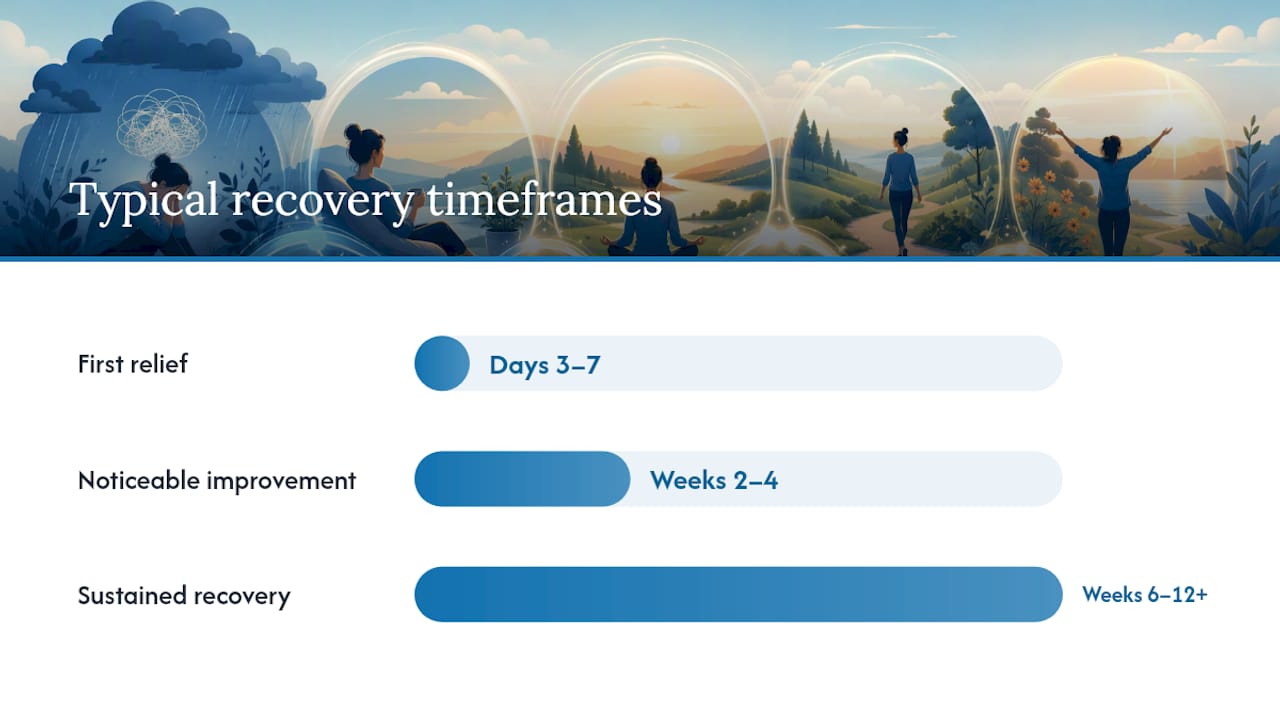
Recovery is not linear, and it rarely feels dramatic. Most people notice the first signs of improvement within two to four weeks of consistent behavioral changes: slightly better sleep, a few hours of genuine focus, less dread at the start of the day. Sustained recovery — where energy and motivation feel reliably restored — typically takes weeks to several months, depending on how long burnout has been building and whether the underlying work conditions have changed.
Peer-reviewed research supports that combined behavioral interventions — schedule changes, sleep improvement, movement, and psychological strategies together — reduce burnout-related exhaustion over this timeframe. No single intervention works in isolation.
How to track your progress:
- Keep a brief daily energy log (rate your energy 1–10 at 9 AM, 1 PM, and 5 PM)
- Note sleep quality and duration each morning
- Track your productive focus windows (how many 90-minute blocks felt genuinely focused)
- Check in on mood weekly: are you experiencing more moments of genuine enjoyment or humor?
Relapse-prevention checklist (review quarterly):
- Are my work hours still within the boundaries I set?
- Have any new commitments crept in without removing old ones?
- Am I still doing my shutdown ritual consistently?
- Is my sleep quality holding?
- Am I maintaining at least one social connection per day?
- Have I had a genuine recovery window in the past week?
| Recovery Milestone | Typical Timeframe | What It Looks Like |
|---|---|---|
| First relief | Days 3–7 | Slightly better sleep, less dread in the morning |
| Noticeable improvement | Weeks 2–4 | More consistent focus, reduced irritability |
| Sustained recovery | Weeks 6–12+ | Restored motivation, energy, and sense of meaning |
| Relapse prevention | Ongoing | Quarterly habit audits, maintained boundaries |
A relapse is not a failure. It usually means one or two protective habits slipped. Catching it early — at the “elevated stress” stage rather than the “full burnout” stage — is exactly what the quarterly check is for.
At-home tools that support your recovery routine
Physical recovery tools won’t fix burnout on their own, but the right ones make the behavioral strategies above easier to sustain. Think of them as habit scaffolding: they lower the friction of doing the right thing at the right time. These are supportive aids, not clinical treatments.
Product categories worth considering:
- White-noise machines: Reduce auditory distractions during deep-work blocks and create a consistent sleep environment. Place one near your workspace during focus hours and move it to your bedroom at night.
- Neck and shoulder massagers: Long video calls create muscle tension that compounds mental fatigue. A five-minute neck massager session after your last call of the day is a concrete physical transition ritual. Look for a home fitness recovery tool with adjustable intensity.
- Acupressure mats: Used for 15–20 minutes during a lunch break or before bed, acupressure mats support relaxation and can ease the physical tension that accumulates during a high-stress workday.
- Sleep masks and sleep aids: Light-blocking sleep masks are a low-cost, high-impact sleep hygiene upgrade, especially if your bedroom isn’t fully dark. Pair with a consistent bedtime routine for best results.
- Posture supports: Poor posture during long work sessions creates chronic neck and back tension that feeds into the physical symptom cluster of burnout. A posture brace worn for part of the workday can reduce that load.
Pro Tip: Use a relaxation product as a transition ritual anchor. The same neck massager, the same acupressure mat, used at the same time each day, becomes a sensory cue your nervous system associates with “recovery mode.” Consistency matters more than duration.
This information is general in nature and is not a substitute for professional medical advice. If your symptoms are severe or persistent, consult a licensed healthcare provider.
Long-term prevention habits to keep burnout from coming back
The strategies above help you recover. These habits keep you from needing to recover again.
Daily habits:
- Set and keep consistent work start and stop times, even on light days
- Do your shutdown ritual every single workday, not just when you feel burned out
- Take at least two micro-breaks during the workday (calendar-blocked, not optional)
- Protect your sleep: consistent bedtime, no screens 30–60 minutes before bed
- Make one genuine social connection per day (a call, a walk, a real conversation)
Weekly habits:
- Review your calendar every Monday morning: are there meetings you can decline or shorten?
- Block a two-to-three hour recovery window on the weekend — protected, non-negotiable
- Do a brief workload audit on Friday: what’s carrying over, what can be dropped or delegated?
Quarterly habits:
- Run through the relapse-prevention checklist above
- Review your work hours over the past month: are they creeping back up?
- Assess your boundary health: are you still protecting your offline hour and deep-work blocks?
- Check in with your manager about workload and priorities before they become a crisis
Making habits stick: The most reliable method is habit stacking — attaching a new habit to an existing one. Shutdown ritual after closing your last task. Walk after lunch. Brain dump before your first meeting. Environment design matters too: a visible notebook on your desk makes brain dumps more likely. A packed work bag by the door makes the shutdown ritual automatic. Building a daily routine around these anchors is one of the most durable ways to prevent burnout from recurring.
The thing most burnout advice gets wrong
Most guides treat burnout as a personal failing that requires personal fixes: meditate more, sleep better, exercise, set boundaries. That framing is half right and half harmful.
The behavioral strategies in this guide work. Sleep, movement, transition rituals, micro-breaks — the evidence behind them is solid. But they work best when the structural conditions that caused burnout are also addressed. A shutdown ritual doesn’t fix a 70-hour workweek. An acupressure mat doesn’t fix a manager who schedules 6 PM calls. Breathwork is genuinely useful; it is not a substitute for a workload conversation.
The most durable recoveries happen when people do both: they change their own habits AND they address the work conditions driving the problem. That’s why the manager conversation section is in this guide, not as an afterthought, but as a core strategy. You have more leverage over your work conditions than burnout makes you feel. The exhaustion and cynicism of burnout actively suppress your sense of agency — which is exactly why the first steps in this guide are small, fast, and doable without anyone else’s permission.
Start with the shutdown ritual. Add the walk. Block the offline hour. Then, when you have a little more energy, have the capacity conversation. Recovery is cumulative. Small changes compound faster than you expect.
Recovery tools that fit your home routine
When you’re working through burnout at home, the right physical environment makes the behavioral strategies easier to sustain. Evergreenbliss carries a focused range of stress-relief and mental-wellness products designed for exactly this kind of home-based recovery: white-noise machines for sleep and focus, neck massagers for post-call tension relief, acupressure mats for midday resets, and sleep masks for better rest.

A white-noise machine placed at your desk during deep-work blocks and moved to your bedroom at night pulls double duty: it reduces distraction during the day and supports sleep quality at night. A neck massager used for five minutes after your last call becomes a physical transition ritual your body starts to recognize. These tools don’t replace the strategies above. They make them easier to do consistently. Browse the personal care and recovery collection to find what fits your routine.
Sources
- Job burnout: How to spot it and take action — Mayo Clinic
- Psychiatry
- How to decompress after work — Healthline
- Recognizing and preventing remote work burnout — BrandMag
- PMC article on physical activity and mood
- ICD-11 browse — WHO
- Weeknight reset habits that beat burnout — The How-To Home