You can maintain healthy posture all day by combining three things: an ergonomic workstation setup, movement microbreaks every 30 minutes, and a short daily strengthening and stretching routine. That’s the whole plan. Everything below is how to execute it.
Start today with these three actions:
- Adjust your chair so your feet rest flat on the floor (or a footrest), knees near 90°, and your monitor top sits at eye level.
- Set a phone alarm or calendar timer to go off every 30 minutes as a movement cue.
- Run through a short daily posture routine (exercises and stretches covered below) before or after work.
Pro Tip: If you’re on a laptop, prop it on a stack of books or a riser and plug in an external keyboard and mouse. This one change fixes the most common posture problem in remote work: hunching over a low screen.
Key Takeaways
Maintaining healthy posture all day requires an ergonomic setup, consistent movement every 30 minutes, and a short daily strengthening and stretching routine practiced at least 2–3 times per week.
| Point | Details |
|---|---|
| Ergonomic setup first | Feet flat, knees at 90°, monitor at eye level, lumbar support in place before you start work. |
| Move every 30 minutes | No static position stays “good” for hours; micro-movements and position changes prevent muscle fatigue. |
| Daily 10–15 minute routine | Morning mobility, midday strengthening, and evening stretching build the muscle support posture depends on. |
| Know the red flags | Numbness, tingling, progressive weakness, or sudden loss of function need prompt clinical attention. |
| Evergreenbliss tools | Posture braces, lumbar cushions, and resistance bands from Evergreenbliss support the routine as training aids. |
Table of Contents
- Why does posture matter for your health?
- How to set up an ergonomic sitting workstation
- What does good standing posture actually look like?
- How often should you move to protect your posture?
- Best posture exercises for your upper back, core, and glutes
- Which stretches relieve the tightness that causes slouching?
- Simple posture checks you can do anywhere
- When should you see a clinician about posture?
- A timed daily routine you can actually follow
- How to maintain good posture during everyday activities
- How to build posture habits that actually stick
- Common posture mistakes that undo your progress
- What most posture advice gets wrong
- Evergreenbliss supports your posture routine at home
- Sources
Why does posture matter for your health?
Posture is how your body holds itself against gravity, whether you’re sitting, standing, or moving. Good posture means your spine maintains its natural curves without exaggeration, your muscles work efficiently, and your joints stay in alignment. Poor posture, especially the kind that builds up over hours of desk work, is a different story.
Prolonged slouching compresses spinal discs, tightens chest muscles, and strains the neck and upper back. According to MedlinePlus, maintaining the spine’s natural curves and keeping the head level are foundational to reducing this strain. Beyond pain, forward head posture restricts the chest cavity and can limit breathing depth, which contributes to fatigue. Poor balance and increased fall risk are longer-term consequences, particularly as muscle weakness compounds over time.
The good news: Harvard Health notes that it’s rarely too late to improve posture, because posture depends primarily on muscle strength and flexibility, not bone structure. Strengthening your core and upper back while stretching tight chest and shoulder tissues produces real, measurable change.
Common health consequences of poor posture:
- Neck pain, upper back pain, and tension headaches
- Lower back pain from compressed lumbar discs
- Restricted breathing and reduced lung capacity
- Persistent fatigue from muscles working overtime to compensate
- Reduced balance and increased injury risk over time
How to set up an ergonomic sitting workstation
A proper ergonomic setup takes about five minutes to configure and pays off every hour you sit. OSHA’s computer workstation guidance provides step-by-step positions for monitor, keyboard, and seating that reduce musculoskeletal strain for computer workers. Here’s what to check:
Ergonomic sitting checklist:
- Feet: Flat on the floor or supported by a footrest. No dangling.
- Knees: Bent at roughly 90°, level with or slightly below your hips.
- Hips: Pushed back in the seat, with lumbar support filling the curve of your lower back.
- Elbows: Bent at 90–110°, close to your body, wrists neutral (not bent up or down).
- Monitor: Top of the screen at eye level, roughly arm’s length away (20–24 inches).
- Head: Ears aligned over shoulders, not jutting forward.
- Shoulders: Relaxed and down, not shrugged toward your ears.
Laptop quick-fixes: A laptop riser or a stack of hardcover books gets the screen to eye level. Add an external keyboard and mouse so your arms can stay at the right angle. A rolled towel or small lumbar pillow works as a temporary lumbar support if your chair lacks one.
One caution: Verywell Health advises against overcorrecting. Forcing an exaggerated upright position creates new tension. Aim for neutral, not military-straight.
Pro Tip: Sit against the back of your chair rather than perching on the edge. Perching feels “active” but fatigues your lower back within 20 minutes.
What does good standing posture actually look like?
Standing for long periods without attention to alignment is just as hard on the body as sitting poorly. The goal is a neutral spine, not a rigid one.
Standing alignment checklist:
- Feet hip-distance apart, weight distributed evenly across both feet.
- Slight bend in the knees (never locked).
- Pelvis in a neutral position, not tilted forward or tucked under.
- Shoulders relaxed and back, not rounded forward.
- Chin slightly tucked, ears over shoulders.
For adjustable standing desks, set the surface so your elbows stay at 90° when your hands rest on the keyboard. A good rule of thumb: if your desk is at the right height for sitting, it’s probably too low for standing.
Alternate between sitting and standing rather than committing to one or the other for hours. Physical therapists generally suggest limiting continuous standing before switching positions.
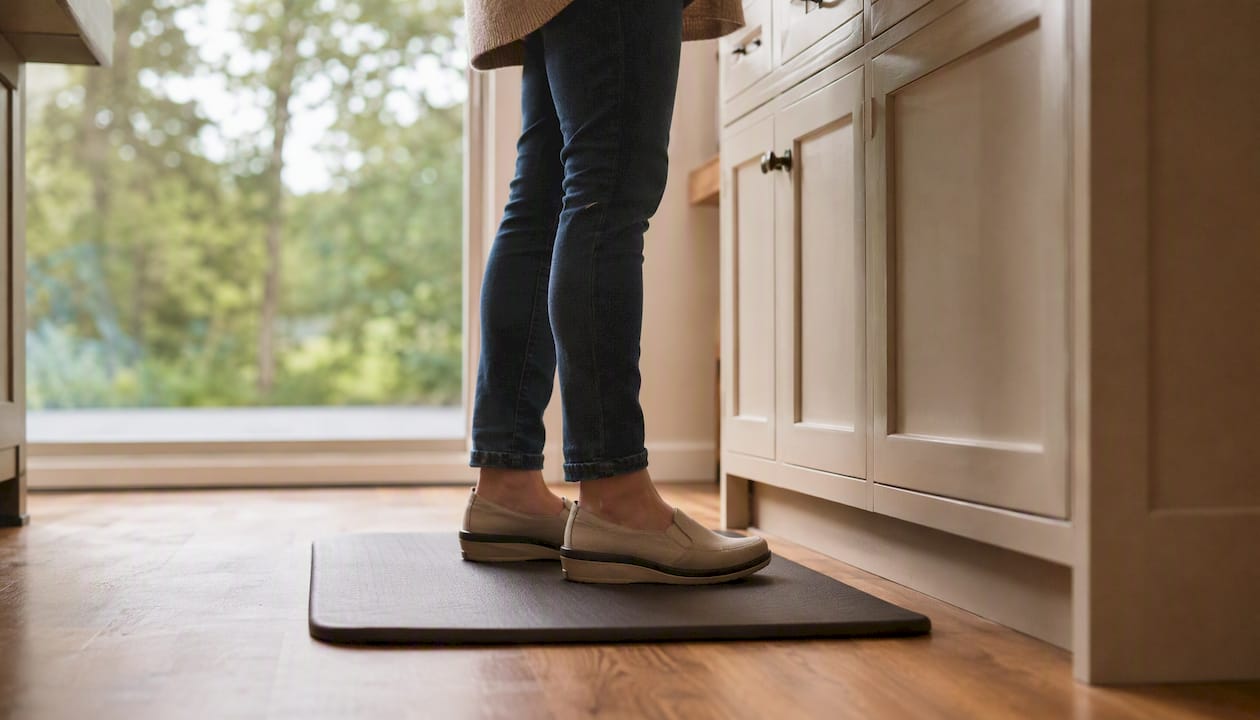
Footwear matters more than most people realize. Shoes with arch support and a low heel keep the pelvis in a neutral position. High heels shift the pelvis forward and increase lumbar curve. Flat, unsupportive shoes can overload the arches and send compensatory strain up the kinetic chain. If you stand on hard floors for extended periods, an anti-fatigue mat reduces the load on your feet, knees, and lower back.
How often should you move to protect your posture?
Physical therapists at HSS emphasize that consistent movement throughout the day, not holding one perfect position, is the most effective posture strategy. No setup, however good, prevents fatigue if you stay static for hours.
The timing framework:
- Check your posture every 15 minutes. A quick glance at your alignment takes three seconds.
- Change position or do a micro-movement at least every 30 minutes.
- Take a longer movement break (stand, walk, stretch) every 60 minutes.
Quick micro-movements you can do at your desk:
- Chin tucks: gently draw your chin straight back, hold 5 seconds, release.
- Shoulder rolls: 5 backward, slow and deliberate.
- Seated cat-cow: arch and round your lower back 5 times.
- Scapular squeeze: pull shoulder blades together, hold 5 seconds.
- Neck side stretch: ear toward shoulder, hold 15 seconds each side.
- Seated march: lift alternating knees for 30 seconds.
- Calf raises: stand and rise onto your toes 10 times.
- Standing hip circles: hands on hips, slow circles 5 each direction.
- Chest opener: clasp hands behind your back, gently lift and open.
- Wrist and forearm stretch: extend one arm, gently pull fingers back.
Pro Tip: Anchor your 30-minute movement break to something you already do, like refilling your water glass or standing up to take a phone call. Habit-stacking beats a timer you’ll eventually ignore.
Best posture exercises for your upper back, core, and glutes
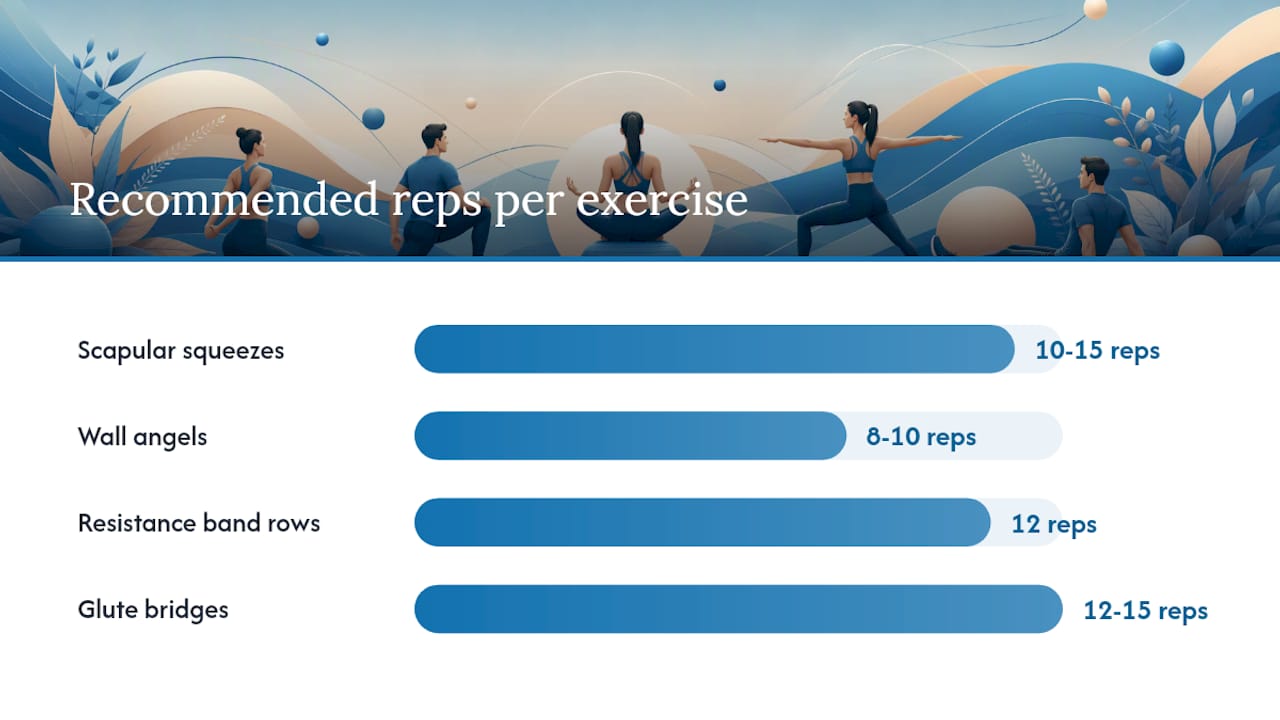
Cleveland Clinic recommends exercises like wall angels, pelvic tilts, and scapular squeezes as clinician-approved moves for strengthening the muscles that support good posture. Aim for 2–3 sessions per week, with at least one rest day between sessions.
-
Scapular squeezes: Sit or stand tall. Pull shoulder blades together and down, hold 5 seconds, release. 3 sets of 10–15 reps. Beginner mod: do it seated with arms at your sides.
-
Wall angels: Stand with your back flat against a wall, arms bent at 90° (goalpost position). Slowly slide arms overhead, keeping contact with the wall throughout. 3 sets of 8–10 reps. Beginner mod: reduce range of motion if your lower back arches off the wall.
-
Resistance band rows: Anchor a band at chest height. Hold one end in each hand, step back to create tension, and pull elbows straight back, squeezing shoulder blades. 3 sets of 12 reps. Beginner mod: use a lighter band or shorter range.
-
Glute bridges: Lie on your back, knees bent, feet flat. Press through your heels to lift your hips until your body forms a straight line from knees to shoulders. Hold 2 seconds at the top. 3 sets of 12–15 reps. Beginner mod: reduce hold time to 1 second.
-
Modified plank (forearm hold): Forearms on the floor, body in a straight line from head to heels. Hold without letting your hips sag or pike. 3 sets of 20–30 seconds. Beginner mod: drop to knees.
-
Pelvic tilts: Lie on your back, knees bent. Gently flatten your lower back against the floor by tightening your abs, hold 5 seconds, release. 2 sets of 10 reps. Great for lower back awareness.
Progress by adding reps or hold time every 1–2 weeks. Stop any exercise that causes sharp or shooting pain.
Which stretches relieve the tightness that causes slouching?
Tight chest muscles and hip flexors are the two biggest drivers of rounded shoulders and forward pelvic tilt. Stretching them daily, especially after long sitting sessions, makes the strengthening work above far more effective. Harvard Health confirms that combining stretching with strengthening is how posture actually changes.
-
Doorway chest stretch: Stand in a doorway, arms at 90° on the frame. Step one foot forward and gently lean through until you feel a stretch across the chest. Hold 20–30 seconds, 2–3 reps. Mod: use a wall corner instead.
-
Upper trap/neck stretch: Sit tall, drop one ear toward your shoulder, and gently place the same-side hand on your head for light added pressure. Hold 20–30 seconds each side, 2 reps.
-
Hip flexor lunge stretch: Step one foot forward into a lunge, drop the back knee to the floor, and shift your hips forward until you feel a stretch at the front of the back hip. Hold 30 seconds each side, 2 reps. Mod: place hands on a chair for balance.
-
Thoracic rotation: Sit sideways on a chair, feet flat. Rotate your upper body toward the chair back, using it as a gentle anchor. Hold 15–20 seconds each side, 2 reps.
-
Seated hamstring stretch: Sit on the edge of a chair, extend one leg straight, flex your foot, and hinge forward from the hips (not the waist). Hold 20–30 seconds each side.
Breathe steadily through every stretch. A gentle pull is the target; sharp pain means back off. Stretching a cold muscle tears tissue, so do these after movement or a warm shower, not first thing out of bed.
Simple posture checks you can do anywhere
You don’t need a mirror or a clinician to check your alignment. Stanford’s postural awareness checklist highlights concrete, observable checkpoints that anyone can use throughout the day.
Three quick posture checks:
- Wall test: Stand with your heels, glutes, upper back, and head touching a wall. If your head can’t reach without straining, your forward head posture needs attention.
- Chin tuck test: Sitting or standing, draw your chin straight back (not down). If this feels dramatically different from your resting position, your head is likely sitting too far forward.
- Seated alignment check: Look down. Can you see your knees directly over your feet? Are your hips level? Is your lower back touching the chair back?
Micro-reset cues for during the workday:
- Take a slow inhale, brace your core lightly, and exhale while settling your shoulders down and back.
- Do a 5-second scapular squeeze, then release completely.
- Rock your pelvis gently forward and back to find neutral.
- Glance at your monitor: if you’re looking down at it, your screen has drifted too low.
Pro Tip: Set your smartwatch or phone to a silent vibration alert every 30 minutes. Label it “posture check.” It takes three seconds and costs nothing.
When should you see a clinician about posture?
Most posture discomfort responds to the strategies above within days to weeks. Comfort often improves quickly once movement increases, but measurable postural change typically takes weeks to months of consistent effort. That’s normal.
Red flags that warrant prompt medical attention:
- Progressive weakness in your arms or legs
- Numbness, tingling, or burning that radiates down an arm or leg
- Severe pain that worsens despite rest and movement
- Sudden loss of bladder or bowel control (seek emergency care immediately)
- Pain following a fall or trauma
For persistent but non-urgent pain, a primary care physician is a reasonable first stop. They can rule out structural issues and refer you to a physical therapist, who can assess your movement patterns and build a targeted program. A spine specialist (orthopedic surgeon or physiatrist) is appropriate when imaging or more advanced intervention may be needed.
Don’t wait months if pain is interfering with daily function. Earlier intervention typically means faster recovery.
A timed daily routine you can actually follow
This 10–15 minute routine bundles the guide’s recommendations into a format you can run before work, during lunch, or in the evening. HSS physical therapists note that consistent movement, not perfection, drives results.
Morning (5 minutes):
- Pelvic tilts: 2 sets of 10
- Hip flexor lunge stretch: 30 seconds each side
- Thoracic rotation: 2 reps each side
- Chin tucks: 10 reps
Midday (5–8 minutes, 2–3x per week):
- Glute bridges: 3 sets of 12
- Scapular squeezes: 3 sets of 12
- Wall angels: 3 sets of 8
- Modified plank: 3 sets of 20–30 seconds
Evening (5 minutes):
- Doorway chest stretch: 3 reps
- Upper trap stretch: 2 reps each side
- Seated hamstring stretch: 2 reps each side
Progression: In weeks 1–4, focus on form. Weeks 5–8, add 2–3 reps per set. By weeks 9–12, increase hold times and try the full plank (feet instead of knees).
Posture supports like a lumbar cushion or a light posture brace can reinforce neutral alignment while habits form, but use them as training aids, not permanent fixes. Wearing a brace for extended periods without strengthening the underlying muscles can create dependency. Always consult a clinician if you’re unsure whether a support device is appropriate for your situation.
Pro Tip: Track your routine in a notes app or a simple paper log. Seeing three consecutive weeks of check marks is more motivating than any fitness app.
How to maintain good posture during everyday activities
Posture doesn’t stop mattering when you leave your desk.
Driving: Adjust your seat so your knees are slightly bent and your lower back is supported. Your headrest should sit behind the middle of your skull, not your neck. Grip the wheel at 9 and 3 (not 10 and 2) to keep your shoulders relaxed. On long drives, stop every 60–90 minutes to walk and stretch.
Carrying bags: A backpack worn on both shoulders distributes weight evenly across the spine. A single-shoulder bag or heavy purse pulls one side down and rotates the spine over time. If you carry a bag on one side, switch shoulders regularly and keep the load light.
Using your phone: “Text neck” is a real phenomenon. Holding your phone at chest or eye level instead of looking down at your lap reduces the load on your cervical spine significantly. The further your head drops forward, the heavier it effectively becomes on your neck muscles.
Sleeping: A pillow that keeps your head aligned with your spine (not propped too high or too flat) matters. Side sleepers benefit from a pillow between the knees to keep the hips neutral. If back pain disrupts your sleep, posture and sleep positioning are worth addressing together.
How to build posture habits that actually stick
Knowing what to do and doing it consistently are two different problems. The second one is harder.
Reminders and apps: A simple phone alarm labeled “posture check” beats any dedicated app for most people. If you prefer something more structured, apps like Stretchly (desktop) or a smartwatch’s movement reminder feature work well for scheduling microbreaks.
Mindful awareness: Pick one daily trigger, like sitting down at your desk in the morning, as a posture reset cue. Every time you do that action, run a quick three-second check: feet flat, shoulders down, chin tucked. Over weeks, the check becomes automatic.
Environment design: Make good posture the path of least resistance. A lumbar cushion already on your chair means you don’t have to decide to use it. A resistance band hanging on your monitor means it’s there when the alarm goes off. Friction reduction is more reliable than willpower.
One thing worth noting: Cleveland Clinic cautions against obsessing over posture. Constant self-monitoring creates its own tension. Brief, intermittent checks combined with a strengthening routine are more sustainable than trying to hold perfect alignment every waking minute.
Common posture mistakes that undo your progress
Most posture problems come down to a short list of repeatable errors.
Sitting on the edge of your chair feels alert but removes lumbar support and fatigues your lower back fast. Push back and use the chair.
Crossing your legs rotates the pelvis and creates asymmetrical hip loading. Fine occasionally; problematic as a default position for hours.
Letting your monitor drift too low is the most common desk mistake. Every inch your head drops forward adds roughly 10 pounds of effective load on your cervical spine.
Holding your breath during focused work increases muscle tension throughout the trunk and neck. Breathing steadily, particularly with a full exhale, resets tension.
Skipping rest days when doing strengthening work. Muscles adapt during recovery, not during the workout. Two to three sessions per week with rest days between them outperforms daily grinding.
Wearing unsupportive footwear all day while standing. Flip-flops and worn-out sneakers offer no arch support and shift postural load upward through the ankles, knees, and hips.
What most posture advice gets wrong
The posture conversation almost always focuses on position: sit straighter, stand taller, pull your shoulders back. That framing misses the real mechanism.
Posture is a movement problem, not a position problem. The research is consistent on this: no single static position is “good” all day. The body is designed to move, and any fixed position, even a textbook-perfect one, becomes a source of strain when held for hours. The people who maintain the best posture long-term aren’t the ones who sit the most rigidly. They’re the ones who move the most frequently.
The second thing most advice underestimates is how much the lower body drives upper body posture. Tight hip flexors from prolonged sitting tilt the pelvis forward, which increases lumbar curve, which pushes the upper back into flexion, which rounds the shoulders and juts the head forward. Fix the hips and the shoulders often follow. That’s why the hip flexor stretch and glute bridge belong in a posture routine, not just core exercises.
Start small. A 10-minute routine done consistently three times a week will outperform a 45-minute program you abandon after two weeks. Progress is cumulative, and the habits you build in the first month are the ones that carry you through the rest of the year.
Evergreenbliss supports your posture routine at home
Posture correction is primarily about movement and habit, but the right tools make the process easier and more consistent.

Evergreenbliss carries posture support braces, lumbar cushions, resistance bands, and home fitness recovery equipment designed to complement the exercises and ergonomic adjustments in this guide. A posture brace worn during focused work sessions can reinforce neutral alignment while your muscles are still building strength. Resistance bands make the rows and scapular exercises above accessible without a gym. A quality lumbar cushion turns any chair into a more supportive seat in seconds.
Browse the full wellness and recovery collection at Evergreenbliss to find the tools that fit your routine. These products are adjuncts to good movement habits, not substitutes for them. For any pain that’s persistent, worsening, or accompanied by neurological symptoms, consult a clinician before adding supportive devices.
Sources
- Is it too late to save your posture? - Harvard Health
- Guide to Good Posture - MedlinePlus
- 6 Ways to Improve Your Posture, From a Physical Therapist - HSS
- Exercises To Improve Posture - Cleveland Clinic
- 11 Tips to Improve and Correct Bad Posture - Verywell Health
- Computer workstations: positions - OSHA
- Postural Awareness - Stanford Environmental Health & Safety
This article is general information, not a substitute for advice from a qualified doctor. Consult a qualified healthcare professional about your own circumstances before acting on anything here.