Posture correctors help, but only in a narrow, specific way: they act as short-term reminders that can ease neck and upper-back discomfort when you pair them with real strengthening work. They are not a fix on their own. The research on posture corrector benefits is mixed at best when it comes to lasting structural change, and no study supports wearing one as a substitute for exercise.
- Best evidence supports: brief use during high-slouch tasks, plus a strengthening routine
- Weakest evidence supports: all-day wear as a stand-alone treatment for chronic pain
- Who should be cautious: anyone with numbness, breathing changes, or suspected scoliosis
A 2025 systematic review in Applied Sciences found immediate improvements in alignment and reduced muscle activity with biofeedback devices, but the studies behind that finding were small and short. That gap between “works right now” and “works long term” runs through nearly everything researchers have published on these devices.
Key Takeaways
Posture correctors work best as short-term proprioceptive reminders that reduce discomfort when paired with targeted strengthening, not as stand-alone fixes for chronic pain.
| Point | Details |
|---|---|
| Short-term relief is real | Some trials show reduced neck and upper-back discomfort with immediate use. |
| Evidence for long-term change is weak | A 2019 review found no high-quality evidence for lasting benefit from consumer garments. |
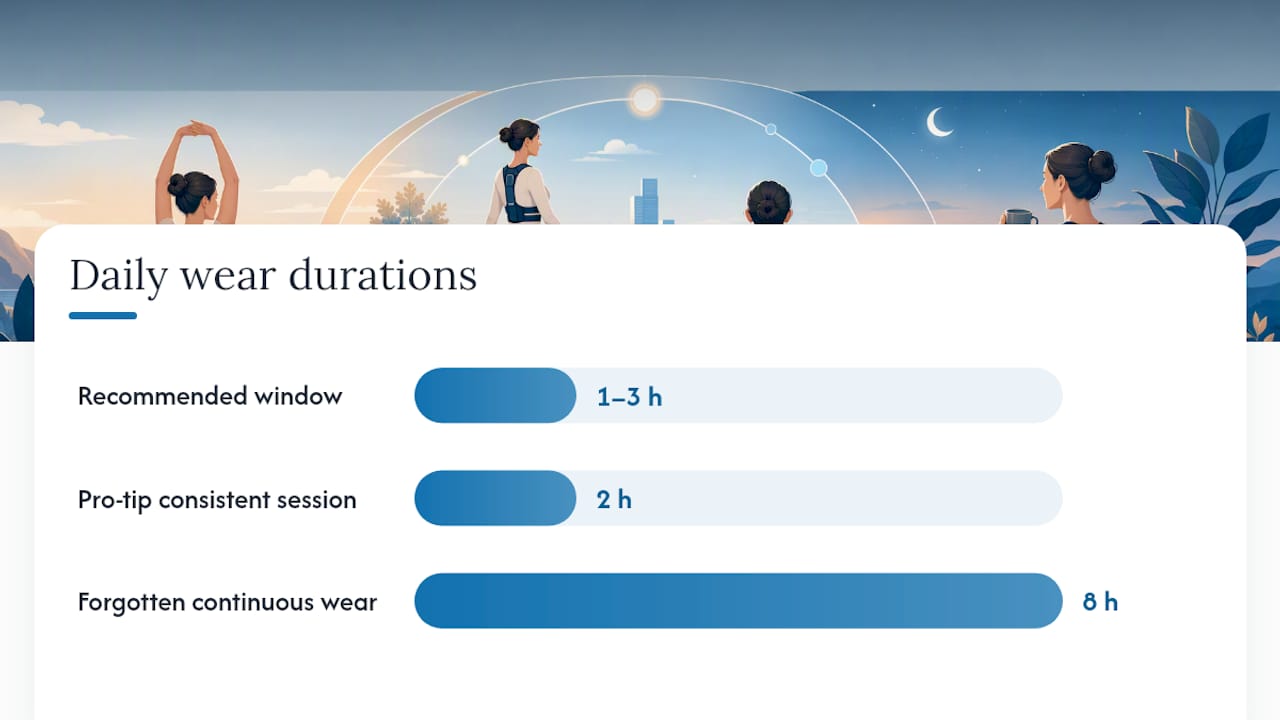
| Wear time matters | Limit use to about 1 to 3 hours daily during high-slouch tasks, per AdventHealth. |
| Pair with exercise always | Rows, scapular squeezes, and thoracic extensions turn passive support into active correction. |
| Choose based on fit and area | Evergreenbliss’s adjustable posture support brace suits users needing customizable shoulder and upper-back support. |
Table of Contents
- Posture Corrector Benefits Start With How They Work
- What Benefits Do People Actually Report?
- How Strong Is the Research, Really?
- How to Use a Posture Corrector Safely
- How to Choose the Right Posture Corrector
- When You Should See a Clinician Instead
- Who’s Behind This Guide
- What the Research Actually Tells Us
- Support Your Posture Routine With the Right Tools
- Sources
Posture Corrector Benefits Start With How They Work
A posture corrector doesn’t strengthen anything by itself. It works mainly through proprioceptive feedback: the gentle pull on your shoulders reminds your brain, over and over, that you’ve slumped forward again. That nagging sensation is the entire mechanism for passive bands and braces.
Biofeedback devices go a step further. Instead of constant pressure, they use vibration or a phone alert triggered by a slouch angle, which several clinicians describe as accelerating motor learning faster than a static brace. The 2025 Applied Sciences review backs this up, noting immediate alignment gains with biofeedback tools, though the effect fades once researchers stop tracking participants.
Here’s the part most buyers skip: a corrector only helps if you’re actively engaging the muscles it’s holding in place. Passive support without effort is like leaning on a crutch that never lets your leg heal.
- Middle trapezius and rhomboids need to fire, not just get pulled into position
- Thoracic extension should come from your spine, not the strap
- Chin tucks reinforce the neck alignment a brace can’t do alone
Pro Tip: Squeeze your shoulder blades together for five seconds every time you notice the brace’s pull. That tiny habit turns a passive device into an active workout.
What Benefits Do People Actually Report?
The most consistent posture corrector benefits show up fast and fade fast: better shoulder position, less forward-head slouching, and a sharper sense of when you’re out of alignment. None of that requires weeks of use. It shows up in the first sitting.
Clinician-facing sources at HSS point to proprioceptive feedback as the reason people notice a difference almost immediately, especially during long stretches at a desk. That awareness effect, not any structural change, is what most users are actually feeling.
- Reduced neck and upper-back discomfort in some short-term trials
- Improved shoulder retraction and reduced forward-head posture during measurement
- Increased postural awareness while sitting for extended periods
- Reported drops in perceived tension and fatigue, though evidence here is inconsistent
Healthline’s 2025 review reaches a similar conclusion: posture correctors can improve posture and decrease discomfort for some users in the short term, but the research base isn’t strong enough yet to promise anything durable. That’s an honest summary, not a dismissal. Are posture correctors effective? For a few hours at a desk, often yes. As a long-term fix, the evidence doesn’t stretch that far.
How Strong Is the Research, Really?
This is where the enthusiasm needs a reality check. A 2019 review in the Scandinavian Journal of Pain found no high-quality evidence to recommend posture-correcting shirts for musculoskeletal pain, and most of the studies it examined used healthy, pain-free participants rather than people actually dealing with chronic discomfort.
Most trials testing consumer posture garments have been short, small, and run on people who weren’t in pain to begin with. That makes it hard to say how well the results translate to someone managing real neck or back pain day after day.
That single design flaw shows up across the literature. Small sample sizes, short follow-up windows, and healthy-volunteer pools all limit how far you can generalize the findings, a limitation the 2025 Applied Sciences review flags directly when discussing biofeedback wearables.
There’s an important contrast worth naming here: clinical bracing for pediatric scoliosis has far stronger evidence behind it than anything sold as a general consumer posture corrector. Those are different tools solving different problems.
| Device category | Evidence strength | Typical use case |
|---|---|---|
| Passive posture bands/shirts | Limited, mostly short-term | Reminder during desk work |
| Biofeedback wearables | Moderate for immediate change | Motor learning, habit training |
| Clinician-prescribed orthoses | Strong for specific conditions | Scoliosis, post-surgical care |
The practical takeaway: treat a consumer corrector as a temporary training aid, not a medical treatment, and pair it with an actual exercise plan.
How to Use a Posture Corrector Safely
Wearing a brace for extended periods without breaks can backfire. Muscles that don’t have to work may weaken, leading to increased dependence on the device rather than less.
- Start with 1 to 3 hours per day, worn during tasks that typically make you slouch, like long computer sessions.
- Pair every session with targeted work: seated rows, scapular squeezes, and thoracic extensions.
- Add mobility work for the chest and hips, since tight muscles pull posture forward regardless of what you’re wearing.
- Never sleep in a corrector or wear it during exercise that needs full shoulder mobility.
- Watch for red flags, including new numbness, tingling, or trouble breathing, and remove the device immediately if any appear.
AdventHealth’s clinical guidance lands on the same window: roughly 1 to 3 hours a day, paired with exercise, to get the reminder effect without training your muscles to rely on external support. Our own guide to improving posture at home walks through exercise progressions that fit well alongside that schedule.
Pro Tip: Set a timer instead of guessing. Two hours of consistent, focused wear beats eight hours of forgetting you even have it on.
How to Choose the Right Posture Corrector
Not every posture issue needs the same device. Someone with rounded shoulders needs different support than someone with lower-back fatigue, and matching the tool to the actual problem matters more than picking whatever has the most reviews.
- Identify the area that needs support: upper back and shoulders, lumbar region, or a full-back garment
- Prioritize adjustable straps, breathable fabric, and a design you can put on without help
- Decide between passive support and a biofeedback device based on your budget and whether you learn better from a physical cue or a vibration alert
- Check the sizing chart, materials, and return policy before buying, since fit failures are the most common reason people stop using a brace
Evergreenbliss’s pain relief and posture correction tools span several of these categories, which makes side-by-side comparison easier than guessing from a single product photo.
When You Should See a Clinician Instead
A posture corrector is not the right tool for every kind of back or neck pain, and some symptoms need professional eyes before you try a brace at all.
- Severe, progressive pain that doesn’t ease with rest or basic stretching
- Any numbness, tingling, or weakness that suggests nerve involvement
- Suspected scoliosis in a child or teenager, which requires specialist evaluation, not a consumer device
- Worsening symptoms after starting a corrector, which means stop wearing it and get assessed
Rehab and post-surgical bracing is its own category entirely. A clinician-prescribed orthosis is fitted, dosed, and monitored in ways a store-bought brace never is, so one shouldn’t substitute for the other.
Who’s Behind This Guide
This article was written by Cadence, a contributor at Evergreenbliss focused on posture and recovery guides, drawing on peer-reviewed research and physical therapy commentary rather than personal anecdote.
- Evergreenbliss sells adjustable posture support braces built around the fit and adjustability criteria covered above
- The site’s posture correction collection groups devices by support area rather than marketing hype
- Claims here reflect published systematic reviews and clinician guidance, not internal testing data
- Full brand background is available at Evergreenbliss
What the Research Actually Tells Us
Most advice on posture correctors falls into two useless extremes: either they’re miracle devices, or they’re a scam. Neither holds up. The honest read on posture corrector benefits is narrower and more useful than either camp wants to admit.
The conventional wisdom oversells wear time. More hours doesn’t mean more benefit. It means more risk of the exact muscle disuse a brace is supposed to prevent. If there’s one thing this research supports clearly, it’s that the device matters less than what you do while wearing it. A $15 band paired with real scapular strengthening will outperform a $60 garment worn passively for ten hours a day.
What gets underestimated is the awareness piece. People dismiss the “reminder effect” as too simple to matter, but proprioceptive feedback is genuinely how new movement habits form. The device isn’t doing the work. It’s just interrupting the pattern long enough for you to do the work yourself.

Prioritize the exercise. Let the brace be the nudge, not the plan.
Support Your Posture Routine With the Right Tools
Getting a posture corrector that actually fits how you move, sit, and work matters more than picking the first brace you find. Evergreenbliss built its personal care and hygiene gadgets collection around that exact idea: adjustable, breathable options sized for real bodies, not a one-size guess that ends up in a drawer after a week.
If you’ve read this far, you already know a brace alone won’t fix your posture. What it can do is give you a consistent reminder while you build the strength that actually holds you upright. Evergreenbliss’s adjustable posture support brace is designed for that exact 1 to 3 hour window clinicians recommend, with strap adjustability that adapts as your posture improves. Pair it with the exercise progressions in our home posture guide, and check the sizing chart on the product page before you order to get the fit right the first time.
Sources
This article is general information, not a substitute for advice from a qualified doctor. Consult a qualified healthcare professional about your own circumstances before acting on anything here.