Chronic pain is defined as persistent pain lasting three months or more, and it directly destroys sleep quality for the majority of people who live with it. Over 50.2 million adults in the US have chronic pain, and between 50% and 90% of those with joint pain report significant sleep disturbances. That overlap is not coincidental. The pain-sleep relationship is bidirectional: pain breaks sleep, and broken sleep makes pain worse the next day. The good news is that targeting both problems at the same time produces better outcomes than treating either one alone.
How does chronic pain disrupt sleep, and why does poor sleep make pain worse?
Pain keeps the nervous system in a state of high alert. That arousal prevents the brain from settling into the deeper, restorative stages of sleep, including slow-wave sleep and REM. When those stages are cut short, the body misses its primary window for tissue repair and inflammation control.
The timing of pain at night is not random. Cortisol levels drop to their lowest point during the nighttime hours, and cortisol is the body’s main anti-inflammatory hormone. Less cortisol means more inflammation, which means more pain. This is why many people with arthritis or fibromyalgia report that their worst flare-ups happen between midnight and early morning.
Poor sleep then feeds directly back into pain. Sleep deprivation lowers the pain threshold, meaning the nervous system registers the same stimulus as more painful than it would after a full night of rest. Inflammatory markers also rise after disrupted sleep, compounding the physical damage already caused by the underlying condition.
“Treating pain and sleep as a combined clinical target, rather than separate issues, leads to higher success rates than addressing either in isolation.” — The Sleep Consultant
This cycle is the core challenge. Breaking it requires simultaneous treatment of sleep and pain, not a sequential approach where you wait for pain to improve before working on sleep. Understanding this mechanism is the first step toward doing something about it.
What pre-bedtime habits and bedroom setup improve sleep despite pain?
The hour before bed sets the physiological stage for the night ahead. A consistent wind-down routine signals the nervous system to lower its arousal level, which directly reduces pain sensitivity at sleep onset. Experts recommend at least 20 minutes of deliberate relaxation before getting into bed.
Here is a practical pre-sleep routine you can build on:
- Gentle movement (minutes 1–10): Do slow, gentle stretching focused on your most painful areas. This is not exercise. The goal is to release muscle tension that builds up from guarded posture during the day.
- Warm shower or bath (minutes 10–20): Warm water raises skin temperature, which then drops as you dry off. That temperature drop mimics the natural cooling signal the body uses to initiate sleep.
- Deep breathing (minutes 20–30): Practice diaphragmatic breathing, inhaling for four counts and exhaling for six. This activates the parasympathetic nervous system and lowers heart rate.
- Consistent sleep and wake times: Go to bed and wake up at the same time every day, including weekends. Irregular schedules fragment the circadian rhythm and worsen pain sensitivity the following night.
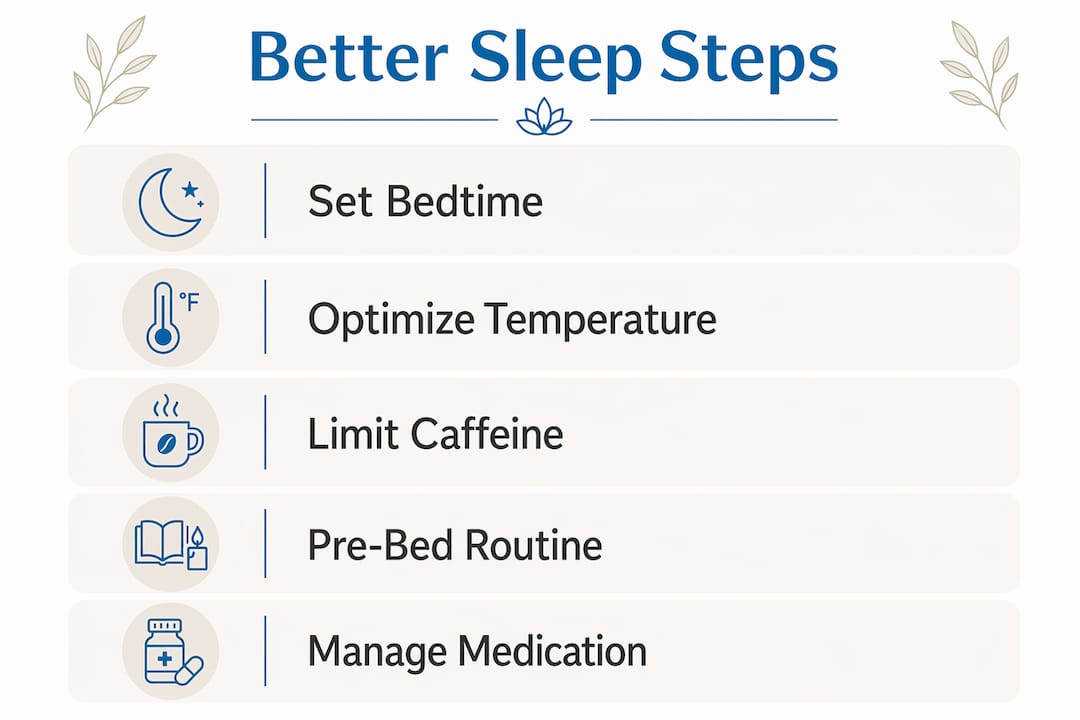
Your bedroom environment matters as much as your routine. Bedroom temperature between 60–67°F supports the core body temperature drop needed for deep sleep. Blackout curtains eliminate light that suppresses melatonin, and a white noise machine or earplugs reduce sound interruptions that are especially disruptive for pain-sensitized sleepers.
Caffeine after mid-afternoon blocks adenosine receptors and delays sleep onset by several hours. Alcohol is equally problematic. It may feel sedating initially, but it fragments sleep in the second half of the night, which is when the most restorative sleep stages occur.
Pro Tip: Set a phone alarm labeled “wind-down” 30 minutes before your target bedtime. Treat it like an appointment. Consistency matters more than perfection.
Which pain management techniques reduce nighttime discomfort?
Sleep position is one of the most underused tools for managing pain at night. The right position reduces pressure on inflamed joints and keeps the spine in a neutral alignment. Here are the most effective positions by pain type:
- Lower back pain: Sleep on your side with a pillow between your knees. This keeps the hips level and reduces spinal rotation.
- Hip pain: Avoid sleeping on the affected hip. Use a firm pillow under the top knee when side sleeping to prevent the hip from rolling inward.
- Shoulder pain: Sleep on your back with a thin pillow under the affected shoulder, or use a body pillow to prevent rolling onto the painful side.
- Knee pain: A pillow under the knees when lying on your back reduces joint extension pressure. Side sleepers should place a pillow between both knees.
Medication timing is a practical strategy that most people overlook. If you take anti-inflammatory medication, coordinate the dose with your healthcare provider so that peak effectiveness aligns with your sleep window. Taking a dose too early means it wears off at 2 a.m., which is exactly when cortisol is lowest and pain is highest.
Over-the-counter sleep aids are not a long-term solution. Regular use of antihistamine-based sleep aids leads to tolerance within days and can worsen cognitive function. Cognitive Behavioral Therapy for Insomnia, known as CBT-I, is the most evidence-backed non-medication treatment for chronic pain sleep disorders. It addresses the thought patterns and behaviors that perpetuate insomnia without creating dependency.

Pro Tip: Ask your prescribing doctor specifically about “pain coverage timing for sleep.” Many providers can adjust release formulations or dosing windows without changing the total daily dose.
How can relaxation techniques address pain-related insomnia?
Behavioral tools work by changing your relationship to pain, not by eliminating it. Mindfulness and CBT for chronic pain teach you to observe pain sensations without reacting to them with tension or anxiety. That shift alone reduces the physiological arousal that keeps you awake. You can also explore stress relief techniques ranked by effectiveness to find the approach that fits your situation.
Four techniques that work well together:
- Body scan meditation: Lie still and move your attention slowly from your feet to your head. When you reach a painful area, breathe into it rather than tensing against it. This reduces reactive muscle guarding.
- Worry log: One hour before bed, write down every concern on your mind along with one possible next step for each. Writing worries down reduces cognitive hyperarousal by offloading mental loops that would otherwise replay at 3 a.m.
- Stimulus control: If you are awake in bed for more than 15–20 minutes, get up and do a quiet, non-stimulating activity in dim light. Return to bed only when you feel sleepy. This breaks the conditioned association between your bed and wakefulness.
- Sleep diary: Track your bedtime, wake time, estimated sleep duration, and pain level each morning. Objective sleep tracking reveals patterns and progress that subjective memory misses, which prevents you from abandoning a routine that is actually working.
| Technique | Primary benefit | Best used when |
|---|---|---|
| Body scan meditation | Reduces muscle tension and reactive pain | Before sleep or after waking in pain |
| Worry log | Lowers cognitive hyperarousal | 60 minutes before bed |
| Stimulus control | Breaks bed-wakefulness association | After 15–20 minutes of wakefulness |
| Sleep diary | Tracks real progress objectively | Every morning upon waking |
The nighttime anxiety cycle is a major driver of pain-related insomnia. Addressing it with these tools produces measurable improvements within two to four weeks for most people.
What are common mistakes that undermine better sleep with chronic pain?
The most common mistake is daytime napping. Napping longer than 20 minutes or napping after 3 p.m. reduces sleep pressure, which is the biological drive that makes you fall asleep at night. For people with chronic pain, reduced sleep pressure means more time lying awake with discomfort.
- Expecting fast results: Sleep improvement with chronic pain is gradual. Most people see meaningful change after two to four weeks of consistent effort, not two to four nights.
- Avoiding all physical activity: Rest feels logical when you are in pain, but physical inactivity worsens both pain and sleep quality. Low-impact movement like walking or swimming during the day builds sleep pressure and reduces inflammatory markers.
- Over-relying on medication: Medication manages symptoms but does not retrain the nervous system. Behavioral strategies are what produce lasting change.
- Ignoring warning signs: New or significantly worsening pain at night, especially with fever, unexplained weight loss, or neurological symptoms, warrants medical evaluation before any self-management approach.
“Progress with pain-related insomnia is rarely linear. A bad night after a week of good sleep is not failure. It is a normal part of the process.”
Sustaining improvement requires combining at least three strategies: environment optimization, a consistent schedule, and one behavioral technique. No single approach works in isolation for most people with chronic pain sleep disorders.
Key takeaways
Sleeping better with chronic pain requires treating pain and sleep as one combined problem, using environment, behavior, and timing strategies together rather than separately.
| Point | Details |
|---|---|
| Pain and sleep are bidirectional | Poor sleep amplifies pain sensitivity, so both must be treated at the same time. |
| Environment sets the stage | Keep your bedroom at 60–67°F, dark, and quiet to support deep sleep stages. |
| Timing medication matters | Coordinate pain medication peaks with your sleep window to reduce nighttime flare-ups. |
| Behavioral tools outperform pills | CBT-I, worry logs, and stimulus control produce lasting change without dependency risk. |
| Track progress objectively | A sleep diary reveals real improvement that subjective memory often misses. |
What I have learned about sleep and chronic pain after years of watching people struggle
The hardest thing to accept about chronic pain and sleep is that there is no single fix. People come to this topic looking for the one position, the one supplement, or the one technique that will solve everything. That search is understandable, and it is also the thing that keeps many people stuck.
What actually works is less exciting but far more reliable. It is the combination of a consistent bedtime, a bedroom that supports sleep, a behavioral technique practiced every night, and medication timing that aligns with the body’s natural rhythm. None of those things are dramatic. All of them compound over time.
The bidirectional nature of the pain-sleep cycle is the insight that changes everything. Once you understand that a bad night of sleep will make tomorrow’s pain worse, and that worse pain will make the next night harder, you stop treating sleep as a luxury. You start treating it as part of your pain management plan. That shift in framing is what separates people who make progress from those who stay stuck.
I have also seen people abandon routines after one or two difficult nights, convinced the approach is not working. A sleep diary almost always shows they were making progress they could not feel yet. Objective data is more trustworthy than a tired brain’s assessment of how things are going. Give any consistent approach at least three weeks before drawing conclusions.
— Cadence
Evergreenbliss products that support restful sleep and pain relief
Living with chronic pain means your recovery tools need to work as hard as your routines do. Evergreenbliss offers a curated range of sleep and relaxation aids designed specifically for people who need more than a standard pillow to get through the night.

From stress relief sleep supplements that support your body’s natural melatonin production to massage and recovery tools that ease muscle tension before bed, the Evergreenbliss collection is built around the same principles covered in this article. Physical comfort and mental calm both matter. Explore the full wellness and recovery range to find products that complement the behavioral strategies you are already building.
FAQ
What is the fastest way to fall asleep with chronic pain?
A 20-minute pre-bed routine combining gentle stretching, deep breathing, and a warm shower lowers nervous system arousal and reduces pain sensitivity at sleep onset. Pairing this with a bedroom temperature of 60–67°F produces the fastest results.
Why does pain feel worse at night?
Cortisol, the body’s primary anti-inflammatory hormone, reaches its lowest level at night. That drop allows inflammation to increase, which raises pain intensity during the hours when you most need to sleep.
Is it safe to use sleep aids for chronic pain insomnia?
Over-the-counter antihistamine-based sleep aids cause tolerance within days and are not recommended for ongoing use. CBT-I is the evidence-backed first-line treatment for chronic pain sleep disorders and carries no dependency risk.
How long does it take to see improvement in sleep with chronic pain?
Most people see meaningful improvement after two to four weeks of consistent behavioral strategies. A sleep diary helps track progress during this period and prevents premature abandonment of routines that are working.
What sleep position is best for back pain?
Side sleeping with a pillow between the knees keeps the hips level and reduces spinal rotation, which is the most effective position for lower back pain. Back sleeping with a pillow under the knees is a strong alternative for those who cannot tolerate side positions.