Measure your chest, not your weight or height. Find the size whose chest circumference range includes your number, and if you land between two sizes, go with the larger one so the brace stays snug rather than restrictive. Aim for “snug, not tight,” and give it a real test wear of 15 to 30 minutes before deciding.
TL;DR:
- Selecting a size based on chest measurement rather than height or weight yields a more accurate fit for posture braces.
- A proper fit allows full breathing, comfortable movement, and causes no residual redness or digging into the skin.
- If straps cannot be tightened or loosened adequately, or if adjusting does not resolve gaps or discomfort, an exchange is necessary.
- Soft, stretchy braces often require sizing up for comfort, while rigid or structured designs demand precise measurements.
- Conduct a 15 to 30-minute fit test wearing the brace during different movements before committing to long-term use.
Table of Contents
- How to Measure for a Posture Brace Correctly
- What Does a Correctly Fitted Posture Brace Feel Like?
- When Should You Exchange for a Different Size?
- How Materials and Brace Style Affect Your Size Choice
- The 15 to 30 Minute Test Every New Brace Needs
- What I Tell People Who Aren’t Sure of Their Size
- Skip the Guesswork With a Brace That Adjusts to You
- Sources
How to Measure for a Posture Brace Correctly
Most posture brace size charts are built around one number: chest circumference. Weight and height show up on some charts too, but they’re weak proxies because two people at the same height can have completely different torso shapes. Chest girth reflects the actual structure the brace has to wrap around, which is why brands that skip straight to chest measurement tend to produce a more reliable fit than ones built on height/weight tables alone.
Here’s how to do it right at home:
- Stand tall with relaxed shoulders. Don’t puff your chest out or slouch to compensate.
- Wrap a soft tape measure around the fullest part of your chest, keeping it parallel to the floor for the proper position for grip measurement.
- Breathe normally and take the reading on a relaxed exhale, not after a deep inhale.
- If the brand’s chart asks for underbust measurement too, take it directly under the bust line, snug but not compressed.
- For designs with shoulder straps, some brands also ask for a shoulder-to-shoulder reach across the back.
Pro Tip: Measure twice, a few minutes apart. Muscle tension and breath timing can shift your number by half an inch, and that’s often the difference between two adjacent sizes on a chart.
Chart ranges vary by brand. One might list Medium as 34 to 38 inches, while another calls that same range Small. That’s why you always check the specific brand’s chart rather than assuming your size carries over from a T-shirt or a different brace you’ve owned. When two brands ask for different inputs, chest measurement over waist or shoulder specs.
What Does a Correctly Fitted Posture Brace Feel Like?
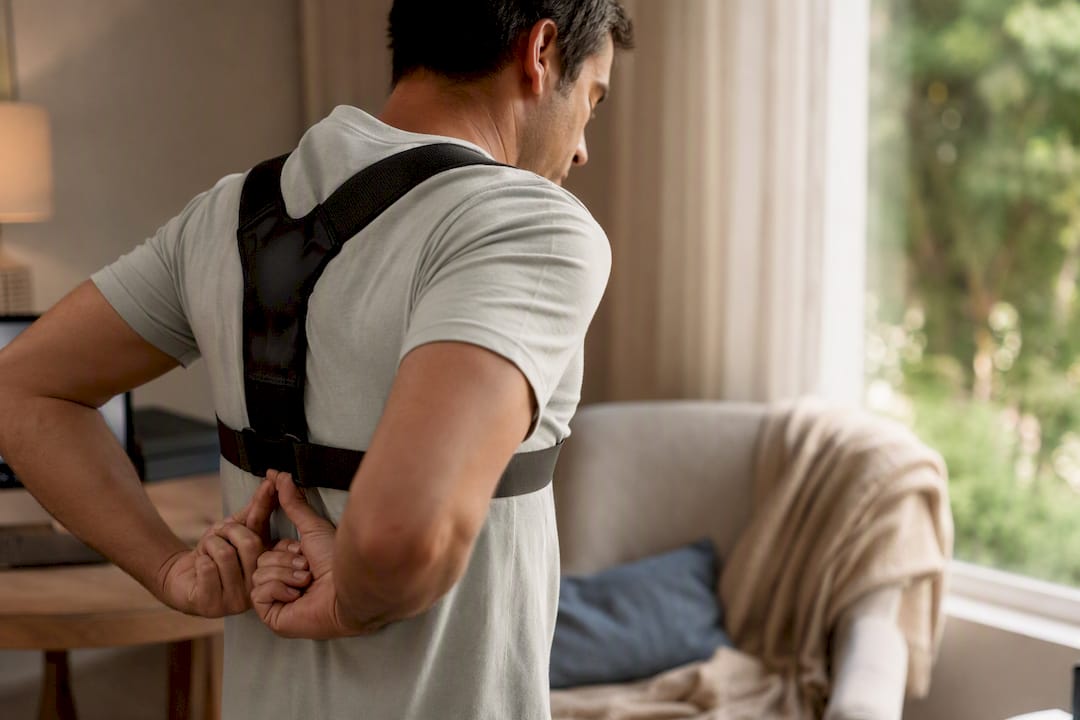
“Snug but not restrictive” is the phrase every brand uses, and it actually means something concrete. You should be able to take a full breath without the straps digging into your ribs. You should be able to reach forward, twist slightly, and sit down without the brace riding up into your armpits or cutting a line into your skin that stays red for minutes after removal.
Fitting a brace correctly follows a sequence, not a single yank of the straps:
- Center the brace on your back first, before tightening anything, so the padding sits where it should.
- Set a base tension on the main strap, just enough that it stays in place without slack.
- Fine-tune the shoulder or side straps in small increments while you move, checking each adjustment against your breathing and range of motion.
Stop immediately if you feel numbness, tingling, or shortness of breath. Those aren’t “break it in” symptoms. They can point to nerve compression, and the fix is to loosen the brace right away, not push through it. If symptoms persist after loosening, that’s a conversation for a doctor, not a strap adjustment.
Pro Tip: Test your fit wearing a thin shirt, not bare skin and not a bulky sweater. That’s the layer thickness most brands design their charts around, and it gives you the truest read on how the brace will feel in daily wear.
When Should You Exchange for a Different Size?
Some fit issues are adjustment problems. Others mean you’re in the wrong size entirely. A quick way to tell them apart:
- Gaping at the chest or straps sliding off your shoulders during normal movement, even after tightening, points to sizing down.
- Straps already maxed out and still loose signals you need to size up.
- Straps at their loosest setting and still digging in or leaving marks means you need to size up.
- Excessive slack throughout, even at minimum tension, means you need to size down.
If none of that resolves it after a couple of adjustment attempts, contact the retailer about an exchange rather than living with a bad fit. And if the issue involves pain, numbness, or breathing trouble rather than plain looseness or tightness, that’s worth a call to a clinician before you try another size at all.
How Materials and Brace Style Affect Your Size Choice
Not every brace behaves the same way at the same listed size, because the materials shift how much give you actually get.
- Soft, stretch-fabric braces compress more against the body, so sizing up often feels more comfortable for all-day wear without losing support.
- Rigid-frame or structured braces have far less forgiveness, which means precise measurement matters more. If you’re unsure between sizes, an adjustable design is the safer bet.
- Wider, padded straps distribute pressure across more surface area, reducing the dig-in feeling that thin straps cause at the same tension.
- If you have sensitive skin or any history of nerve issues in the shoulders or arms, favor a brace with wide, cushioned straps and fully adjustable tension over a fixed-fit design.
The 15 to 30 Minute Test Every New Brace Needs
Don’t judge a brace in the first sixty seconds. Run it through a short protocol before deciding it’s the right size.
- Right after putting it on, check that you can breathe normally, your posture feels lifted rather than jerked, and no strap is at its absolute max or min.
- Wear it for 15 minutes while sitting, standing, and walking around the house. Watch for slipping, digging, or numbness.
- At the 30 minute mark, decide: keep it as is, make a minor strap adjustment, or start the exchange process if the problems persist.
Pro Tip: Don’t jump straight to eight hour wear once a size passes this test. Build up gradually over one to two weeks, adding wear time daily, so your muscles and posture adjust instead of fighting the brace.
What I Tell People Who Aren’t Sure of Their Size

Three checks settle most sizing doubts. Can you take a full breath without the straps biting in? Can you sit down and stand back up without the brace sliding? Is there any tingling anywhere after ten minutes? If those three answers come back “yes, yes, no,” you’ve probably got the right size.
Evergreenbliss builds its adjustable posture support brace around this exact reality: nobody’s torso matches a chart perfectly, and adjustability closes that gap better than chasing a “perfect” fixed size. That’s also why an easy exchange policy matters more than most buyers realize going in. If you’re stuck between two sizes, use it. Guessing wrong on a rigid brace usually means it sits in a drawer.
— Cadence
Skip the Guesswork With a Brace That Adjusts to You
Evergreenbliss’s adjustable posture support brace solves the exact problem this whole guide is built around: you don’t have to nail your measurement to the millimeter, because the strap range does the fine-tuning for you. The design uses breathable, padded materials that distribute pressure across wider straps instead of thin bands that dig in, and every adjustment point is built to move with your body through a full day of sitting, standing, and walking.

If you measured yourself and landed right between two sizes, this is exactly the scenario the brace is built to handle. Combine that with an easy-return policy, and there’s no real downside to trying it against your own measurements first. Browse the personal care and hygiene gadgets collection to check sizing details and place an order.
Sources
For deeper reading on fit and safety: BodySpec’s guide to posture correctors covers measurement and trial-wear steps, SpineHealth explains posture alignment and device safety, and Healthline’s overview of nerve compression details warning signs to watch for.
- Posture Correctors: Do They Work and How to Use Them | BodySpec
- Nerve compression syndrome | Healthline
Recommended
- Adjustable Posture Support Brace for Better Alignment
- Neck Posture Brace - Enhance Comfort & Support Your Neck
- Do Posture Correctors Actually Work? The Evidence So Far
- How to Improve Your Posture at Home: A Complete Guide
Sources and further reading
- Why good posture matters – Harvard Health Publishing
- 8 Posture Exercises To Sit and Stand Straighter – Cleveland Clinic