The fastest way to build long-term wellness habits is to identify the single health pillar you’re weakest in, then build one small, repeatable action around it. Longevity research frames this as biological capital: consistent micro-habits compound across years the same way interest compounds in a savings account. According to the CDC, six in ten American adults live with at least one chronic disease, most of which are preventable through lifestyle. The U.S. Department of Health and Human Services recommends regular moderate-intensity activity per week as a baseline, yet many people do not meet this level.
Start here, in the next 48 hours:
- Pick your weakest pillar from the five that Harvard Health identifies as the foundation of longevity: movement, nutrition, sleep, stress reduction, and social connection.
- Set one consistent wake time and hold it seven days a week, even on weekends.
- Add a 10-minute walk after one meal today. That’s it. One walk.
Table of Contents
- How do you identify which habit will give you the highest return?
- Why starting small is the most underrated long-term health strategy
- What are the core habits worth building across each pillar?
- When do tools and gadgets actually help?
- How do you handle relapses, boredom, and life changes?
- Key Takeaways
- The gap between what wellness promises and what actually moves the needle
- Evergreen Bliss home wellness tools that support your habit plan
How do you identify which habit will give you the highest return?
The logic is simple: the pillar you’re worst at has the most room to improve, so fixing it produces the largest personal return. Harvard Health’s longevity framework makes this explicit: rather than spreading effort evenly across all five pillars, target your weakest one first.
Run this quick self-audit. Answer honestly:
- Social connection: — Have you gone more than a week without a meaningful conversation with someone you care about?
The pillar with the most “yes” answers is your starting point. From there, write a one-line SMART goal: specific, measurable, achievable, relevant, and time-bound. “I will walk for 10 minutes after dinner every weekday for the next three weeks” beats “I want to be more active” every time.
Pro Tip: Don’t audit all five pillars and try to fix them simultaneously. Pick the single weakest one, write your one-line goal, and commit to it for 21 days before adding a second habit.
Why starting small is the most underrated long-term health strategy
Small changes compound. Cleveland Clinic experts point to a 10-minute walk and a 30-minute earlier bedtime as genuinely effective, sustainable changes, not consolation prizes for people who can’t do more. The behavior-change evidence is consistent: tiny habits lower the activation energy required to start, which means you actually do them.
Low-effort, high-impact starter moves worth considering:
- A 10-minute walk after any meal
- Moving your bedtime 30 minutes earlier for one week
- Adding 10 grams of protein to breakfast (one egg, a scoop of Greek yogurt)
- One minute of deep breathing before checking your phone in the morning
- Drinking a full glass of water before coffee
A sample micro-plan for weeks 1–4: Week 1, pick one habit and do it daily. Week 2, hold that habit and notice how it feels. Week 3, add a second habit using stacking (see below). Week 4, assess what’s working and adjust one variable.
Pro Tip: Habit stacking means attaching a new behavior to an existing one. “After I pour my morning coffee, I will do one minute of breathing” is far more durable than a free-floating intention. Kaiser Permanente’s habit research confirms that specificity and repetition, not willpower, are what make habits stick. For a deeper look at how this works neurologically, Evergreen Bliss’s science guide to habit formation breaks down the cue-routine-reward cycle.
What are the core habits worth building across each pillar?
Stanford Medicine clinicians advise building strength training, consistent cardio, solid nutrition, sleep hygiene, and stress management as the non-negotiable foundation. Here’s what that looks like in practice.
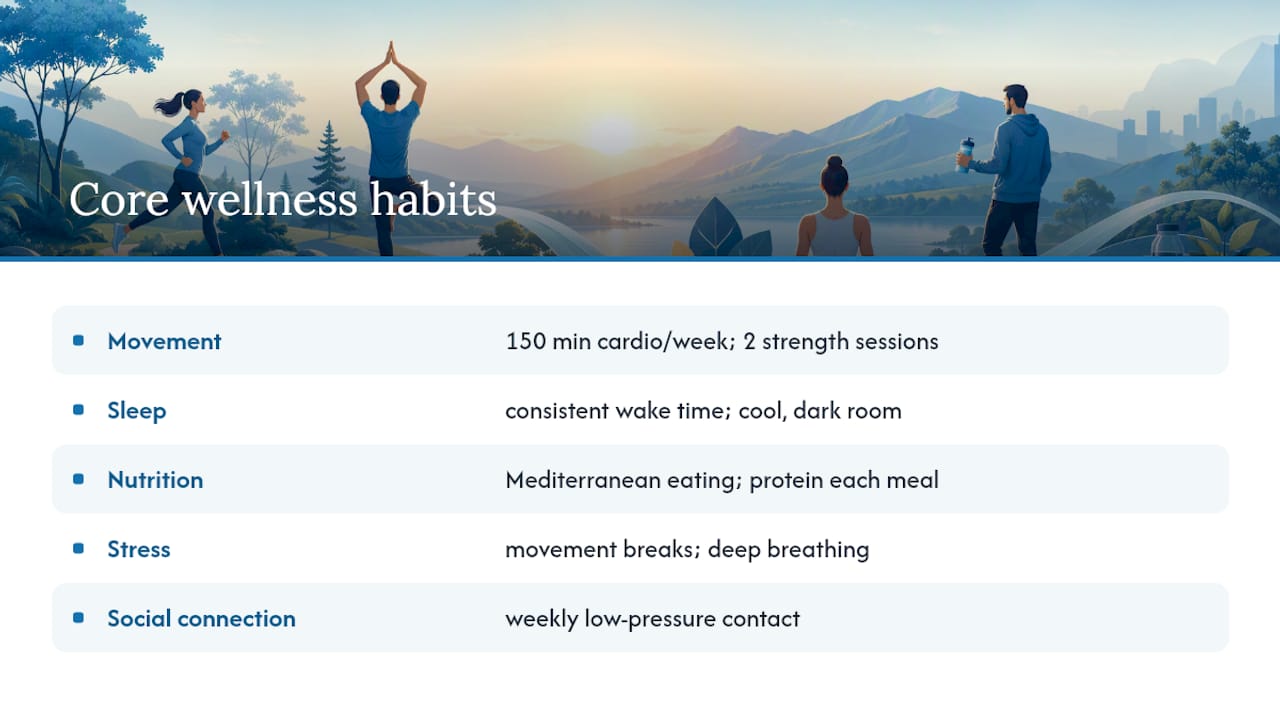
Movement: Aim for 150 minutes of moderate cardio per week, split however works for you. Add two strength sessions. Stanford’s research supports targeting roughly 7,000 steps per day rather than the often-cited 10,000, which removes a common psychological barrier.
Sleep: A consistent wake time anchors your circadian rhythm more reliably than a consistent bedtime. Keep the bedroom cool and dark, avoid screens for 30 minutes before bed, and treat your sleep window like a non-negotiable appointment. For a step-by-step routine, Evergreen Bliss’s bedtime wellness guide covers the specifics.

Nutrition: Mediterranean-style eating, meaning mostly vegetables, legumes, whole grains, fish, and olive oil, consistently outperforms more restrictive diets for long-term adherence. Prioritize protein at every meal. Skip the elaborate meal plans until the basics are automatic.
Stress: Mayo Clinic’s wellness program highlights movement breaks, hobbies, and social contact as practical daily stress regulators. Deep breathing is one of the fastest-acting tools available. A science-backed breakdown of breathing techniques explains exactly how and why it works.

Social connection: Harvard Health places social relationships on par with other health metrics for survival outcomes. A recurring, low-pressure weekly contact, a standing coffee, a regular call, counts. Protect it the way you’d protect a workout.
Do: prioritize consistency over intensity. Don’t: spend money on supplements or advanced biohacks before these basics are locked in. RecoveryStack’s longevity protocol is direct on this point: sleep, exercise, and whole-food protein deliver the largest biological returns, and most supplements are marginal without that foundation.
When do tools and gadgets actually help?
Tools can shorten the friction curve, but they won’t replace the basics. Buy a gadget when you’ve identified a specific barrier, not before. RecoveryStack’s protocol is clear: fix sleep, movement, and nutrition first.
A useful gadget checklist before you buy:
- Does it solve one specific barrier you’ve already identified?
- Will you use it within your existing routine, or does it require a new one?
- Is setup simple enough that you’ll actually set it up?
- Does it fit your budget without requiring ongoing subscription costs?
Evergreen Bliss carries several categories worth considering once your basics are in place. A white-noise machine protects sleep consistency when ambient noise is disrupting your window. An acupressure mat or neck massager supports post-workout recovery and reduces the soreness that makes people skip the next session. A posture support brace addresses the desk-sitting pattern that compounds stress and back tension over time.
Pro Tip: Buy for one specific barrier and test it for 30 days. If it removes that friction, keep it. If it doesn’t, return it. Evergreen Bliss offers easy returns, so the risk is low.
How do you handle relapses, boredom, and life changes?
Relapses are expected. Treat them as data, not failure. The question isn’t whether you’ll miss days; it’s how quickly you restart.
When you slip, run this short sequence: identify what triggered the miss (travel, stress, schedule change), shorten the habit to its smallest possible version (a 2-minute walk still counts), re-attach it to its original cue, and remove one friction point. A daily routine structure helps here because it reduces the number of decisions required each day.
For accountability, a habit buddy works better than most apps. Text one person your weekly intention on Sunday. That’s the whole system. Calendar blocks for workouts and sleep windows serve the same purpose: they make the habit an appointment rather than a preference.
When life changes, such as a new job, travel, or a family shift, don’t abandon the portfolio. Shrink it. A 5-minute stretch, a single high-protein meal, and a consistent wake time are enough to maintain the neural pathway until capacity returns. Flexibility isn’t weakness; it’s what separates a sustainable health practice from a failed resolution.
Key Takeaways
Investing in long-term well-being habits works best when you target your weakest pillar first, start with one tiny repeatable action, and track both objective metrics and how you actually feel.
| Point | Details |
|---|---|
| Start with your weakest pillar | The pillar with the most room to improve gives you the largest personal return fastest. |
| Small habits compound | A 10-minute walk and a 30-minute earlier bedtime are genuinely effective starting points. |
| Track objective and subjective | Log steps or sleep hours alongside a daily mood or energy note for stronger adherence. |
| Basics before gadgets | Sleep, movement, and whole-food protein outperform supplements and advanced tools until the foundation is solid. |
| Evergreen Bliss as support | Once basics are in place, targeted tools like sleep aids, recovery devices, and posture supports reduce friction at specific barriers. |
The gap between what wellness promises and what actually moves the needle
Most wellness content sells the feeling of starting over. New app, new supplement, new morning routine. The problem is that novelty and transformation are not the same thing. Real change is boring by design: the same walk, the same bedtime, the same protein-forward breakfast, repeated until it stops requiring a decision.
What people consistently underestimate is the power of fixing the single worst thing first. Not the most glamorous thing, not the thing the algorithm is currently promoting. The weakest pillar. If you’re sleeping five hours a night, no amount of meditation or cold plunging will compensate for that deficit. If you haven’t moved your body in months, a new supplement stack is a distraction.
The investment metaphor holds because it’s accurate. You don’t build wealth by chasing every hot asset simultaneously. You build a base, let it compound, then diversify. The same logic applies here. Lock in one habit, let it become automatic, then add the next. Evergreen Bliss’s tools fit into this framework as targeted supports, not shortcuts. A white-noise machine that protects your sleep window is a legitimate investment. Buying it before you’ve committed to a consistent bedtime is just spending.
Evergreen Bliss home wellness tools that support your habit plan
The hardest part of any habit isn’t starting. It’s removing the small daily frictions that make skipping feel easier than showing up. That’s where a targeted tool earns its place.
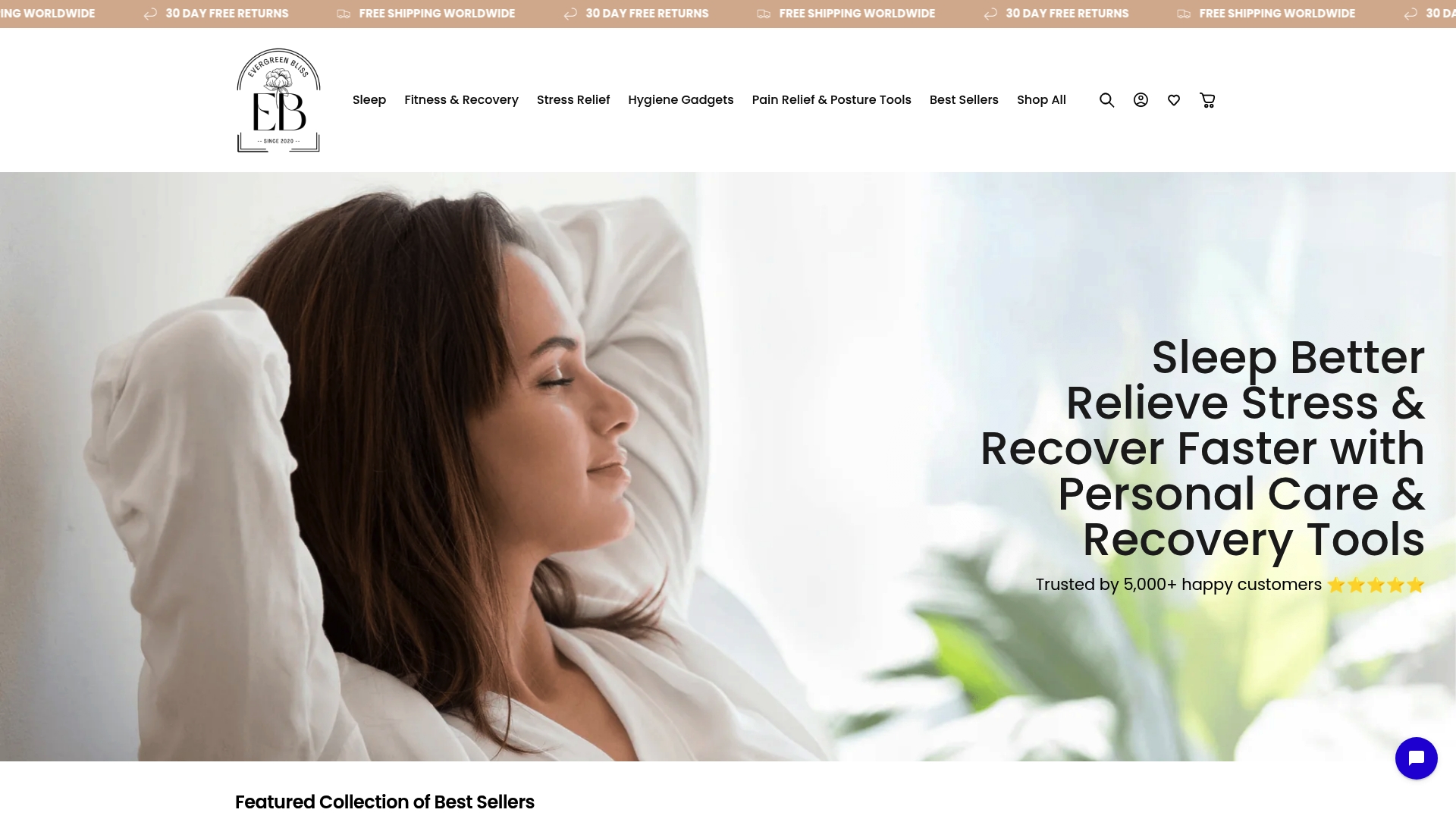
Evergreen Bliss offers wellness and recovery products built specifically for home use: white-noise machines that protect sleep consistency, acupressure mats and massage devices that make post-workout recovery something you’ll actually do, posture supports that counteract the desk tension that builds into chronic stress, and stress-relief tools that give your nervous system a concrete off-ramp. Free shipping, easy returns, and no subscription required. Browse the full collection, pick one tool that solves your most specific barrier, and test it for 30 days.
Useful sources for further reading
- The 5 pillars of longevity: Movement, nutrition, sleep, stress reduction, and social connection - Harvard Health
- 10 Healthy Habits To Follow Every Day - Cleveland Clinic
- Five healthy habits to develop in your 20s and 30s - Stanford Medicine
- How to build healthy habits that stick | Kaiser Permanente
- Changing habits for better health — NIDDK
- Foundations — How to Build Biological Capital and Start Investing in Your Health | Longevity Protocols
- The Longevity Protocol: A Realistic Daily Routine (2026) — RecoveryStack
- Fall into wellness — Mayo Clinic Health System