Your bedroom temperature is one of the most direct levers you have over sleep quality. The short answer: ambient temperature that is too high or too low interferes with the body’s natural core-cooling process, which is the physiological trigger for sleep onset and maintenance. A practical starting point for most adults is 65°F (18.3°C), though the evidence-backed range runs from roughly 60–67°F (15.5–19.5°C), with more recent field research pointing to 68–77°F (20–25°C) as the zone where sleep efficiency peaks in real-world conditions.
Why does that range matter?
- Core temperature must drop by roughly 1–2°F at sleep onset; a room that is too warm prevents that drop.
- Distal vasodilation (blood flowing to hands and feet) is how the body sheds heat; ambient heat or cold can block this mechanism.
- Sleep stages are not equally resilient — deep slow-wave sleep (SWS) and REM are the first casualties when temperature goes wrong.
- Individual variation is real: age, body composition, hormonal status, and even your partner’s preferences all shift where your personal comfort window sits.
Key Takeaways
Ambient temperature affects rest because it directly controls whether your body can execute the core cooling process that triggers and maintains sleep, and the evidence shows that getting this wrong costs measurable hours of deep sleep.
| Point | Details |
|---|---|
| Start at 65°F (18.3°C) | Field evidence supports 20–25°C (68–77°F) with normal bedding; adjust based on your two-week test. |
| Heat hits deep sleep hardest | A 10°C rise in ambient temperature is linked to a 20.1% increase in odds of sleep insufficiency and ~9.67 fewer minutes of total sleep. |
| Humidity compounds heat | Keep bedroom relative humidity between 40–60%; above 60%, sweat evaporation stalls and thermal load rises. |
| Personalize, don’t prescribe | Individual variation is large; modular bedding adjustments at the bed level often outperform a single whole-room thermostat setting. |
| Evergreenbliss for modular tools | Sleep masks, fans, and breathable bedding accessories from Evergreenbliss support the personalized microclimate approach described here. |
Table of Contents
- Why ambient temperature affects rest: the physiology behind it
- What heat does to your sleep architecture
- How cold ambient temperature affects sleep and why bedding matters
- How ambient temperature interacts with your circadian rhythm
- Who is most affected by bedroom temperature?
- What does the evidence say about the ideal bedroom temperature?
- Practical steps to optimize your sleep environment
- How to measure your sleep environment and test what works for you
- Building a personalized thermal sleep plan
- What the research actually shows: evidence and its limits
- A perspective on personalization over prescription
- The case for personalization over a single temperature rule
- Sleep tools that support your thermal comfort
- Sources
Why ambient temperature affects rest: the physiology behind it
Sleep does not just happen when you feel tired. It requires a coordinated drop in core body temperature, and that drop depends almost entirely on how well your body can shed heat into the surrounding environment.
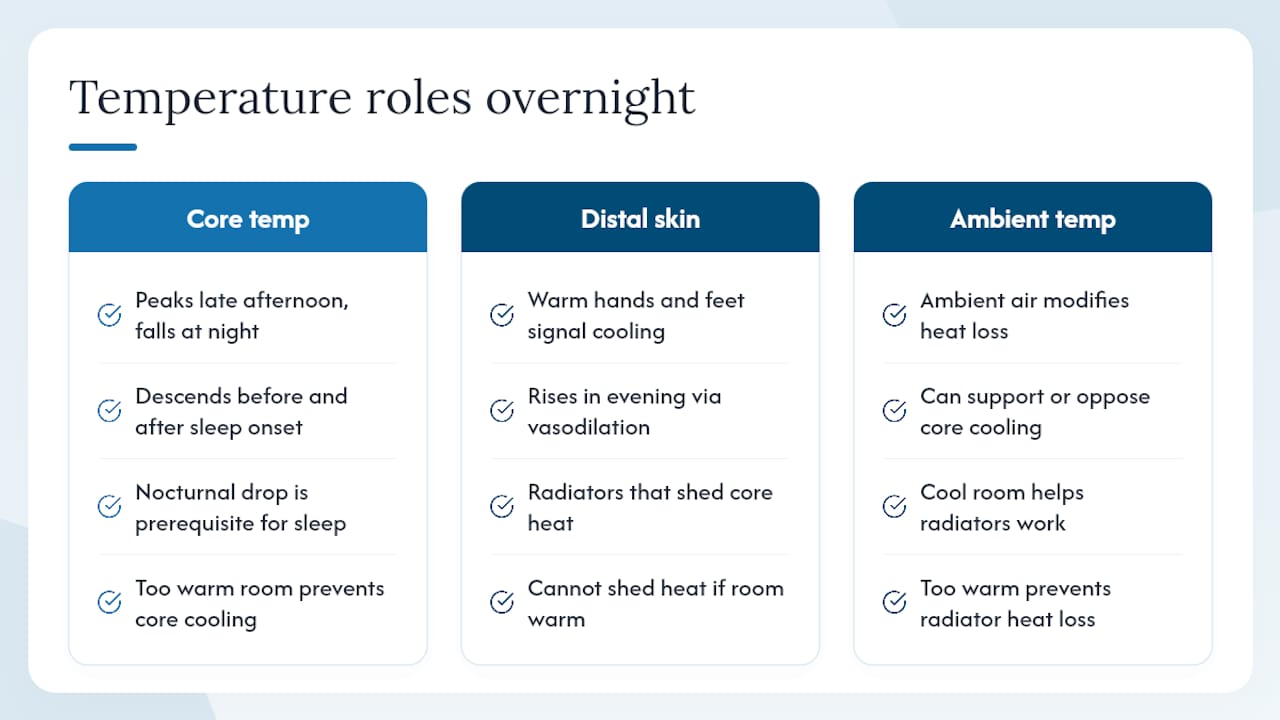
Your core temperature follows a circadian rhythm, peaking in the late afternoon and falling in the hours before and after sleep onset. That nocturnal decline is not incidental; it is a prerequisite. When the core cools, the brain interprets it as a signal to shift into sleep. The mechanism that drives the cooling is distal vasodilation: blood vessels in the hands and feet dilate, routing warm blood to the skin surface where heat can radiate outward. Research on the distal-to-proximal skin temperature gradient shows it predicts sleep onset reliably — warm hands and feet are a sign the body is actively cooling its core.
Think of it as a radiator system. The hands and feet are the radiators; the ambient air is the coolant. If the room is too warm, the radiators cannot shed heat efficiently. If it is too cold and the person is inadequately covered, peripheral vasoconstriction kicks in to protect core warmth, and that same radiator system shuts down, delaying sleep onset from the other direction.
A diagram of this process would show three parallel tracks: (1) the circadian core temperature curve, descending from its afternoon peak through the sleep window and reaching its nadir in the early morning hours; (2) distal skin temperature rising as vasodilation begins in the evening; and (3) ambient temperature as a modifying layer that either supports or opposes the body’s own trajectory.
Sleep stages add another layer of complexity. During non-REM sleep, the body retains some thermoregulatory capacity. During REM, it largely suspends active temperature regulation, making the sleeper essentially poikilothermic (temperature-dependent on the environment) for those periods. That is why a room that feels tolerable at sleep onset can become disruptive during the REM-heavy second half of the night, when the body can no longer compensate for an uncomfortable ambient temperature. For a deeper look at how these stage-specific dynamics play out, the science of body temperature and sleep is worth reading alongside this article.
What heat does to your sleep architecture
Elevated ambient temperature suppresses the core cooling process directly, and the damage shows up in measurable changes to sleep architecture. Heat exposure increases wakefulness, reduces slow-wave sleep, and can blunt REM propensity. Laboratory and experimental evidence confirms this pattern consistently across multiple study designs.
The field-study numbers are striking. A community-based study found sleep was most efficient between 20–25°C; an 8°C increase from 22°C to 30°C was associated with roughly a 10% drop in sleep efficiency and a model-predicted reduction of approximately 60 minutes of total sleep time. A large repeated-measure dataset of 23 million records found that each 10°C increase in ambient temperature was associated with a 20.1% increase in odds of sleep insufficiency and a ~9.67-minute decrease in total sleep time, with deep sleep showing the largest proportional decline.
Humidity compounds every one of these effects. When relative humidity is high, sweat does not evaporate efficiently, so the body’s primary cooling mechanism stalls. Skin temperature rises, vasodilation increases in a futile attempt to shed heat, and the thermal load on the sleeper climbs even if the air temperature reads the same number on the thermometer. A humid 75°F room is physiologically harder to sleep in than a dry 75°F room.
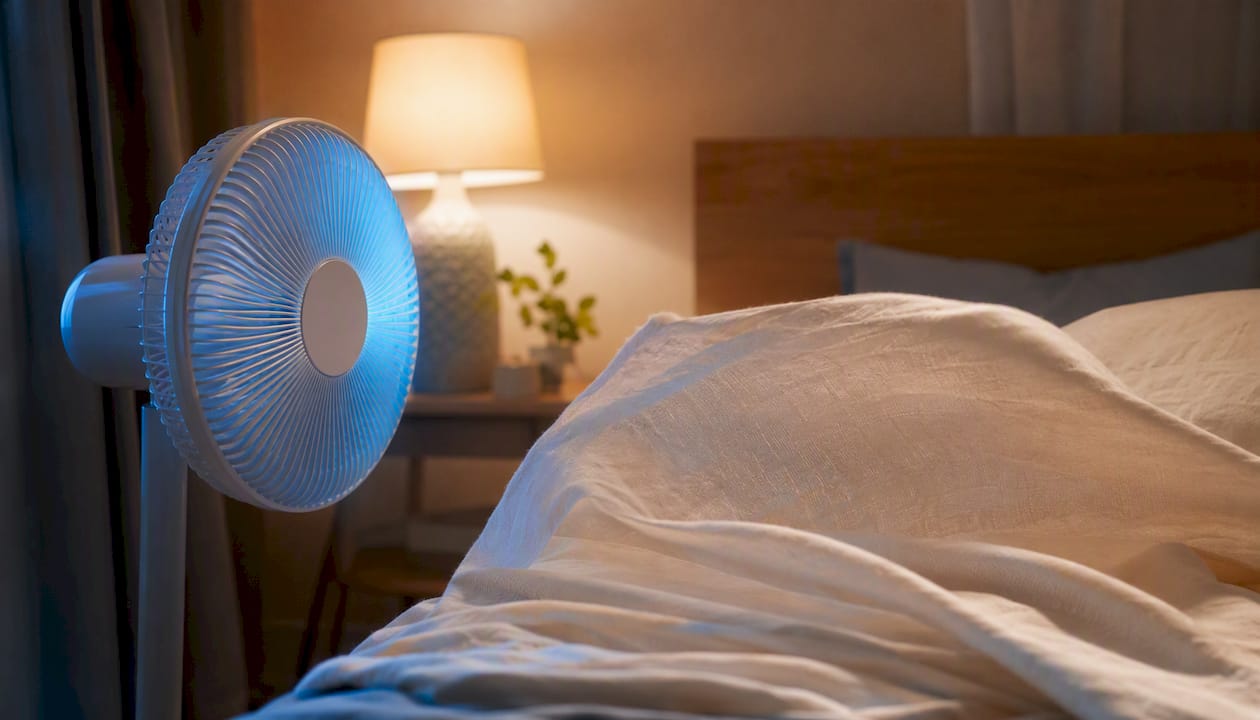
Pro Tip: A small fan directed across the body does double duty: it lowers perceived temperature and accelerates sweat evaporation, addressing both the heat and humidity problem simultaneously.
How cold ambient temperature affects sleep and why bedding matters
Cold is not simply the opposite of heat when it comes to sleep. The relationship is more nuanced, and bedding is the variable that determines whether cold helps or harms.
At moderate cold (say, a room in the low 60s°F / ~16–17°C), the body’s thermoregulatory system can compensate with appropriate bedding, and some people sleep very well in these conditions. The problem arises at extremes or when bedding is inadequate. Peripheral vasoconstriction, the body’s response to cold, narrows the blood vessels in the hands and feet, which is the opposite of the distal vasodilation needed for sleep onset. A person who is genuinely cold at bedtime will often lie awake longer, not because they are uncomfortable in a subjective sense, but because the physiological pathway to sleep is blocked.
The practical fix is layering: breathable, moisture-wicking materials that trap enough warmth to keep distal skin temperature elevated without causing sweating. Wool and certain synthetic blends manage this better than cotton alone in cold conditions. The goal is to keep hands and feet warm enough to vasodilate while keeping the core from overheating under the covers.
There is a less visible risk with cold that deserves a direct mention. Even when sleep stages appear relatively preserved in cold conditions, autonomic nervous system activity can shift, with increased sympathetic tone and changes in heart rate variability. For people with cardiovascular conditions or autonomic dysfunction, sleeping in an excessively cold room carries a real physiological cost that does not show up in a basic sleep-stage readout. If you fall into that category, erring toward the warmer end of the recommended range and using extra bedding is the safer approach.
How ambient temperature interacts with your circadian rhythm
Temperature is not the primary circadian cue — light is. But ambient temperature acts as a secondary signal and a masking factor that can shift or reinforce the body’s internal clock, particularly around sleep onset and wake time.
Controlled laboratory studies show that cyclic ambient temperature changes, specifically cooling before sleep and warming toward wake time, can advance the core temperature nadir and alter REM propensity. In practical terms, a room that cools in the evening and warms slightly in the early morning hours aligns with the body’s own temperature trajectory rather than fighting it.
A timed temperature strategy that works with this research:
- 90 minutes before bed: lower the thermostat to your target sleep temperature (start at 65°F / 18.3°C and adjust from there).
- During sleep: keep the room stable; large temperature swings mid-night increase arousal risk.
- 30–60 minutes before your target wake time: allow the room to warm slightly (2–3°F / 1–2°C). This can ease the transition out of deep sleep and reduce grogginess.
The caveat: these effects are real but modest in magnitude for most people. Temperature timing will not override a severely misaligned circadian rhythm or compensate for chronic sleep deprivation. Think of it as fine-tuning, not a reset.
Pro Tip: Smart thermostats like Ecobee or Nest allow you to program temperature schedules down to 30-minute intervals, making the evening cool-down and pre-wake warm-up automatic rather than something you have to remember.
Who is most affected by bedroom temperature?
Individual differences in temperature sensitivity are large enough that two people sleeping in the same room can have genuinely different optimal temperatures. That is not a preference issue; it reflects real physiological differences.
Older adults lose thermoregulatory efficiency with age. The circadian amplitude of core temperature flattens, distal vasodilation becomes less robust, and the ability to sweat effectively declines. Research on vulnerable groups and adaptation confirms that older adults and people with higher BMI experience larger, clinically meaningful drops in sleep efficiency in warm conditions. For this group, targeted localized cooling (a fan directed at the bed, a cooling mattress topper) is often more effective than relying on whole-room air conditioning alone.
People going through menopause face a specific challenge: vasomotor symptoms (hot flashes and night sweats) generate sudden, intense heat episodes that can wake a person from any sleep stage. The ambient temperature that felt fine at sleep onset may feel suffocating 90 minutes later. Layered, easily removable bedding and moisture-wicking sleepwear address this better than a single thermostat setting.
Higher-BMI individuals have more insulating tissue and generate more metabolic heat per unit of surface area, which means they tend to run warmer and benefit from cooler ambient temperatures and more breathable bedding.
Couples with different preferences face a coordination problem that a single thermostat cannot solve. The practical answer is dual-zone bedding (separate comforters rather than a shared one) combined with a room temperature that splits the difference, then individual adjustments at the bed level.
For households where air conditioning is not accessible or affordable, targeted tools like cooling sleep masks, breathable toppers, and fans represent a faster and more affordable adaptation than whole-house cooling. A safety note: in extreme heat events, vulnerable individuals (older adults, young children, people with cardiovascular or respiratory conditions) face genuine health risks beyond poor sleep. In those situations, access to a cooled space is a health priority, not a comfort preference.
What does the evidence say about the ideal bedroom temperature?
The most commonly cited consumer recommendation is a cool bedroom temperature, often suggested in older laboratory studies conducted under controlled conditions with young, healthy adults in minimal bedding. It is a reasonable starting point, but it is not a universal prescription.
More recent field evidence, including the community-based study cited earlier, points to 20–25°C (68–77°F) as the range where sleep efficiency peaks in real-world conditions with normal bedding. The apparent conflict between these two ranges is largely explained by context: the older lab range assumes minimal bedding and a controlled environment; the field range reflects how people actually sleep, with blankets, pajamas, and variable humidity.
Reconciling them is straightforward:
- If you sleep with light or no bedding in a controlled environment, the 60–67°F range is appropriate.
- If you sleep with standard bedding (a sheet and a light comforter), 68–72°F (20–22°C) is a more realistic target.
- Adjust upward or downward based on your personal response over two weeks of testing.
On humidity: a moderate range for bedroom relative humidity is recommended. Dry air below this range can irritate airways and skin, causing micro-arousals, while higher humidity impairs evaporative cooling and increases thermal load on the sleeper even at moderate temperatures. A basic hygrometer (under $15 at most hardware stores) tells you where you stand.
Practical steps to optimize your sleep environment
The most impactful actions, in order: control ambient temperature first, then optimize your bed microclimate, then adjust your pre-sleep routine. Everything else is fine-tuning.
-
Set a thermostat schedule. Program your thermostat to drop to your target sleep temperature 60–90 minutes before bed. If you do not have a programmable thermostat, a simple box fan in the window can drop a room’s temperature by several degrees in 20–30 minutes on cooler evenings.
-
Use a fan strategically. A ceiling fan or box fan creates airflow that accelerates evaporative cooling. In summer, position a box fan to draw cooler outdoor air in at night (if outdoor temps drop below your target). In winter, reverse a ceiling fan to push warm air down from the ceiling.
-
Swap bedding by season. A single comforter year-round is a compromise that serves no season well. A lightweight, breathable quilt for summer and a heavier layered system for winter lets you match thermal resistance to ambient conditions.
-
Choose sleepwear that wicks moisture. Moisture-wicking fabrics (merino wool, certain polyester blends, bamboo) keep sweat off the skin and support evaporative cooling. Cotton holds moisture against the skin, which feels cold and clammy once you stop sweating.
-
Take a warm shower or bath 60–90 minutes before bed. This sounds counterintuitive, but it works by triggering distal vasodilation: the warm water heats the skin surface, the body responds by dilating peripheral vessels, and when you step out into a cooler room, heat radiates away rapidly, accelerating the core temperature drop that triggers sleep onset.
-
Use a cooling or warming mattress topper. Gel-infused foam, phase-change materials, and water-cooled toppers address the bed microclimate directly, which is where most of your body’s heat exchange actually happens during sleep.
-
Address humidity separately from temperature. A portable dehumidifier or a window AC unit with a humidity control setting handles both simultaneously in summer.
Safety note: Avoid setting a room below 60°F (15.5°C) for older adults, infants, or anyone with cardiovascular or respiratory conditions. At the other extreme, sleeping in a room above 80°F (26.7°C) without cooling is a genuine health risk for vulnerable individuals during heat events. If you are managing a chronic condition and experiencing persistent sleep disruption tied to temperature, a conversation with a physician is warranted.
How to measure your sleep environment and test what works for you
Measuring before and after is the fastest way to find what actually works for your body, rather than guessing based on population averages.
The two-week A/B protocol:
Week one: set your bedroom to Temperature A (start with 68°F / 20°C if you have no baseline). Track nightly: time to fall asleep, number of awakenings, how rested you feel on a 1–10 scale in the morning, and total time in bed. A simple sleep diary works fine; you do not need a wearable.
Week two: shift to Temperature B (try 72°F / 22°C, or 64°F / 18°C if you suspect you sleep hot). Track the same metrics. At the end of two weeks, compare the averages. A difference of 30+ minutes in total sleep time, or a consistent 2-point shift in your morning restfulness score, is a meaningful signal worth acting on.
What to measure with:
- Room thermometer and hygrometer combo: devices like the Govee or Inkbird models give you temperature and humidity simultaneously for under $20. Place it at mattress height, not on the ceiling or near a vent.
- Wearable sleep trackers: devices like the Oura Ring, Fitbit, or Garmin watches estimate sleep stages and give you a sleep score that correlates reasonably well with objective measures in research settings. They are not clinical-grade, but they are sensitive enough to detect meaningful changes across weeks.
- Sleep diary (no tech required): for readers who prefer low-tech, a sleep tracking approach without wearables is a practical alternative that captures subjective quality and timing reliably.
Interpret results conservatively. Night-to-night variability is high; one bad night proves nothing. Look for consistent patterns across five or more nights at each temperature before drawing conclusions.
Building a personalized thermal sleep plan
A single room temperature set for everyone in the household is rarely the right answer. Personalization, using modular bedding and small incremental experiments, almost always outperforms a fixed whole-room setpoint.
A one-week personalization plan:
- Day 1–2: establish your baseline. Sleep at your current default temperature with your current bedding. Note morning restfulness score and any nighttime awakenings.
- Day 3–4: add or remove one bedding layer (swap a heavy comforter for a lighter quilt, or add a blanket). Keep room temperature the same. Note changes.
- Day 5–6: adjust room temperature by 2°F in the direction your baseline suggests (cooler if you woke sweating, warmer if you woke cold). Keep the new bedding configuration.
- Day 7: assess. If morning scores improved, hold the new configuration for another week before making another change. If they did not, reverse one variable at a time.
Product categories that support this approach:
- Breathable quilts and lightweight down-alternative comforters for warm sleepers
- Cooling mattress toppers (gel-infused foam or phase-change material) for people who run hot at the bed surface
- Layered comforter systems (duvet insert plus a separate coverlet) for couples or people with variable needs
- Moisture-wicking sleep masks that do not trap heat around the face
- White noise machines, which address the acoustic environment but also help mask the sound of fans or AC units
- Portable fans with multiple speed settings for airflow control without overcooling
The goal is to create a microclimate around the sleeper rather than forcing the entire room to an extreme. A cooler room with a warmer, breathable bedding layer often works better than a very cold room with heavy insulation, because the former supports distal vasodilation while the latter can trigger vasoconstriction. For more on designing your sleep environment from the ground up, that guide covers room layout, light, and sound alongside temperature.
What the research actually shows: evidence and its limits
The overall evidence base is strong on direction and moderate on precision. Laboratory studies establish the causal mechanism clearly: heat suppresses SWS and REM, increases wakefulness, and disrupts the core cooling process. Field studies confirm the association at population scale, though effect sizes vary considerably by individual and setting.
| Study / Source | Design | Key Finding |
|---|---|---|
| Obradovich et al., Science Advances | Large survey dataset | +1°C nighttime anomaly linked to an increase in sleep insufficiency |
| Zheng et al., Nature Communications | 23 million repeated-measure records | Per 10°C increase: +20.1% odds of sleep insufficiency; ~9.67-minute reduction in total sleep time; deep sleep most affected |
| Okamoto-Mizuno & Mizuno, PMC | Lab review | Heat increases wakefulness, suppresses SWS/REM; humidity compounds thermal load |
| Ngo et al., PMC | Community field study (older adults) | Optimal range 20–25°C; ~10% drop in sleep efficiency from 22°C to 30°C; ~60-minute TST reduction |
| Systematic review, Sleep Medicine Reviews | Systematic review | Consistent negative relationship between heat and sleep quality worldwide; effects strongest in vulnerable groups and warm regions |
Methodological limitations worth knowing:
- Most laboratory studies use young, healthy adults in controlled conditions; results may not generalize to older adults, people with chronic conditions, or real-world bedrooms.
- Field studies rely heavily on self-reported sleep quality or consumer wearables, which are less precise than polysomnography.
- Between-subject variability is large enough that population averages can obscure the fact that some individuals show minimal response to temperature changes while others show dramatic ones.
- Most studies examine heat effects; cold-exposure sleep research is thinner, particularly in real-world settings.
- The interaction between temperature, humidity, bedding type, and individual physiology is rarely studied simultaneously, leaving gaps in practical guidance.
For a broader look at how sleep architecture responds to environmental variables, that resource covers the stage-by-stage picture in more detail.
A perspective on personalization over prescription
The case for personalization over a single temperature rule
The conventional advice to “keep your bedroom at 65°F” is not wrong, but it is incomplete in a way that matters. That number comes from controlled lab studies with young adults in minimal bedding, and it gets repeated so often that it has taken on the authority of a universal prescription. It is not one.
What the evidence actually shows is a range, not a point, and a range that shifts based on age, body composition, hormonal status, bedding, humidity, and whether you share a bed. The most honest reading of the research is that the 60–67°F consumer rule and the 20–25°C field-evidence range are both correct in their respective contexts, and the gap between them is explained almost entirely by bedding and real-world conditions.
The deeper issue is that most people never test their own response. They pick a thermostat setting based on habit or a number they read somewhere, and they never run even a two-week experiment to see if a 3°F shift changes how they feel in the morning.
There is also a tendency to treat a cold room as the goal, full stop. Cold rooms are not inherently better. Sleep onset requires distal vasodilation, which requires warm hands and feet. A room that is too cold without adequate bedding blocks that mechanism just as effectively as a room that is too warm. The goal is homeostasis: an ambient temperature and bedding combination that lets the body execute its own cooling process without interference from either direction.
Sleep tools that support your thermal comfort
Getting your sleep temperature right is one thing. Having the right tools to maintain it consistently is another. Evergreenbliss carries a range of sleep accessories and personal wellness gadgets designed to help you build the kind of modular sleep environment the research points toward, without requiring a full bedroom renovation.

From breathable sleep masks and white noise machines to recovery tools that support relaxation before bed, the collection is built around the idea that small, targeted adjustments at the bed level often outperform whole-room solutions. Individual results vary, and no single product replaces the two-week testing protocol described earlier. But having the right categories available, cooling accessories, layered bedding options, airflow tools, makes the personalization process faster and more precise.
Browse the wellness and sleep accessories collection to find tools that match the strategies covered here, or visit Evergreenbliss for the full range of personal care and recovery products.
Sources
The studies below are the primary scientific sources cited in this article. Each represents a different tier of evidence, from large-scale field data to controlled laboratory reviews.
- Nighttime Ambient Temperature and Sleep in Community-Dwelling Older Adults - PMC
- Effects of thermal environment on sleep and circadian rhythm - PMC
- Nighttime temperature and human sleep loss in a changing climate | Science Advances
- Climate warming may undermine sleep duration and quality in repeated-measure study of 23 million records | Nature Communications
- A systematic review of ambient heat and sleep in a warming climate
This article is general information, not a substitute for advice from a qualified doctor. Consult a qualified healthcare professional about your own circumstances before acting on anything here.