Deep sleep, clinically called slow-wave sleep or N3, is the most physically restorative phase of your sleep cycle. It drives tissue repair, immune function, and memory consolidation. The good news: you can improve deep sleep quality naturally through targeted lifestyle changes that work faster than most people expect. Natural lifestyle changes can raise deep sleep duration by 40–80% within 4–6 weeks when you stack the right interventions. Tools like the Oura Ring track your N3 progress, magnesium glycinate supports sleep physiology, and a consistent schedule does more than any supplement alone. This guide covers exactly what works, in what order, and why.
How does bedroom temperature affect deep sleep quality?
Temperature is the most underrated lever for deep sleep. Your body must drop its core temperature to initiate slow-wave sleep, and a room that stays too warm blocks that process entirely. Sleeping hot is one of the most common hidden barriers to deep sleep, even in people who take supplements religiously.
The target range is 65–67°F (18–19°C). Keeping your bedroom consistently in that range can increase deep sleep by 13–17%. That is a meaningful gain from a zero-cost change. A smart thermostat like the Nest or Ecobee makes this automatic, but a basic fan and lighter bedding work just as well.
Here is what to adjust in your sleep environment:
- Set your thermostat to 65–67°F before bed, not just at bedtime
- Switch to breathable cotton or bamboo sheets instead of synthetic blends
- Wear minimal or loose clothing to allow skin-level heat release
- Use a fan for airflow even if the room is already cool
- Avoid intense exercise within 3 hours of bed since it raises core temperature for hours
Pro Tip: If you share a bed with a partner who runs hot, a dual-zone mattress pad like the ChiliSleep OOLER lets each person control their side independently.
Heavy bedding and late workouts are the two most common culprits when people report poor sleep despite doing “everything right.” Fix the temperature first before adding any supplement or device.
What role do consistent sleep and wake times play in better sleep?
Your circadian rhythm is controlled by the suprachiasmatic nucleus, a cluster of neurons in the hypothalamus that syncs your body clock to light and behavioral cues. When your wake time varies by more than 30 minutes day to day, that clock drifts, and deep sleep timing shifts with it.
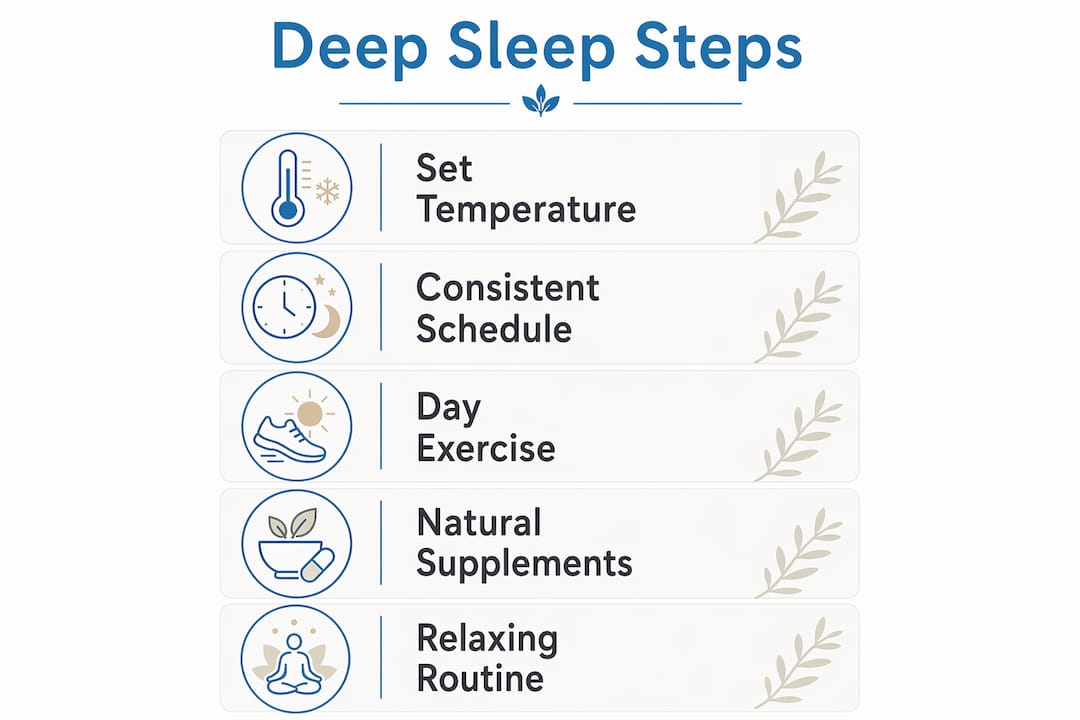
Consistent wake times alone can add approximately 22 minutes of N3 sleep per night. That is more than most supplements deliver on their own. The mechanism is simple: a fixed wake time builds sleep pressure steadily across the day, so your body enters deep sleep faster and stays there longer.
Practical steps to lock in your schedule:
- Set a single alarm for the same time every day, including weekends
- Resist sleeping in more than 30 minutes on days off, even after poor nights
- Use morning light exposure (10–15 minutes outside) to reinforce your wake signal
- Shift bedtime gradually by 15 minutes per night if you need to move it earlier
Pro Tip: The weekend is where most sleep schedules fall apart. Treat Saturday and Sunday wake times as non-negotiable for at least 3 weeks. The payoff in weeknight deep sleep is significant.
Circadian consistency is more impactful than supplements combined, according to deep sleep research. That finding flips the usual priority order most people follow. Most people reach for melatonin before they fix their schedule. The schedule should come first.
How can daytime aerobic exercise improve deep sleep naturally?
Exercise increases adenosine, the chemical that drives sleep pressure, and it strengthens circadian rhythm signals. Both effects directly increase the depth and duration of slow-wave sleep. The relationship is dose-dependent and well-documented.

150 minutes per week of moderate aerobic exercise increases deep sleep by 8–10 minutes on average. Previously sedentary individuals see the largest gains, sometimes 30–40 additional minutes of N3 after 2–6 weeks. That is a dramatic improvement from a habit most people already know they should build.
Follow this sequence to get the most from exercise for sleep:
- Choose your activity. Brisk walking, jogging, cycling, and swimming all qualify. Resistance training also helps, though aerobic work produces the strongest N3 effect.
- Time it correctly. Finish moderate exercise at least 4–6 hours before bed. Late workouts raise cortisol and core temperature, both of which suppress deep sleep.
- Start with 30 minutes, five days a week. This hits the 150-minute weekly target without requiring long sessions.
- Prioritize morning or midday slots. Morning exercise reinforces your circadian wake signal and compounds the sleep benefit.
- Track your N3 response. Devices like the Oura Ring or Garmin smartwatches show N3 duration so you can see the direct effect of exercise timing on your sleep.
The 4–6 hour window before bed is the most commonly ignored detail. People who exercise at 9 p.m. and then wonder why they sleep poorly are experiencing a timing problem, not a fitness problem. Shift the workout earlier and the sleep usually follows.
What natural sleep aids and supplements can enhance deep sleep?
Natural sleep aids work differently from prescription sedatives. They regulate circadian rhythm and reduce physiological stress rather than forcing unconsciousness. That distinction matters because natural supplements primarily support your body’s own sleep systems rather than overriding them.
The most evidence-backed options are:
| Supplement | Dose | Mechanism | Effect on Deep Sleep |
|---|---|---|---|
| Magnesium glycinate | 400 mg before bed | Relaxes nervous system, enhances CNS penetration | Adds ~18 minutes of N3 when combined with other habits |
| Glycine | 3 g before bed | Lowers core body temperature | Improves sleep quality and reduces fatigue |
| Tart cherry juice | 8–16 oz daily | Boosts natural melatonin production | Increases deep sleep by up to 90 minutes on average |
| Melatonin | 0.5–1 mg at dusk | Signals circadian onset, not sedation | Improves sleep timing, not depth directly |
Alcohol deserves special attention here because many people use it as a sleep aid. It is not one. Eliminating alcohol within 4 hours of bedtime restores a net 15–25% loss in deep sleep caused by pre-bed drinking. Improvements appear after the first alcohol-free night and fully establish within 3–5 nights. That is one of the fastest wins available.
Valerian root is often marketed as a natural sedative, but the evidence for direct deep sleep improvement is weaker than for magnesium or glycine. Use it cautiously and prioritize the options in the table above. For a deeper look at how these compounds interact with sleep physiology, the science behind sleep supplements explains the mechanisms clearly.
Pro Tip: Take magnesium glycinate and glycine together 30–45 minutes before bed. Both lower core temperature through different pathways, and the combined effect is greater than either alone.
How to design a nightly routine that maximizes deep sleep
The first 3–4 hours of the night contain the highest concentration of slow-wave sleep. Protecting that window by going to bed earlier and reducing disruptions yields faster improvement than supplements alone. Your evening routine is the delivery mechanism for every other intervention in this guide.
Here is a step-by-step routine that works:
- Cut screens 1–2 hours before bed. Blue light exposure suppresses melatonin and delays sleep onset. Use blue-light blocking glasses or switch to amber lighting if you cannot avoid screens entirely.
- Take a warm bath or shower 60–90 minutes before bed. A meta-analysis found a 36% reduction in sleep latency from this habit. The warm water triggers vasodilation, and the rapid cooling afterward signals your brain that sleep time is near.
- Practice a relaxation method for 10–15 minutes. Breathing exercises, meditation, and journaling all reduce cortisol and improve sleep efficiency. Apps like Calm or Insight Timer guide structured sessions.
- Set your bedroom conditions. Blackout curtains, a white noise machine, and a room temperature of 65–67°F create the physical environment your body needs.
- Keep your bedtime consistent. Pair it with your fixed wake time to protect the early-night deep sleep window every night.
Stress and elevated cortisol directly reduce deep sleep duration and increase nighttime awakenings. The relaxation step is not optional. It is the bridge between a stressful day and a restorative night. Understanding what non-REM sleep does for your body makes it easier to take these steps seriously.
Pro Tip: Journal for 5 minutes before bed by writing tomorrow’s to-do list. Research shows this offloads mental preoccupation and shortens the time it takes to fall asleep.
Key takeaways
Deep sleep improves fastest when you combine temperature control, schedule consistency, and targeted supplements rather than relying on any single change.
| Point | Details |
|---|---|
| Temperature is the first fix | Keep your bedroom at 65–67°F to trigger the core cooling your body needs for slow-wave sleep. |
| Consistent wake times beat supplements | A fixed daily wake time adds ~22 minutes of N3 sleep, more than most supplements deliver alone. |
| Exercise timing matters as much as type | Finish aerobic workouts 4–6 hours before bed to avoid cortisol and heat disrupting deep sleep. |
| Stack supplements strategically | Magnesium glycinate (400 mg) plus glycine (3 g) before bed adds measurable N3 time within days. |
| Protect the first 3–4 hours | Going to bed earlier preserves your natural deep sleep window and accelerates every other gain. |
What i’ve learned from tracking deep sleep for years
Most people approach sleep improvement the way they approach dieting: they pick one change, expect fast results, and quit when nothing dramatic happens in week one. Deep sleep does not work that way.
The research is clear that stacking interventions produces additive effects. Cooling alone adds 13 minutes. Consistent wake times add 22 minutes. Magnesium adds 18 minutes. Combined, those three changes can nearly double your N3 time. But each one feels modest in isolation, which is why most people underestimate them.
The other misconception I see constantly is that natural sleep aids should feel like sedatives. They should not. Magnesium glycinate does not knock you out. Tart cherry juice does not make you drowsy. They work quietly, over days, by supporting the systems your body already has. If you are expecting a dramatic effect the first night, you will abandon something that would have worked by week two.
There is no direct switch for deep sleep. It results from protecting your circadian rhythm and building the right daytime habits, not from anything you do in the last 30 minutes before bed. The evening routine matters, but it is the final step in a full-day process. Track your N3 time with an Oura Ring or similar device for at least 4 weeks before judging whether a change is working. Patience and consistency are the actual active ingredients.
— Cadence
Build on your natural sleep habits with Evergreenbliss
The habits in this guide work. They work even better when your tools match your goals.

Evergreenbliss carries a curated selection of sleep and relaxation aids designed to complement the natural methods covered here, from neck massagers that reduce pre-bed tension to stress-relief sleep supplements formulated to support your body’s own sleep systems. If you are building a nightly routine and want tools that actually fit into it, the mental wellness collection at Evergreenbliss is worth exploring. Free shipping, easy returns, and products chosen for real results.
FAQ
What is the fastest way to increase deep sleep naturally?
Combining a consistent wake time with a bedroom temperature of 65–67°F produces measurable N3 gains within the first week. Adding magnesium glycinate (400 mg) before bed accelerates the effect further.
How long does it take to see results from natural deep sleep methods?
Most people notice improvement within 1–2 weeks of consistent changes. The full benefit of stacked interventions typically appears within 4–6 weeks, with deep sleep increasing by 40–80% in some cases.
Does melatonin directly improve deep sleep quality?
Melatonin regulates the timing of sleep onset rather than increasing deep sleep depth directly. It works best for circadian rhythm correction, not as a substitute for lifestyle-based deep sleep techniques.
Can alcohol ruin deep sleep even in small amounts?
Yes. Alcohol consumed within 4 hours of bedtime causes a 15–25% net loss in deep sleep. The disruption is measurable even from moderate intake, and recovery begins after the first alcohol-free night.
How do i know if i am getting enough deep sleep?
Adults typically need 1.5–2 hours of N3 sleep per night, representing roughly 20–25% of total sleep. Wearables like the Oura Ring or Garmin devices track N3 duration and give you a reliable baseline to measure progress against.
Recommended
- How to Improve Breathing During Sleep Tonight | Evergreen Bliss
- What Does Non-REM Sleep Do for Your Health? | Evergreen Bliss
- Top 3 ShopHappyology.com Sleep Alternatives 2026 | Evergreen Bliss
- Why Sleep Supplements Work: Science and Safe Use | Evergreen Bliss
Sources and further reading
- Brain Basics: Understanding Sleep – National Institute of Neurological Disorders and Stroke (NIH)
- Mastering Sleep Hygiene: Your Path to Quality Sleep – Sleep Foundation
- Sleep Deprivation and Deficiency - How Sleep Affects Your Health – National Heart, Lung, and Blood Institute (NIH)