Non-wearable sleep tracking is defined as monitoring your sleep patterns using manual sleep journals, smartphone sensors, or AI-powered apps, without any device attached to your body. You can track sleep cycles without wearables just as effectively as with a fitness band, and in some cases more accurately for clinical purposes. Methods like the Consensus Sleep Diary and sound-based AI apps trained on clinical polysomnography (PSG) data give you real, usable data about your sleep. The standard industry term for this approach is “passive sleep monitoring,” and it covers everything from a paper log on your nightstand to an app that listens while you sleep. Both approaches are cost-effective and accessible, requiring little more than a pen or a smartphone.
What tools and methods let you track sleep cycles without wearables?
Two primary methods exist for non-wearable sleep cycle tracking: paper-based sleep journals and smartphone AI apps. Each captures different types of data, and together they give you a fuller picture than either one alone.
Sleep journals and sleep diaries
A sleep journal, also called a sleep diary, is a daily written record of your sleep behavior. You log fields like bedtime, wake time, estimated time to fall asleep, number of nighttime awakenings, and a subjective quality rating. The Consensus Sleep Diary is the most widely used clinical template. Paper sleep logs are the diagnostic backbone of Cognitive Behavioral Therapy for Insomnia (CBT-I), capturing subjective measures that no sensor can replicate. That includes your perceived sleep latency, how refreshed you feel, and contextual notes like stress or caffeine intake.
Smartphone apps using sensors and AI
Smartphone apps use your phone’s built-in accelerometer and microphone to detect movement and sound during the night. The AI models inside these apps have been trained on over 7,000 clinical PSG nights, giving them a validated foundation for estimating sleep stages. They can infer light sleep, deep sleep, and REM cycles from breathing patterns, snoring, and body movement. Most apps run passively after a one-time setup, so you do not interact with them during the night.
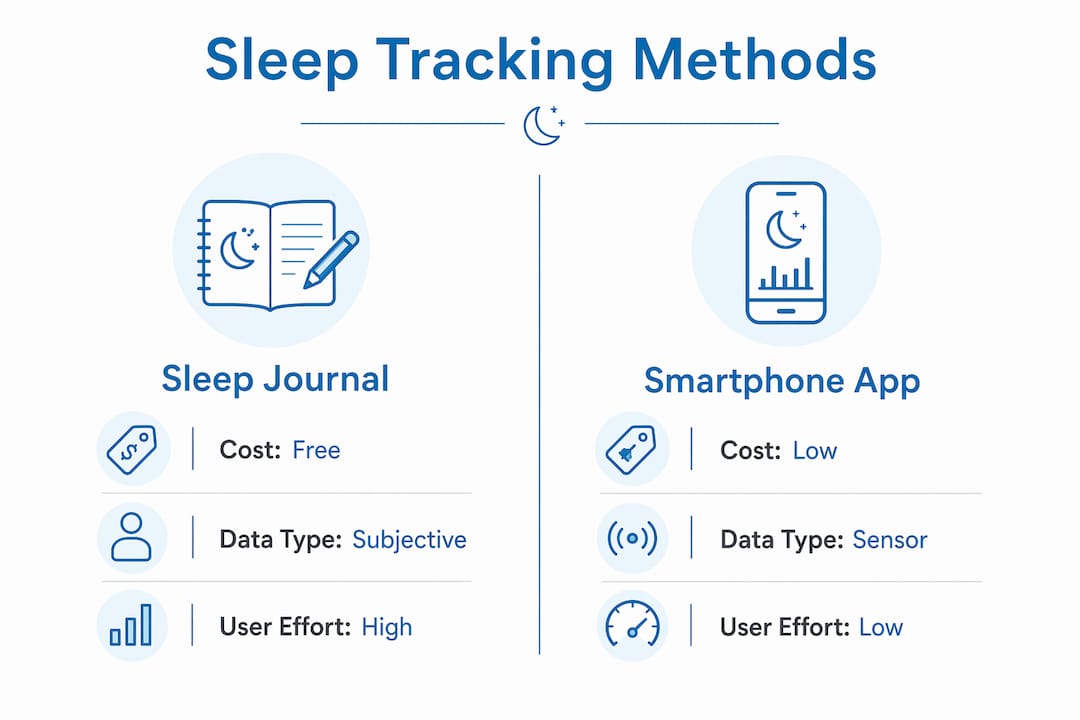
Comparing the two approaches
| Feature | Sleep journal | Smartphone app |
|---|---|---|
| Cost | Free or near-free | Free to low-cost |
| Data type | Subjective (perceived quality) | Objective (sensor-based) |
| Clinical use | CBT-I standard tool | Supplementary tracking |
| Setup effort | Daily manual entry | One-time setup |
| Context capture | High (mood, diet, stress) | Low |
Pro Tip: Use both methods together. The journal captures why you slept poorly; the app captures what happened while you slept. Combined, they give you the clearest picture of your sleep habits.
How to keep a sleep journal that actually works
A sleep journal only delivers useful data if you fill it out consistently and correctly. Inconsistent entries produce misleading patterns, which can lead you to wrong conclusions about your sleep.
-
Choose your format. Use the Consensus Sleep Diary template or a simple notebook with fixed fields. The fields that matter most are: bedtime, estimated sleep onset time, number of awakenings, total sleep time, wake time, and a 1–5 quality rating.
-
Fill it in every morning. Morning diary entries preserve memory accuracy and prevent the anxiety that comes from checking the clock during the night. Write your estimates, not precise times.
-
Record daytime factors. Note caffeine intake, exercise, stress levels, and any naps. These factors directly affect your sleep hygiene and explain patterns in your nightly data.
-
Track for at least two weeks. CBT-I clinical protocols require a minimum of two weeks of consistent sleep log data to identify reliable patterns. One week is rarely enough to spot trends.
-
Review weekly, not nightly. Look at your data once a week. Reviewing it every morning creates anxiety and shifts your focus from resting to monitoring.
Pro Tip: Never write exact clock times in your journal. Estimates like “about 30 minutes to fall asleep” are more accurate than precise times and reduce the urge to watch the clock at night.
What your journal data tells you
Your sleep journal reveals three key metrics that matter clinically. Sleep latency (how long it takes to fall asleep) signals anxiety or poor sleep pressure. Frequent awakenings point to sleep fragmentation, which affects deep sleep quality. Your morning refreshment rating is the single most predictive measure of how well you actually slept. Subjective sleep quality predicts daytime functioning more accurately than consumer wearable sensor data. That means your journal’s “felt rested” rating is clinically more meaningful than a wearable’s sleep stage graph.
How do AI-powered smartphone apps track sleep cycles without wearables?
Smartphone apps use two sensors you already have: the accelerometer and the microphone. The accelerometer detects movement in the mattress when your phone rests face-down near your pillow. The microphone picks up breathing sounds, snoring, and sleep talking. AI models process these signals together to estimate which sleep stage you are in throughout the night.
The accuracy of these apps comes from their training data. AI sound models trained on thousands of clinical PSG nights can recognize the acoustic signatures of light sleep, deep sleep, and REM. That training is what separates a validated app from a simple alarm clock with a motion sensor. The result is a sleep graph you can review each morning without wearing anything to bed.
What these apps can and cannot detect
- Can detect: Sleep onset time, approximate sleep stages, snoring frequency, sleep duration, and wake events
- Can detect: Patterns across multiple nights, such as consistently poor sleep on weekdays
- Cannot detect: Precise REM duration with clinical accuracy
- Cannot detect: Context like stress, diet, or room temperature
- Cannot detect: Sleep disorders with diagnostic certainty (a doctor’s evaluation is required for that)
Privacy is a real concern with microphone-based apps. The best apps process audio data locally on your device, meaning your sleep sounds never leave your phone. Check your app’s privacy policy before enabling microphone access.
Pro Tip: Place your phone face-down on the mattress, not on a nightstand. The accelerometer needs to detect mattress vibrations from your breathing and movement to work correctly.
Apps designed for passive sleep tracking work best with minimal interaction after setup. Checking your data obsessively each morning defeats the purpose and can increase sleep anxiety.
Common mistakes when tracking sleep without wearables
The biggest mistake people make is treating sleep data like a performance score. Sleep tracking is a tool for awareness, not a competition. When you start optimizing for better numbers instead of better rest, you create a condition called “orthosomnia,” which is anxiety about sleep caused by obsessive monitoring. Apps that require minimal interaction after setup reduce this risk significantly.
Other common errors include:
- Skipping entries. Missing even three days in a two-week journal period makes pattern analysis unreliable.
- Writing exact times. Precise clock times encourage clock-watching at night, which worsens insomnia.
- Ignoring daytime data. Sleep quality is shaped by what happens during the day. Leaving out caffeine, exercise, and stress data removes half the picture.
- Expecting instant results. Two weeks is the minimum for meaningful data. Conclusions drawn from three or four nights are almost always wrong.
- Relying on one method alone. An app without a journal misses context. A journal without an app misses objective patterns.
“Sleep journals not only record data but are therapeutic by encouraging reflection, which is essential for insomnia treatment progress. Clinicians consider diaries essential for diagnostic insights beyond what AI or sensors detect.”
If your journal consistently shows sleep latency over 30 minutes, more than two awakenings per night, or a refreshment rating below 3 out of 5 for two or more weeks, seek a professional sleep evaluation. Tracking data is most valuable when it prompts the right next step, including knowing when self-monitoring is not enough. Reducing nighttime anxiety is often the first intervention a clinician will recommend alongside structured tracking.
Key takeaways
Monitoring your sleep patterns without wearables works best when you combine a consistent morning sleep journal with a passive AI smartphone app, using at least two weeks of data before drawing conclusions.
| Point | Details |
|---|---|
| Use both methods together | A sleep journal captures context; an app captures sensor data. Both together give the clearest picture. |
| Fill your journal every morning | Morning entries preserve accuracy and prevent clock-watching anxiety during the night. |
| Track for at least two weeks | CBT-I protocols require two weeks of data to identify reliable sleep patterns. |
| Subjective quality matters most | Your “felt rested” rating predicts daytime functioning better than wearable sleep stage estimates. |
| Avoid obsessive monitoring | Set-and-forget apps and weekly data reviews reduce orthosomnia risk and support consistent tracking. |
What I’ve learned from years of watching people track their sleep
The most common mistake I see is treating sleep tracking as a diagnostic tool rather than a reflection tool. People download an app, check their sleep graph every morning, and immediately start worrying about their REM percentage. That worry is often more damaging than whatever the graph shows.
The research backs this up. Subjective measures like how refreshed you feel consistently outperform wearable sensor data for predicting how you will function during the day. A wearable might tell you that you got 90 minutes of deep sleep. Your journal tells you that you woke up exhausted after a stressful evening. The journal is almost always more clinically useful.
My honest recommendation is to start with the journal and add the app only after you have two weeks of written data. The journal forces you to pay attention to the right things: your bedtime routine, your stress levels, your caffeine habits. Understanding why REM sleep matters becomes much more meaningful once you have two weeks of your own data to look at.
The goal is not perfect sleep data. The goal is better sleep. Those are not the same thing. Use these tools to build awareness, not to chase numbers.
— Cadence
Sleep better with Evergreenbliss
Tracking your sleep is the first step. Supporting better rest is the next one.

Evergreenbliss carries a curated range of sleep and relaxation aids designed to complement the habits you build through sleep journaling and passive tracking. From sleep supplements to relaxation tools, each product targets the conditions that make restful sleep possible. If your journal data points to stress or tension as a recurring factor, the mental wellness collection offers targeted options for winding down before bed. Free shipping, easy returns, and a straightforward checkout make it simple to try what works for you.
FAQ
What is the most accurate way to track sleep without a wearable?
Combining a morning sleep journal with a passive AI smartphone app gives the most complete picture. The journal captures subjective quality and context; the app captures movement and sound patterns across the night.
How long should I keep a sleep journal before seeing results?
Track for at least two weeks. CBT-I clinical protocols set two weeks as the minimum baseline for identifying reliable sleep patterns and making informed adjustments.
Can a smartphone app really detect sleep stages without a wearable?
Yes, with limitations. Apps trained on clinical PSG data can estimate light, deep, and REM sleep from microphone and accelerometer signals. They are not clinically diagnostic but are accurate enough for personal pattern tracking.
What is orthosomnia and how do I avoid it?
Orthosomnia is sleep anxiety caused by obsessive monitoring of sleep data. Avoid it by reviewing your data weekly rather than daily, and by choosing apps that require minimal interaction after the initial setup.
When should I see a doctor instead of tracking sleep myself?
Seek a professional evaluation if your journal shows sleep latency over 30 minutes, more than two awakenings per night, or consistently low refreshment ratings for two or more weeks.
Recommended
- Improve Deep Sleep Quality Naturally in 2026 | Evergreen Bliss
- What Is Slow Wave Sleep and Why It Matters | Evergreen Bliss
- Use White Noise for Better Sleep Tonight | Evergreen Bliss
- Wireless Bluetooth Sleep Mask - Enjoy Music While You Rest | Evergreen Bliss
Sources and further reading
- Brain Basics: Understanding Sleep – National Institute of Neurological Disorders and Stroke (NIH)
- New Research Evaluates Accuracy of Sleep Trackers – Sleep Foundation