Yes, self-massage is a reasonable first move for most sciatica flare-ups. Start with a controlled piriformis release using a tennis ball, staying within a 0 to 3 out of 10 pressure scale, and pair it with gentle movement rather than rest. Stop immediately for new leg weakness, numbness in the saddle area, or bladder changes. Harvard Health and Mayo Clinic both back conservative home care as the standard first response.
TL;DR:
- Self-massage using a tennis ball or foam roller is effective for sciatica relief if pressure stays within a gentle range of 0 to 3 out of 10.
- Focus on the piriformis muscle, glutes, and hamstrings, with sessions lasting under a minute per spot, and stop immediately if symptoms worsen.
- Use ice within 72 hours after a flare-up and switch to heat afterward to relax muscles, applying each with a barrier to avoid burns or numbness.
- Avoid deep pressure on the spine, sacrum, or nerve pathways, and seek medical attention if new weakness, numbness, or loss of control occurs.
- Daily or every-other-day routines of 10 to 20 minutes combining massage, movement, and gentle stretches support recovery and symptom management.
Table of Contents
- Sciatica Massage at Home: The Quick-Reference Checklist with general timing and precautions
- How Do You Massage the Piriformis, Glutes, and Hamstrings at Home?
- What Are the Safety Rules for Sciatica Self-Massage?
- Should You Use Ice or Heat With Sciatica Massage?
- Which Massage Tools Work Best for Sciatica at Home?
- How Often and How Long Should You Massage for Sciatica?
- What Stretches Pair Well With Sciatica Massage?
- What Should You Realistically Expect From Home Massage?
- Which Evergreenbliss Tools Support an At-Home Sciatica Routine?
- Sources
Sciatica Massage at Home: The Quick-Reference Checklist with general timing and precautions
Before touching a tennis ball to sore glutes, run through this list once. It covers the tools worth keeping nearby, how long to work each spot, and the signs that mean you should stop.
Tools that actually help:
- A tennis ball or a soft massage ball for trigger points
- A foam roller for the hamstrings and glutes
- A heating pad and a thin towel or cloth barrier
Timing that works for most people:
- Hold each spot for a short duration that is comfortable, generally under a minute
- Cover 1 to 4 tender spots per side
- Keep the full session brief and repeat regularly according to what your body tolerates
Techniques to try first:
- Piriformis ball hold
- Glute trigger-point release
- Hamstring foam roll
Stop and call a clinician if you notice:
- New or worsening leg weakness
- Numbness in the saddle area
- Loss of bladder or bowel control
- Pain that gets sharply worse instead of easing
How Do You Massage the Piriformis, Glutes, and Hamstrings at Home?
Sciatica pain usually traces back to irritation somewhere along the sciatic nerve’s path, and the piriformis muscle, tucked deep in the glute, is one of the most common culprits when it tightens and presses on the nerve. Massage therapists reach for deep tissue work, trigger-point pressure, and myofascial release for exactly this reason. Here’s how to recreate those effects on your own floor or bed.
-
Piriformis release (seated or lying down). Sit on a tennis ball placed under one glute, angled slightly toward the outer hip. Lean into the tender spot, breathe steadily, and hold for 20 to 45 seconds. Shift an inch or two and repeat across 2 to 4 spots per side. Lying on your back with knees bent works just as well if sitting upright is uncomfortable.
-
Two-ball paraspinal release for the low back. Tape two tennis balls together and lie down so they sit on either side of the spine, never directly on the bony ridge of the spine or sacrum. Keep your hips and knees bent, and make small, controlled movements instead of long rolling motions. Ninety seconds total is plenty here.
-
Foam roller for glutes and hamstrings. Roll slowly, pausing 20 to 30 seconds wherever you find a tender knot. Skip rapid back-and-forth rolling, and avoid rolling directly over the lower spine at all.
-
Calf and lower leg work. Use your hands or a smaller roller from ankle to knee, pausing on any knot you find. If you notice numbness or tingling in this area, lighten the pressure immediately rather than pushing through it.
-
Seated or bed-based adaptations. If getting to the floor is difficult, a chair works fine for the piriformis hold, and a rolled towel under the low back can substitute for the two-ball technique while lying in bed.
Pro Tip: Use the “hurts good” test: pressure that feels like a deep, satisfying ache is fine, but anything that feels sharp, electric, or shooting down the leg means you’ve found the nerve itself, not the muscle, and it’s time to ease off.
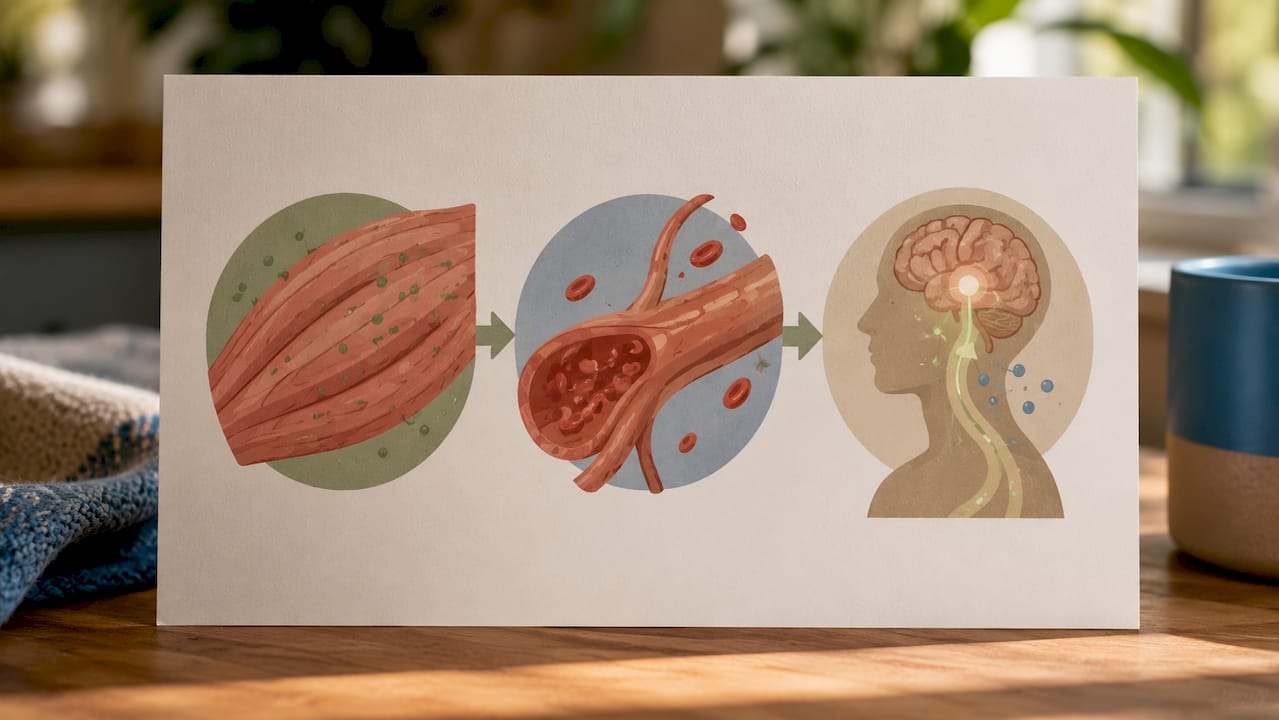
Massage works partly by loosening tight muscle fibers, improving local blood flow, and triggering an endorphin response that changes how the brain registers pain signals. That’s why the same tender spot often feels less intense on the second or third pass through a session.
What Are the Safety Rules for Sciatica Self-Massage?
The 0 to 3 out of 10 pressure scale is your guardrail for every technique above. Anything past a 3, especially a sharp or electric sensation, means you’ve likely hit the nerve rather than the muscle, and the right move is to back off, not push through it.
- Never dig directly into the bony spine, the sacrum, or the path where the nerve itself runs.
- If soreness lingers more than 24 hours after a session, skip a day before trying again.
- Keep individual sessions short. Long, aggressive sessions that leave you sorer than before defeat the purpose.
- Seek same-day medical evaluation for new leg weakness, numbness around the groin or inner thighs, loss of bladder or bowel control, fever paired with back pain, or pain following a fall or injury.
Roughly 90% of people with sciatica improve without surgery, often within weeks to a few months, using exactly this kind of conservative home care. That statistic is reassuring, but it assumes you’re also watching for the red flags above. Cleveland Clinic lists massage as a legitimate self-care option while cautioning that worsening symptoms warrant a clinician visit, not more massage.
Should You Use Ice or Heat With Sciatica Massage?
Timing matters more than most people realize here. In the first 48 to 72 hours after a flare, ice calms inflammation; after that window, heat does more to relax the muscles you’re about to work on.
- Ice (first 48 to 72 hours): 15 to 20 minutes per application, always with a cloth barrier between the pack and skin, with a break before reapplying.
- Heat (after the acute phase): 15 to 20 minutes, again with a barrier, watching closely to avoid burns.
- Sequencing with massage: if you’re still acutely inflamed, ice first, wait about 30 minutes, then massage gently. Once you’re past the acute phase, save heat for right after your massage session to help the tissue stay relaxed.
- Never apply either ice or heat directly to skin that feels numb. Harvard Health recommends this exact ice-then-heat progression as a standard adjunct to home care.
Which Massage Tools Work Best for Sciatica at Home?
A tennis ball and a foam roller cover most of what you need, but a few details separate a useful session from an irritating one.
- Tennis ball or taped twin balls: ideal for pinpoint trigger-point work on the piriformis and, taped together, for controlled pressure beside (never on) the spine.
- Foam roller: better suited to larger areas like the glutes and hamstrings; move slowly and stay cautious anywhere near the lumbar spine.
- Percussion massagers: keep these on low intensity and well away from the bony spine or the direct nerve path. A spiky massage roller can add more targeted texture for stubborn glute knots without the intensity of a percussion device.
- Comfort basics: a folded towel under bony areas and a few minutes to get positioned comfortably make a real difference in how much you actually stick with the routine.
Pro Tip: If you’re new to self-massage tools, start with the softest ball you own. A firmer ball feels more effective in theory, but a piriformis muscle in spasm often responds better to gentler, more frequent pressure than one aggressive session.
How Often and How Long Should You Massage for Sciatica?
A short, repeatable routine beats a long, occasional one. Aim for daily or every-other-day sessions of 10 to 20 minutes total, built around 2 to 4 spots per side held 20 to 45 seconds each.
- Warm up with heat for 5 to 10 minutes.
- Work the piriformis with ball holds.
- Foam roll the hamstrings.
- Follow with a gentle stretch.
- Finish with heat again if muscles still feel tight.
Back off the frequency any time soreness lingers past 24 hours. Consistency at a lower intensity beats pushing hard once and needing three days to recover.
What Stretches Pair Well With Sciatica Massage?
Massage loosens the tissue; movement keeps it that way. Mayo Clinic’s guidance on staying active rather than resting in bed applies directly here, and a few low-load stretches make a natural follow-up to any massage session.
- Figure-4 stretch: lying on your back, cross one ankle over the opposite knee and gently pull the lower leg toward your chest; a seated version works too if lying down is uncomfortable.
- Knee-to-chest stretch: pull one knee toward your chest at a time, holding briefly without forcing the range.
- Hamstring or nerve-glide variations: straighten one leg slowly while lying down, stopping well before any sharp or electric sensation.
- Bridging and cat-cow: both encourage gentle spinal movement and glute activation without heavy loading.
Keep every stretch in a comfortable range. The goal is gentle motion, not a deep stretch that reproduces your leg pain. For a broader look at movement-based approaches, this guide to strength training for lower back pain covers how to build resilience once the acute flare settles.
What Should You Realistically Expect From Home Massage?
Massage eases symptoms; it rarely fixes the underlying cause by itself. The people who get the most out of a home routine pair it with movement, stretching, and a clinician’s input when pain doesn’t ease within a few weeks.
The most common mistakes are predictable: pressing too hard because more pressure feels like it should mean more relief, fixating on the single most painful spot instead of working the surrounding area, and skipping the pain-scale check because the routine feels tedious. A slower, more disciplined approach almost always outperforms an aggressive one here.
— Cadence
Which Evergreenbliss Tools Support an At-Home Sciatica Routine?
The product lineup supports low-effort, high-consistency care that sciatica recovery often benefits from. A foam roller with the right density gives you controlled pressure on the glutes and hamstrings without the guesswork of finding random equipment around the house, and a heated pad provides continuous warmth without the need for frequent reheating.

When picking tools, match density to your tolerance: firmer rollers suit people who’ve been doing this for a while, softer ones suit anyone just starting out or working around a sensitive lower back. Look for a roller sized to reach the glutes comfortably and, if heat matters to your routine, a pad with adjustable settings rather than one fixed temperature. Evergreenbliss’s massage foam roller fits the glute and hamstring work described above, and the broader personal care and hygiene gadgets collection covers heat and recovery tools if you want to build out a fuller at-home setup. Browse either page and pick the piece that matches the technique you’re most likely to actually stick with.
This article is general information, not a substitute for advice from a qualified doctor. Consult a qualified healthcare professional about your own circumstances before acting on anything here.
Sources
- Sciatica home remedies and self-care - Harvard Health
- Sciatica - Diagnosis and treatment - Mayo Clinic
- Sciatica - Cleveland Clinic