Yes, heated neck massagers help. They provide genuine short-term relief for muscle tension, stiffness, and stress by combining two things that work well together: mechanical pressure and warmth. The primary benefits show up fast: looser muscles, better blood flow, less perceived tightness, and a body that’s more ready to stretch or move without wincing.
The catch is that clinical evidence for heat therapy alone is thinner than most product pages let on. It’s consistent, but limited to small trials.
- Muscle relaxation and reduced stiffness within minutes of use
- Increased local blood flow to the treated area
- Lower perceived tightness, which makes stretching feel less painful
- Better readiness for exercise or physical therapy right after use
None of this replaces movement. Heat works best as a warmup act, not the whole show.
Key Takeaways
Heated neck massagers provide reliable short-term relief for muscle tension and stiffness, but lasting improvement depends on pairing heat with movement and exercise.
| Point | Details |
|---|---|
| Heat works, evidence is thin | Small trials show consistent short-term pain relief, but the research base remains limited. |
| Timing matters | Use ice for the first 48 to 72 hours after injury; switch to heat for stiffness afterward. |
| Session length | Keep sessions to 10 to 20 minutes at low to moderate heat to avoid skin irritation. |
| Heat enables movement | Pairing heat with stretching or PT exercises produces better outcomes than heat alone. |
| Evergreenbliss fit | The Neck Massager with Soothing Heating Mode offers adjustable heat and auto-shutoff for safe daily use. |
This article is general information, not a substitute for advice from a qualified doctor. Consult a qualified healthcare professional about your own circumstances before acting on anything here.
Table of Contents
- How heat therapy works: the science behind heated neck massager benefits
- What does the research say about heat for neck pain?
- How do you use a heated neck massager safely?
- When should you avoid heat on your neck?
- Combining heat with movement for real neck pain relief
- What else does a heated neck massager improve besides pain?
- How do heated neck massagers compare to other neck pain treatments?
- Are there risks specific to heated neck massagers?
- What do people actually notice when they start using one?
- The gap between what’s marketed and what the evidence supports
- Which Evergreenbliss neck massager fits this advice?
- Sources
How heat therapy works: the science behind heated neck massager benefits
Heat does something simple at the tissue level: it dilates blood vessels. That increased blood flow, called vasodilation, raises the local metabolic rate and delivers more oxygen and nutrients to strained muscle fibers. Warmer tissue also becomes more pliable. Collagen fibers in muscle and connective tissue loosen their grip when heated, which is why a warm muscle stretches farther than a cold one before it complains.
This matters for anyone with a stiff neck because tight muscles often guard against movement. Heat interrupts that guarding response. It raises tissue extensibility and can reduce sensitivity at trigger points, the little knots that flare up when you’ve been hunched over a laptop for six hours. That lets a massage device actually reach deeper muscle layers instead of just working the surface.
There’s also a nervous-system piece. Warmth on the skin soothes nociceptive signals, the pain messages your nerves send to the brain. That’s part of why a heated massager feels calming in a way a plain vibrating one doesn’t. It’s not just mechanical relief; it’s a mild sedative effect on the nerves themselves, which is where the stress-reduction benefit comes from.
- Vasodilation increases blood flow and speeds tissue warming
- Raised tissue temperature improves flexibility and extensibility
- Warmth dampens pain signals and lowers trigger-point sensitivity
- Combined heat and pressure reach deeper muscle layers than either alone
Pro Tip: Run the heat function for two or three minutes before starting the massage cycle. Pre-warming the muscle gives the massage heads something looser to work with, instead of fighting a cold, guarded muscle from the first second.
What does the research say about heat for neck pain?
The honest answer: the evidence is real but modest. A systematic review of heat therapy for non-specific neck pain found only two small trials, covering 67 participants total, that met inclusion criteria. Both reported pain reductions, but the review rated the overall evidence as low certainty. That’s not a rejection of heat. It’s a statement that the research base is thin, not that the effect is fake.
A separate emergency-department randomized controlled trial comparing heat and cold for back and neck strains found something useful for anyone standing in the heat-or-ice aisle: 30 minutes of a heating pad produced pain relief similar to 30 minutes of a cold pack, when both were added to ibuprofen. Neither beat the other by much. Patient preference varied, which tells you the choice between heat and cold often comes down to what feels better to you, not which one is objectively superior.
Only two trials, 67 total participants, met the bar for a formal systematic review of heat therapy in neck pain. That’s the entire clinical evidence base most product claims are quietly built on.
Broader clinical guidance leans supportive of heat, especially for chronic stiffness and tension rather than fresh injuries. Most mild to moderate neck pain resolves within two to three weeks with self-care that includes heat, over-the-counter pain relievers, and gentle movement. Some studies on thermotherapy paired with exercise found better pain, function, and quality-of-life scores than exercise alone, reinforcing that heat’s real strength is what it enables, not what it fixes on its own.
- Systematic review: low certainty evidence, but consistent direction of benefit
- RCT: heat and cold performed similarly for acute strain relief
- Clinical guidance: heat is favored for stiffness and chronic tension over acute injury
- Realistic framing: heat supports recovery, it doesn’t replace it
How do you use a heated neck massager safely?
Getting the benefit without the burn risk comes down to following a few practical rules.
- Start low and short. Begin with about 10 minutes at low to moderate heat. Most safe sessions run between 10 and 20 minutes; going longer doesn’t add much benefit and raises skin irritation risk.
- Test sensation before you turn up the heat. If an area feels numb, tingly, or you have reduced sensation from a condition like diabetic neuropathy, skip high settings entirely.
- Never sleep with it running. An active heating device left on overnight is one of the most common ways people burn themselves. Auto-shutoff features exist for exactly this reason.
- Follow up with movement. After the session, do gentle range-of-motion work or the neck stabilization exercises your physical therapist gave you. This is where temporary relief turns into actual functional gains.
- Check the device features before you buy. Look for adjustable heat levels, an automatic shutoff timer, and a fit that sits snugly without pinching. A clear return policy and warranty matter more than people expect, since fit varies a lot between necks and shoulders.
Pro Tip: If your massager has multiple heat settings, use the lowest one that still feels effective. Higher heat doesn’t speed up muscle relaxation past a certain point. It just increases the odds of skin redness or discomfort with no added benefit.
When should you avoid heat on your neck?
Heat isn’t right for every kind of neck pain, and using it at the wrong moment can make things worse.
Skip heat for the first 48 to 72 hours after a new injury, strain, or whiplash. Swelling and inflammation respond better to ice during that window; heat can increase blood flow to an area that’s already inflamed and make swelling worse. Once that acute phase passes, heat becomes the better tool for stiffness.
Physical therapists and spine specialists consistently draw the same line: ice first for fresh injury and swelling, heat later for stiffness and chronic tension.
Never apply heat to open wounds, skin with reduced sensation, or any area where infection is suspected. And treat these as signals to call a doctor, not adjust your massager settings: fever, progressive weakness, numbness that spreads down an arm, pain that keeps getting worse instead of better, or any sign of nerve involvement like shooting pain or tingling. Those point to something a heating pad can’t fix.
Combining heat with movement for real neck pain relief
Heat’s real job isn’t to fix your neck. It’s to make the fix possible. Warm, relaxed muscle tolerates stretching and exercise far better than cold, guarded muscle, which is why clinicians frame heat as a facilitator rather than a treatment on its own.
A practical sequence that works for most people:
- Warm the neck and upper shoulders for 10 to 15 minutes with a heated massager.
- Move into gentle range-of-motion work, followed by 5 to 10 minutes of neck stabilization exercises or whatever your physical therapist has prescribed. Research on thermotherapy combined with exercise found better pain and function outcomes than exercise alone in chronic neck pain groups.
- Finish with a posture check. Look at screen height, chair support, and how far your head juts forward during the day.
If pain keeps returning despite this routine, that’s a sign to get a targeted assessment rather than leaning harder on the device. A neck posture brace can help reinforce good positioning between sessions, and structured neck-strengthening routines address the postural habits that create tension in the first place.
What else does a heated neck massager improve besides pain?
Pain relief gets the headlines, but the sleep and stress benefits are often what keep people using these devices long after the initial soreness fades.
Warmth triggers a mild parasympathetic response, the “rest and digest” side of your nervous system that counters the fight-or-flight tension most people carry in their neck and shoulders by evening. That’s part of why a heat session before bed tends to help people fall asleep faster than a massage alone would. The muscle relaxation combines with a genuine drop in perceived stress, not just a distraction from it.
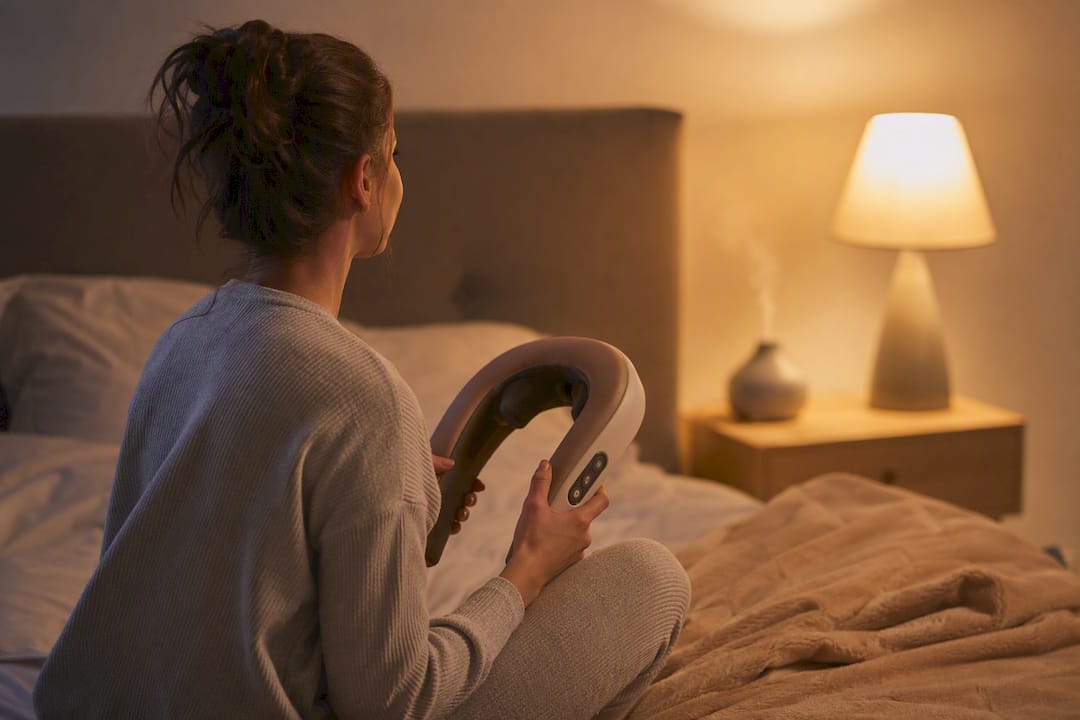
There’s a practical routine benefit too. A short heated session becomes a signal to your body that the day is winding down, similar to how a warm shower works before bed. Pairing it with a deep sleep-focused neck massager built specifically for evening use reinforces that wind-down cue rather than fighting against it.
Stress reduction and pain relief aren’t separate mechanisms here. Chronic neck tension and stress feed each other: tight muscles make you feel more strained, and mental stress shows up physically as a clenched jaw and hunched shoulders. Breaking that loop with 15 to 20 minutes of heat and gentle pressure does double duty, loosening the muscle and calming the nervous system that’s been keeping it tight in the first place. That combination is harder to get from stretching alone or from a cold compress, which addresses inflammation but does nothing for the stress side of the equation.
How do heated neck massagers compare to other neck pain treatments?
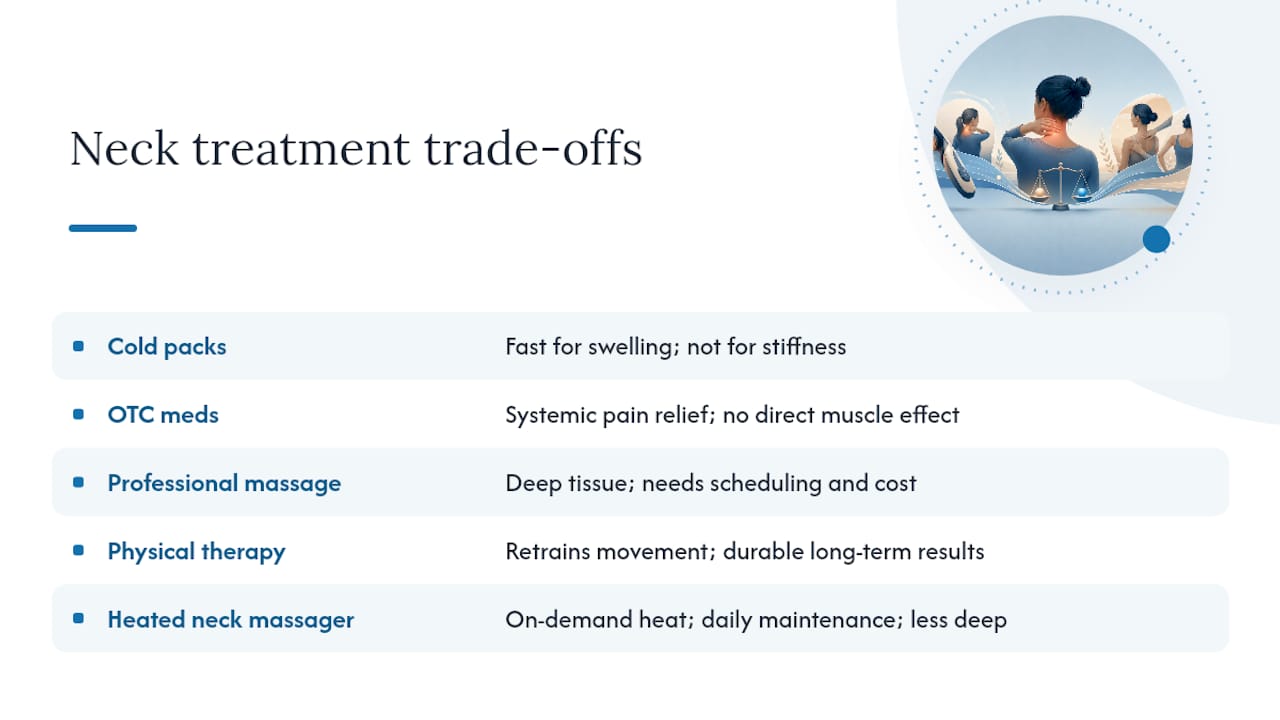
Every neck pain option trades off convenience against depth of effect, and heated massagers land in a specific spot on that spectrum.
Cold packs work faster on acute swelling but do nothing for the stiffness and stress components of chronic tension. Over-the-counter pain relievers address inflammation and pain signaling systemically, but they don’t touch tight muscle fibers directly and carry their own limits on frequency of use. Professional massage therapy reaches deep tissue more effectively than a home device, and a sports massage can address specific injury patterns a heated massager can’t diagnose, but it requires scheduling, travel, and a real cost per session.
Physical therapy and targeted stretch therapy deliver the most durable long-term results because they retrain movement patterns rather than just easing symptoms, but they take weeks of consistent sessions to show results. A heated neck massager sits between these options: available on demand, no appointment needed, and effective enough for daily maintenance, but it isn’t a substitute for a clinician’s hands or a structured rehab program when the underlying problem is structural or postural.
The practical answer for most people isn’t choosing one option over the others. It’s using heat daily for maintenance and stress relief, saving ice for fresh injuries, and bringing in professional massage or physical therapy when pain is severe, recurring, or tied to a specific movement pattern that needs correcting.
Are there risks specific to heated neck massagers?
General heat therapy risks apply here (burns, worsened inflammation on fresh injuries) but devices add a few risks unique to the mechanism.
The combined pressure and heat can mask overuse. A massage feels good in the moment even when a muscle is being worked past what it needs, and the warmth can delay the discomfort signal that would normally tell you to stop. Some devices also concentrate heat unevenly across the massage nodes, creating hot spots that feel fine at first but can irritate skin over a longer session.
Battery-powered and cord-based devices also introduce electrical safety as a factor plain heating pads don’t carry to the same degree, which is why auto-shutoff timers and low-voltage designs matter more than they might seem to on a spec sheet. Anyone using a pacemaker or with a history of skin conditions in the neck area should check with a doctor before adding a heat-and-pressure device to their routine, since the combination is more intense than a simple heating pad alone.
The fix for most of this is straightforward: respect the session-length guidance, don’t chase the highest heat setting out of habit, and stop a session if a spot feels hot rather than warm. These devices are low-risk when used as directed, but “low-risk” isn’t the same as “risk-free.”
What do people actually notice when they start using one?
The most common first reaction isn’t dramatic pain relief. It’s a noticeable drop in tension within the first few minutes, the kind of release that makes people realize how tight they’d actually been holding their shoulders all day.
Recurring themes show up across how people describe the experience: relief arrives fast but doesn’t last without follow-up movement, evening use tends to help with falling asleep, and the heat setting matters more to satisfaction than the massage intensity does. People with desk jobs report reaching for the device during the workday for a quick reset, while those managing chronic stiffness tend to build it into a nightly routine paired with stretching.
The pattern that separates satisfied long-term users from disappointed one-time buyers is expectations. People who treat the massager as a daily maintenance tool, something that keeps tension from building up rather than a cure for an existing problem, tend to stick with it and report steady benefit. People expecting one session to fix months of postural strain are usually disappointed, not because the device failed, but because that was never a realistic job for it to do.
The gap between what’s marketed and what the evidence supports
Most product pages for heated neck massagers oversell the science. They’ll cite “clinical studies” without mentioning that the actual research base, the systematic review on heat for non-specific neck pain, is built on two small trials. That’s not damning. It’s just smaller than the marketing implies, and readers deserve to know the difference between “consistently reported benefit” and “proven.”
Where conventional advice falls short is treating heat as competitive with physical therapy or exercise, as though you’re choosing one or the other. They’re not competitors. The RCT comparing heat and cold for acute strains found both work about equally well for short-term symptom relief, which tells you neither is a magic bullet. They’re both tools that buy you a window of reduced pain.
What should the reader prioritize first? Not the fanciest device. The habit of pairing heat with movement, every time. A person who uses a basic heated massager for 10 minutes before doing their prescribed stretches will get more durable relief than someone using a premium device passively for 20 minutes while scrolling their phone. The tool matters less than what you do in the five minutes after you turn it off.
— Cadence
Which Evergreenbliss neck massager fits this advice?
Everything above points to the same shopping checklist: adjustable heat, a shutoff you don’t have to think about, and a fit that actually stays put on your neck instead of sliding around while you move. The Neck Massager with Soothing Heating Mode from Evergreenbliss is built around exactly that combination, giving you multiple heat settings so you can start low and adjust as your muscles warm up, plus the auto-shutoff safety feature that matters most for anyone tempted to leave it running too long.

If evening relaxation and sleep are the bigger priority for you, the Deep Sleep Neck Massager is designed for that wind-down window specifically, pairing heat with a gentler massage pattern suited to bedtime use. Both products come with Evergreenbliss’s standard return policy, so fit issues (a real concern with neck devices, since necks vary more than most people expect) aren’t a reason to avoid trying one.
Browse the full personal care and hygiene gadgets collection to compare heat settings and sizing side by side, and pick the one that matches how and when you’ll actually use it.
Sources
- Systematic review: use of heat for non-specific neck pain
- Randomized trial comparing heat and cold for back and neck strains
- Neck pain diagnosis and treatment (Mayo Clinic)