Wearing a sleep mask puts light pressure around the eyes, but for most healthy adults that pressure is harmless as long as the mask fits well and stays clean. People with glaucoma, ocular hypertension, recent eye surgery, or severe dry eye should be more careful. If your vision stays blurry more than a day after waking, switch to a contoured design, loosen the strap, and call your eye doctor.
TL;DR:
- Most healthy adults can wear sleep masks safely if the mask fits well and is kept clean, with little risk of causing eye injury.
- People with glaucoma, ocular hypertension, recent eye surgery, or severe dry eye should pay extra attention to mask fit and avoid direct corneal contact.
- Persistent blurred vision, eye pain, discharge, or sudden vision loss after wearing a mask are warning signs requiring immediate eye examination.
- Contoured masks with eye cups and adjustable straps reduce pressure on the eyelid and prevent dry eye or gland dysfunction issues.
- Regular cleaning, proper fit-checks, and avoiding weighted masks over the eyes are key to maintaining eye health during use.
Table of Contents
- Sleep Mask Pressure on Eyes: The Real Risks and Who Should Worry
- Normal Discomfort vs. Warning Signs After Wearing a Mask
- Why Eye Pressure and Tear Film Actually Change Under a Mask
- How to Choose a Sleep Mask That Won’t Compress Your Eyes
- When Mask-Related Symptoms Need an Eye Doctor’s Input
- Why Most Mask Complaints Are a Design Problem, Not a Danger
- A Sleep Mask Collection Built Around Fit and Hygiene
- Sources
Sleep Mask Pressure on Eyes: The Real Risks and Who Should Worry
Most of what people blame on “sleep mask pressure on eyes” is actually a fit problem, not a physiological one. A standard flat mask resting gently against closed eyelids doesn’t generate enough force to injure a healthy eye. According to the Cleveland Clinic, morning blurriness usually traces back to a mask that’s too tight, positioned wrong, or pressing directly on the cornea rather than the bony orbital rim around it.
That said, three distinct risk categories deserve separate attention.
- Transient blur versus real pressure changes. A few seconds of hazy vision right after removing a mask is common and usually resolves on its own. Persistent elevation of intraocular pressure is a different animal entirely, and it’s the one that matters for people with existing eye disease.
- Infection and eyelid inflammation. Fabric held against the skin overnight, night after night, creates a warm, moist environment where bacteria multiply. Research on microbial colonization of contact surfaces shows that unwashed fabric surfaces become breeding grounds fast, which is why an unwashed mask can trigger blepharitis or lid margin irritation.
- Dry eye and gland dysfunction. Sustained lid pressure can interfere with the meibomian glands, tiny oil-producing structures along the eyelid edge that keep tears from evaporating too quickly.
Here’s the reassuring part: healthy adults with no history of eye disease sit at the low end of this risk spectrum. The people who need to pay closer attention are those already managing glaucoma, ocular hypertension, dry eye disease, or anyone within a few months of eye surgery. For that group, a poorly fitted mask isn’t just uncomfortable. It’s a variable worth discussing with a doctor.
Normal Discomfort vs. Warning Signs After Wearing a Mask
Not every strange sensation after a night in a sleep mask means something is wrong. Knowing the difference between “shake it off” and “call your doctor” saves a lot of unnecessary worry.
- Brief blurriness on waking. If it clears within a minute or two of blinking and rubbing your eyes gently, this is typical and not a red flag.
- Faint creasing or a temporary mark on the skin. Cosmetic, not medical. It fades within 15 to 30 minutes for almost everyone.
- Blurred vision lasting more than 24 hours. According to All About Vision, blur that persists past a full day warrants a proper eye exam rather than a wait-and-see approach.
- Eye pain, aching, or a feeling of pressure behind the eye. This is not a normal mask response and should prompt evaluation, especially if it’s new or worsening.
- Sudden vision loss or dramatic changes in vision. Treat this as an emergency, mask-related or not.
- Discharge, crusting, or redness along the lash line. These point toward blepharitis or a lid infection rather than simple pressure.
A useful habit: right after removing your mask each morning, take ten seconds to check for lingering blur, tenderness at the temples or brow bone, or any discharge. Catching a pattern early, rather than after a week of symptoms, makes any conversation with an eye-care provider far more useful.
Why Eye Pressure and Tear Film Actually Change Under a Mask
The mechanism behind mask-related eye problems comes down to two things: where the mask touches, and how long it stays there.
Periorbital compression, pressure applied to the tissue around the eye socket, can raise intraocular pressure (IOP) in some people, particularly when a mask presses directly on the eyeball rather than the surrounding bone. One clinical perspective on sleep masks and eye health notes this effect is most relevant for people who already have glaucoma or ocular hypertension, where even modest pressure spikes carry more weight.
- Corneal contact versus eye-cup space. Flat masks tend to rest directly on the closed eyelid and cornea beneath. Contoured masks with built-in eye cups create a small dome of empty space, so the fabric touches your brow and cheekbones instead of the eyeball itself.
- Tear film disruption. Consistent lid pressure interferes with the meibomian glands’ ability to release the oily layer that keeps tears stable. A review of meibomian gland function links this disruption to dry eye symptoms that show up as grittiness or burning during the day.
- Timing matters. IOP naturally runs higher in the early morning hours for most people, the exact window when a mask has been in contact with the eye the longest. That overlap is part of why morning symptoms get reported more than evening ones.
None of this means masks are dangerous by default. It means design and duration both matter more than most people assume.
How to Choose a Sleep Mask That Won’t Compress Your Eyes
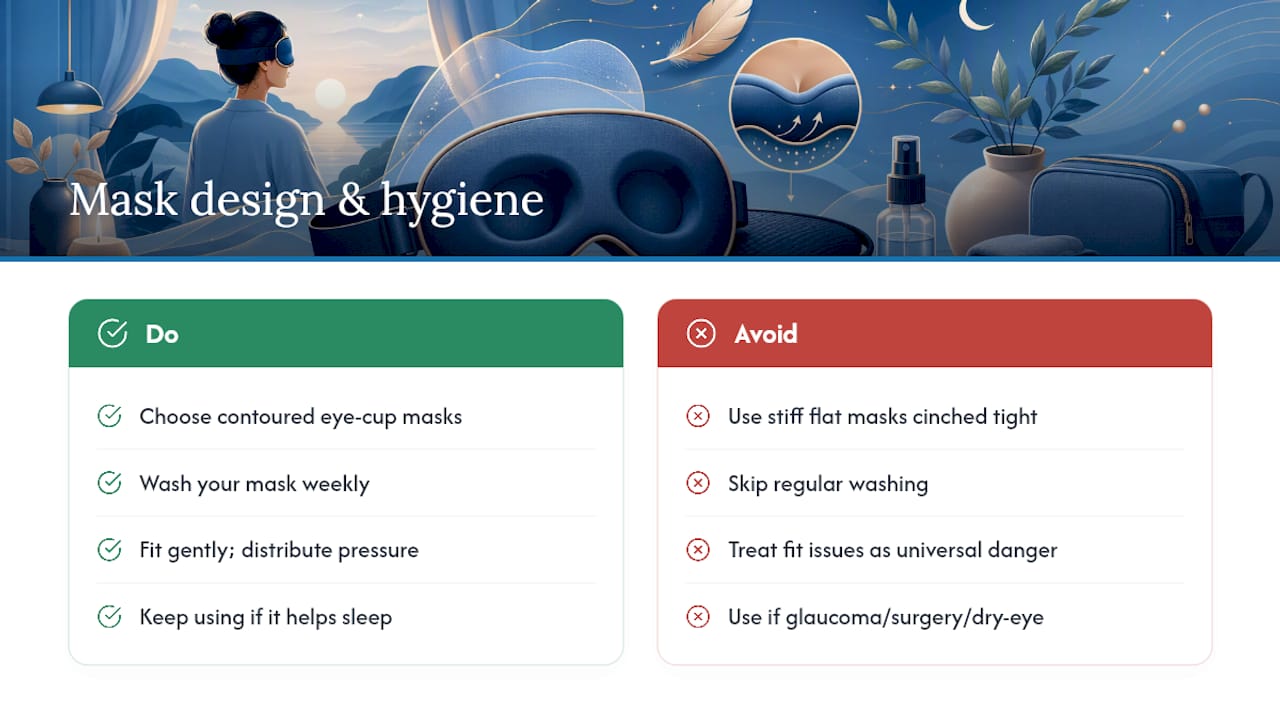
The single biggest lever you have is design. A contoured, eye-cup mask keeps fabric off the eyeball entirely, resting its structure on the brow bone and cheekbones instead. Flat masks are cheaper and more common, but they’re also the design most likely to produce that pressed-cornea sensation by morning.
Strap tension is the second lever, and it’s the one people get wrong most often. The mask should stay in place through normal head movement without leaving an indent on your skin. If you wake up with a deep line across your temple or a headache at the brow, the strap is too tight, full stop. Adjustable straps with a Velcro or slider closure let you fine-tune this instead of stretching a fixed elastic band into a compromise.
Material matters for comfort and for allergy risk; choosing the right fabric can reduce issues like skin creasing and irritation around the eyes, as discussed in dark circles under eyes treatment Cambridge. Smooth interior fabrics like silk or a soft, breathable synthetic reduce friction against skin and eyelashes. Avoid stiff synthetic linings if you have sensitive skin or a history of contact dermatitis.
Hygiene is where a lot of guidance quietly falls apart in practice. Clinical evidence on contact-surface bacteria supports a simple rule: wash your mask weekly if you wear it nightly, remove eye makeup before bed rather than letting it transfer onto the fabric, and let the mask dry completely before the next use.

Weighted masks deserve a specific caution. Light, evenly distributed weight can feel calming for some sleepers, but concentrated weight directly over the eyes raises the exact compression risk this whole guide is about. Anyone with glaucoma, ocular hypertension, or a recent eye procedure should skip weighted designs entirely unless an eye doctor has cleared it.
Run this quick fit check before your first full night in any new mask:
- Put it on and check whether fabric touches your closed eyelids directly, or floats above them.
- Move your head side to side. It should stay put without needing to be cinched tighter.
- Remove it after 20 minutes and look for red marks or deep creasing.
- Confirm you can still blink freely without fabric brushing your lashes.
Pro Tip: If you’re new to sleep masks, wear one for short naps or the first hour of sleep for a few nights before committing to a full night. Your face and the mask both need a break-in period, and this avoids waking up to discomfort you can’t diagnose in the dark.
If breathing comfort is part of your nighttime routine too, pairing a well-fitted mask with nasal strips or other airflow support can round out a more comfortable setup, especially for anyone dealing with congestion alongside light sensitivity.
When Mask-Related Symptoms Need an Eye Doctor’s Input
Most mask discomfort resolves with a fit adjustment. But certain symptoms mean it’s time to stop troubleshooting on your own and get an eye exam instead.
- Same day, if you experience: sudden vision loss, severe eye pain, or a marked change in vision that doesn’t improve with blinking.
- Within a few days, if you experience: blurred vision lasting more than 24 hours, persistent eye redness, or discharge along the lash line.
- At your next routine visit, mention: how many hours a night you wear a mask, whether it’s flat or contoured, and any recurring morning symptoms, even mild ones.
People managing glaucoma, ocular hypertension, dry eye disease, or anyone within the recovery window after eye surgery should bring up mask use proactively rather than waiting for a symptom to appear. A five-minute conversation about strap tension and mask design can prevent months of guessing.
Why Most Mask Complaints Are a Design Problem, Not a Danger
Here’s what gets lost in most coverage of this topic: the conversation about sleep mask safety almost always defaults to alarm, when the actual clinical picture points toward a design and hygiene problem that’s genuinely fixable. Healthy eyes tolerate gentle, well-distributed pressure just fine. What they don’t tolerate is a stiff flat mask cinched too tight against the cornea for eight hours, night after night, without ever getting washed.
The gap between “sleep masks might be bad for your eyes” and what the evidence actually supports is wide. Contoured designs solve the mechanical problem. A weekly wash cycle solves the hygiene problem. Neither requires giving up a product that genuinely helps people fall and stay asleep by blocking ambient light.
Where I’d push back on conventional advice is the blanket caution some sources apply to everyone. That caution belongs squarely with people who have glaucoma, recent eye surgery, or diagnosed dry eye disease, not with every mask wearer. Treating a fit-and-hygiene issue as a universal medical concern makes people abandon a genuinely useful sleep tool for no good reason.
— Cadence
A Sleep Mask Collection Built Around Fit and Hygiene
Some sleep mask brands focus on contoured, eye-cup designs and adjustable straps, which help keep fabric off the cornea and reduce pressure around the eyes. Many masks use washable materials, making it easier to maintain a good hygiene routine.

When your order arrives, try the fit-check routine covered above before your first full night: check for direct eyelid contact, test strap tension with head movement, and look for marks after a short trial run. If something isn’t right, some companies offer easy return policies so you’re not stuck with a mask that doesn’t fit well. Browse the personal care and sleep essentials collection to find a contoured mask sized for your fit, and if you like built-in audio for winding down, the Bluetooth sleep mask pairs that same contoured comfort with sound.
Sources
For deeper reading, the Cleveland Clinic covers general mask safety, the Sleep Foundation breaks down mask types and use cases, and All About Vision addresses buying tips and symptom thresholds. The NCBI review on meibomian gland function backs the physiology behind dry eye and pressure effects.
This article is general information, not a substitute for advice from a qualified doctor. Consult a qualified healthcare professional about your own circumstances before acting on anything here.
- The case for wearing a sleep mask — Cleveland Clinic
- Eye masks for sleep: Benefits, safety and buying tips — All About Vision
- NCBI review on eyelid and meibomian gland function — PMC6751071
- NCBI: microbial colonization of contact surfaces — PMC2887188