Short answer: an acupressure mat can help you fall asleep faster and feel more relaxed at bedtime, especially if you carry tension, stress, or mild chronic pain into the evening. A randomized controlled trial on self-administered acupressure found meaningfully better insomnia scores after eight weeks compared with sleep-hygiene education alone, and clinicians interviewed by Healthline point to the mat’s real strength: it forces you into ten quiet, phone-free minutes right before bed.
It won’t fix a sleep disorder or replace treatment for chronic insomnia, and it’s not the right tool for everyone. If you’re pregnant, have peripheral neuropathy, take blood thinners, or have an active skin condition, read the safety section below before you try one. For most healthy adults dealing with a racing mind or a tight lower back at 11 p.m., though, a mat is a low-risk, low-cost way to signal to your body that it’s time to slow down.
Key Takeaways
Acupressure mats work best as a short, consistent bedtime ritual that combines mild pressure-point stimulation with the calming effect of ten distraction-free minutes before sleep.
| Point | Details |
|---|---|
| Evidence is real but narrow | Trials show moderate improvement in insomnia and sleep quality scores, but most test trained acupressure, not spike mats specifically. |
| Session length matters | Start at 5 to 10 minutes and build to 15 to 20 minutes; never sleep on the mat overnight. |
| Safety checklist first | Skip or check with a doctor if pregnant, on blood thinners, diabetic with neuropathy, or dealing with active skin conditions. |
| Give it real time | Judge results after two to three weeks of consistent use, not a single first session. |
| Evergreenbliss offers a ready option | The Premium Acupressure Massage Mat & Pillow Set pairs dense spike coverage with a neck pillow and washable cover built for nightly use. |
Table of Contents
- What Is an Acupressure Mat for Sleep, Exactly?
- How an Acupressure Mat Might Help You Sleep
- What Benefits Do People Actually Report?
- Who Should Be Careful With an Acupressure Mat
- Your Step-By-Step Bedtime Mat Routine
- What to Expect and How to Fix Common Problems
- How to Choose the Right Acupressure Mat
- Why This Guidance Holds Up
- An Editor’s Honest Take on Acupressure Mats and Sleep
- Try the Evergreen Bliss Acupressure Mat and Pillow Set Tonight
- Frequently Asked Questions
- Sources
What Is an Acupressure Mat for Sleep, Exactly?
An acupressure mat is a flat pad covered in small plastic discs, each studded with dozens of blunt spikes, designed to press into your skin when you lie on it. The pressure is meant to mimic acupressure and acupuncture, stimulating nerve endings across your back, neck, or feet without needles. Unlike a weighted blanket or a white noise machine, which work through weight or sound, a mat works through direct, distributed skin pressure that most people describe as intense at first and oddly soothing after a few minutes.
The build varies more than shoppers expect, and those differences change how a session actually feels:
- Mat shell and fill: Usually cotton or linen fabric over a foam core; firmer foam transmits more pressure than a plush one.
- Spike discs: Individual plastic tiles, often called “flowers” or “lotus” discs, each with 20 to 33 points; total contact points across a full mat commonly run from 6,000 into the low eight thousands.
- Neck pillow: A smaller matching pad, sometimes cylindrical, sold separately or bundled for cervical support.
- Carry bag: A rolled or folded storage case, standard on most full-size sets meant for travel or under-bed storage.
Intensity comes down to three variables: how dense the spikes are packed, how firm the foam underneath is, and how much surface area of your body makes contact. A denser, firmer mat spreads your body weight over more points and feels sharper initially but often relaxes faster once your skin acclimates.
How an Acupressure Mat Might Help You Sleep
The honest picture is that acupressure mats work through a mix of physiological response and simple ritual, and researchers haven’t fully untangled which one does more heavy lifting.
On the physiological side, pressing dozens of blunt points into your back is thought to increase local blood flow, trigger a release of endorphins and serotonin, and ease tight fascia around the spine and shoulders. Some practitioners also point to vagal nerve stimulation, the idea that steady, tolerable pressure nudges your parasympathetic nervous system into the “rest and digest” state that makes falling asleep easier.

The behavioral side may matter just as much. Healthline’s clinicians argue that much of the mat’s benefit comes from forcing ten uninterrupted minutes of slow breathing and body awareness, away from screens, which naturally calms a racing mind before bed. Reporting in The Guardian echoes this: trial results on mats specifically are mixed, but the structured wind-down habit itself appears to reduce perceived stress regardless of the exact mechanism.
The clinical evidence is real but narrower than marketing copy suggests. The strongest trial isn’t about spike mats at all: a randomized controlled trial teaching self-administered acupressure to people with insomnia disorder found their Insomnia Severity Index scores improved significantly more than a sleep-hygiene-education control group, with a mean difference of 1.89 points at four weeks and 2.89 points at eight weeks, and effect sizes (Cohen’s d) between 0.51 and 0.67. A systematic review and meta-analysis of 23 auricular acupressure trials covering nearly 1,700 patients found significant reductions in Pittsburgh Sleep Quality Index scores versus control, though the authors flagged inconsistent study quality across the pool. Sleep sums up the mat-specific research as thin: a handful of small trials in people with back or neck pain show improved relaxation and modest sleep benefits, but nothing conclusive enough to promise results for everyone.
| Study or review | Population | Sleep outcome measured | Result |
|---|---|---|---|
| Self-administered acupressure RCT | Adults with insomnia disorder | Insomnia Severity Index | Mean difference −1.89 (week 4), −2.89 (week 8) vs. control |
| Auricular acupressure meta-analysis | —, 23 trials | Pittsburgh Sleep Quality Index | Significant PSQI reduction vs. control; quality varies |
| Small trials cited by Sleep | People with back/neck pain | Relaxation and sleep quality | Improved relaxation; sleep benefit modest, not conclusive |
Here’s the catch worth sitting with: almost none of the strongest trials tested a spike mat directly. Most tested trained acupressure technique or auricular (ear) acupressure, both delivered by a practitioner or after formal instruction. The effect sizes above (0.51 to 0.67) are considered moderate in clinical research, roughly comparable to some behavioral sleep interventions, but they describe a taught technique, not ten minutes of lying on a foam pad you bought online. That gap matters for how much confidence you put in a spike mat specifically, even though the underlying mechanism (pressure point stimulation) is the same family of intervention.
What Benefits Do People Actually Report?
Most of what people say they notice falls into a handful of consistent patterns, and it lines up reasonably well with what limited research supports.
- Falling asleep faster after a mat session, particularly when used as the last thing before lights-out.
- A deeper, more physical sense of relaxation than stretching or reading alone provides.
- Loosened tension in the lower back, shoulders, and neck that otherwise keeps people shifting positions in bed.
- An improved mood in the fifteen to twenty minutes after use, which several testers describe as similar to the calm after a short massage.
Testing and reader reports collected by Verywell Fit describe this same pattern: users notice muscle relaxation and better short-term mood fairly consistently, with sleep quality improvements reported by many but not universally.
Not all of these claims rest on equal footing. Pain relief and short-term relaxation have the clearest support, both from small trials and from the sheer consistency of user reports across independent testers. Faster sleep onset and better sleep quality are plausible and reported often, but the direct evidence is thinner and mostly anecdotal outside the insomnia-specific acupressure trial cited above. Treat the mood boost and pain relief as reasonably reliable, and treat “it cured my insomnia” claims with healthy skepticism.
Who Should Be Careful With an Acupressure Mat
Most healthy adults tolerate acupressure mats without issue, but a few groups should either skip them or check with a doctor first.
- Pregnancy: Certain pressure points are traditionally linked to uterine stimulation; skip mat use without clearing it with your obstetrician first.
- Diabetes or peripheral neuropathy: Reduced sensation in the feet or back can mask overuse or injury, since you may not feel damage building up.
- Blood thinners or clotting disorders: Concentrated pressure points raise the risk of bruising in anyone on anticoagulant medication.
- Active skin conditions: Open wounds, eczema flares, or psoriasis patches can be irritated further by repeated spike contact.
- Recent surgery: Healing incisions or grafts near the back, neck, or feet shouldn’t take direct pressure until a doctor clears it.
Short-term reactions are common even in low-risk users. Expect temporary redness, faint dot-shaped indentations, and occasionally mild bruising if you press too hard or stay too long. These almost always fade within an hour or two. Wearing a thin shirt for your first several sessions and keeping sessions under 20 minutes minimizes all three.
Do not sleep on an acupressure mat overnight. Sustained pressure for hours, rather than the recommended 10 to 30 minutes, raises the risk of skin breakdown and bruising, and it defeats the purpose of a short, deliberate wind-down ritual. If you have diabetes, a clotting disorder, or a skin condition and you’re unsure whether a mat is appropriate, talk to a doctor before adding one to your bedtime routine.
Your Step-By-Step Bedtime Mat Routine
Setting up correctly changes the entire experience, so don’t skip the basics before you get on the mat.
Lay the mat on a firm surface rather than a soft mattress or thick rug. A firm floor, yoga mat layer, or low-pile carpet lets the spikes press evenly instead of sinking unevenly into a soft cushion, which produces uneven and sometimes uncomfortable pressure points. Position the neck pillow, if you have one, so it supports the natural curve of your cervical spine, and if you’re targeting lower back tension, angle the mat so your lumbar region sits centered over the densest section of spikes.
Start with a thin, snug T-shirt for your first week. Bare skin delivers more intense pressure and is worth working up to once you know how your body responds, but going in unprotected on day one is the most common reason people quit after one try.
- Lower yourself onto the mat slowly, shoulders first if lying on your back, rather than dropping your full weight at once.
- Settle into position and take one slow breath in through your nose for a count of four.
- Exhale for a count of six, letting your shoulders drop away from your ears.
- Continue this breathing pattern for the first one to three minutes, which is typically the most intense part of the session.
- Once the sharp sensation eases into warmth, stay still and let your mind settle, keeping your breathing slow and steady.
- When your session time is up, roll onto your side and sit up gradually rather than standing immediately.
Pro Tip: The first one to three minutes on a new mat often feel sharp, sometimes described as a “mountain” of discomfort. Breathe through it deliberately, long exhales especially, rather than tensing up or pulling away. Most people report the sensation shifting into warmth and relaxation right on the other side of that initial discomfort, which lines up with when endorphin-related effects are thought to kick in.
Build up gradually rather than diving into a 30-minute session on night one.
| Experience level | Recommended session length |
|---|---|
| Week 1 | 5 to 10 minutes, worn over a thin shirt |
| Week 2 | 10 to 15 minutes, shirt or bare skin |
| Week 3 and beyond | 15 to 20 minutes, bare skin if comfortable |
| Ongoing maintenance | 10 to 20 minutes, 3 to 5 nights per week |
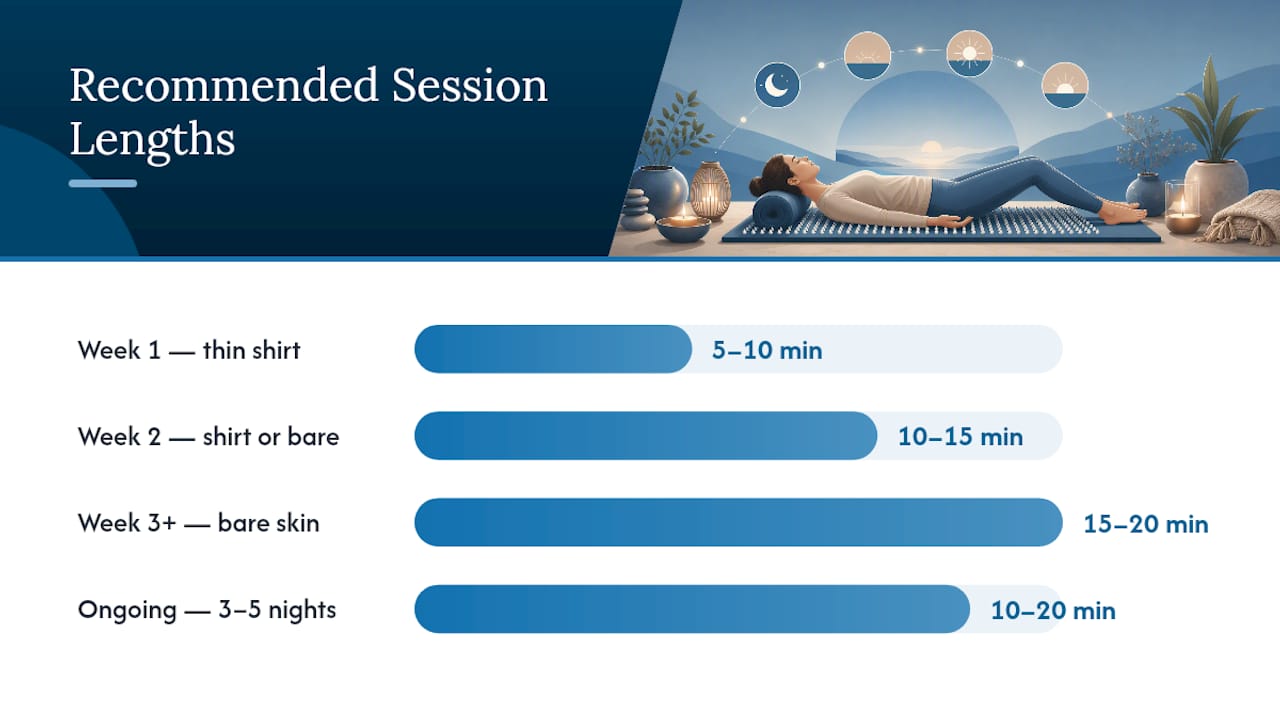
These durations track closely with guidance echoed across MindBodyGreen’s clinician-sourced advice and manufacturer dosing recommendations, which generally cluster in the same 10 to 30 minute daily window.
What to Expect and How to Fix Common Problems
The first few sessions follow a fairly predictable timeline, and knowing it in advance stops people from quitting right when things start to feel good.
In the first zero to three minutes, expect a sharp, sometimes surprising intensity as the spikes make full contact, particularly if you’re on bare skin. Between three and ten minutes, most people notice the sharpness fading into a warm, tingling sensation, often accompanied by the first wave of genuine relaxation. Past the ten-minute mark, drowsiness and a heavier, looser feeling in the muscles are the most commonly reported sensations, which is exactly the state you want heading into bed.
A few adjustments handle almost every complaint:
- If the pressure feels like too much, add a folded towel or keep your shirt on rather than abandoning the mat entirely.
- If you feel lightheaded, sit up slowly and give your circulation a minute to adjust before standing.
- Small red dots or indentation marks after a session are normal and typically fade within an hour or two.
Stop using the mat and check with a healthcare provider if you notice numbness that doesn’t resolve after your session, pain that feels sharp rather than intense, or any sign of skin infection around a pressure point. Those symptoms go beyond normal adjustment and deserve a professional look.
How to Choose the Right Acupressure Mat
Not every mat delivers the same experience, and the differences show up fast once you’re lying on one at 10 p.m. trying to unwind.
- Spike material and shape: Blunt, rounded plastic points spread pressure more evenly than sharp or thin spikes, which matters most for sensitive skin.
- Spike density: More contact points per square inch generally means a gentler, more distributed sensation rather than a few sharp jabs.
- Padding and fill: Firmer foam transmits more pressure for a stronger session; softer padding suits beginners or sensitive users.
- Size and coverage: A full-size mat that covers your back and pairs with a matching pillow works far better for a real bedtime ritual than a small travel pad meant for one shoulder.
- Cover washability: A removable, machine-washable cover matters for hygiene, since you’ll be sweating and pressing skin into it regularly.
- Portability: A folding design with a carry bag is worth prioritizing if you travel often and don’t want to break your routine.
For sleep-focused use specifically, prioritize a full-size mat with a matching neck pillow over a compact travel version. The pillow addition matters more than shoppers expect, since neck and upper shoulder tension is one of the more common physical blockers to falling asleep.
The Evergreen Bliss Premium Acupressure Massage Mat & Pillow Set checks each of these boxes: dense spike coverage for even pressure distribution, a firm foam core built for real bedtime sessions rather than a novelty demo, a matching neck pillow, a washable cover, and a travel bag if your routine needs to survive a hotel room. It’s built around the same buying criteria above rather than a single standout gimmick, which is exactly what you want in a tool meant for nightly repetition, not occasional novelty.
Why This Guidance Holds Up
This guide draws on peer-reviewed randomized controlled trials, a systematic review and meta-analysis of nearly two dozen studies, and clinician commentary from outlets that test wellness products directly rather than relying on manufacturer claims alone. Where the evidence gets thin, that’s stated plainly rather than smoothed over.
The honest limitation is this: strong clinical trials on acupressure technique exist, but very few of them test the specific spike-mat product category you’ll find on a store shelf. Most rigorous studies test trained acupressure or auricular (ear) acupressure delivered under guidance, not a foam pad used solo at home.
That gap doesn’t mean spike mats don’t work. It means the confidence level should sit at “reasonably promising, low-risk, worth a real trial” rather than “clinically proven.” Cadence, writing on behalf of Evergreenbliss, brings that same evidence-first framing to product recommendations here, treating the mat as one supportive tool within a broader wellness routine rather than a stand-alone cure.
An Editor’s Honest Take on Acupressure Mats and Sleep
The mistake most people make with an acupressure mat is treating it like a supplement, something you either “believe in” or dismiss outright based on one bad first try. That framing misses what’s actually going on. A mat is closer to a forcing function than a pill: it makes you sit still, breathe slowly, and put your phone down for ten minutes at a moment in the day when almost nobody voluntarily does that.
What gets underestimated is how much of the reported benefit likely comes from that structural forcing function rather than a specific physiological mechanism unique to plastic spikes. That’s not a knock against the product category. A tool that reliably gets you to slow your breathing before bed, night after night, is doing real work regardless of whether the mechanism is endorphin release, vagal tone, or simply the absence of a screen for ten minutes.
Give it two to three weeks of consistent use, not one skeptical five-minute session, before deciding it isn’t for you. The first session is often the least representative one you’ll have, since your body hasn’t adapted to the sensation yet. If after three or four weeks you’re still gritting your teeth through every session rather than settling into it, it’s a reasonable signal the mat isn’t your tool, and that’s fine. Not every wellness routine has to work for every person.
Try the Evergreen Bliss Acupressure Mat and Pillow Set Tonight
If you’ve read this far, you already know a good mat needs firm foam, dense spike coverage, a matching neck pillow, and a washable cover you won’t dread cleaning after a week of sweaty sessions. The Evergreen Bliss Premium Acupressure Massage Mat & Pillow Set was built around exactly that checklist rather than around a single flashy feature.

The set includes a full-size mat with dense, evenly distributed spike discs, a contoured neck pillow for cervical support, a removable machine-washable cover, and a folding travel bag if your bedtime routine needs to survive a work trip. That combination maps directly onto the buying criteria covered above: firm enough for real pressure, big enough for a full-back session, and practical enough to actually use nightly instead of letting it collect dust under the bed.
Evergreenbliss ships with free shipping and easy returns, so testing the two-to-three-week window mentioned above carries little downside if it turns out not to be your fit. Browse the full home recovery and wellness collection if you want to pair the mat with other recovery tools, and keep the safety checklist from this guide in mind, especially around session length and the contraindications list, no matter which mat you land on.
Frequently Asked Questions
Does an acupressure mat actually help you fall asleep faster? It can, particularly if racing thoughts or muscle tension are what’s keeping you up. The strongest supporting trial showed meaningful improvement in insomnia severity scores after consistent use over eight weeks, though that study tested taught acupressure technique rather than a spike mat specifically.
How long should I use an acupressure mat before bed? Start with 5 to 10 minutes in your first week and build toward 15 to 20 minutes by week three. Sessions longer than 30 minutes offer little added benefit and raise the risk of skin irritation.
Can I sleep on an acupressure mat all night? No. Sustained pressure for hours increases the risk of bruising and skin breakdown. Use the mat for a defined session before bed, then move to your regular mattress to sleep.
Is it normal to see red marks after using an acupressure mat? Yes, faint red dots or indentation patterns are common and typically fade within an hour or two. Persistent marks, sustained numbness, or sharp pain are signs to stop and consult a doctor.
Who should avoid using an acupressure mat? People who are pregnant, have peripheral neuropathy or diabetes with reduced sensation, take blood thinners, have active skin conditions, or recently had surgery near the treatment area should check with a doctor before use.
How does an acupressure mat compare to a weighted blanket for sleep? They work through different mechanisms. A weighted blanket applies gentle, even pressure through weight and works passively all night, while an acupressure mat delivers a short, active session of targeted pressure-point stimulation before bed. Many people use both as complementary tools within a broader bedtime wellness routine.
This article is general information, not a substitute for advice from a qualified doctor. Consult a qualified healthcare professional about your own circumstances before acting on anything here.
Sources
- Self-administered Acupressure for Insomnia Disorder: A Randomized
- Systematic review and meta-analysis of auricular acupressure for insomnia (PMC12713953)
- Acupressure mat (Healthline)
- Do acupressure (Shakti) mats ease pain, stress and insomnia? (The Guardian)
- The 8 Best Acupressure Mats of 2026, Tested (Verywell Fit)
- Sleep