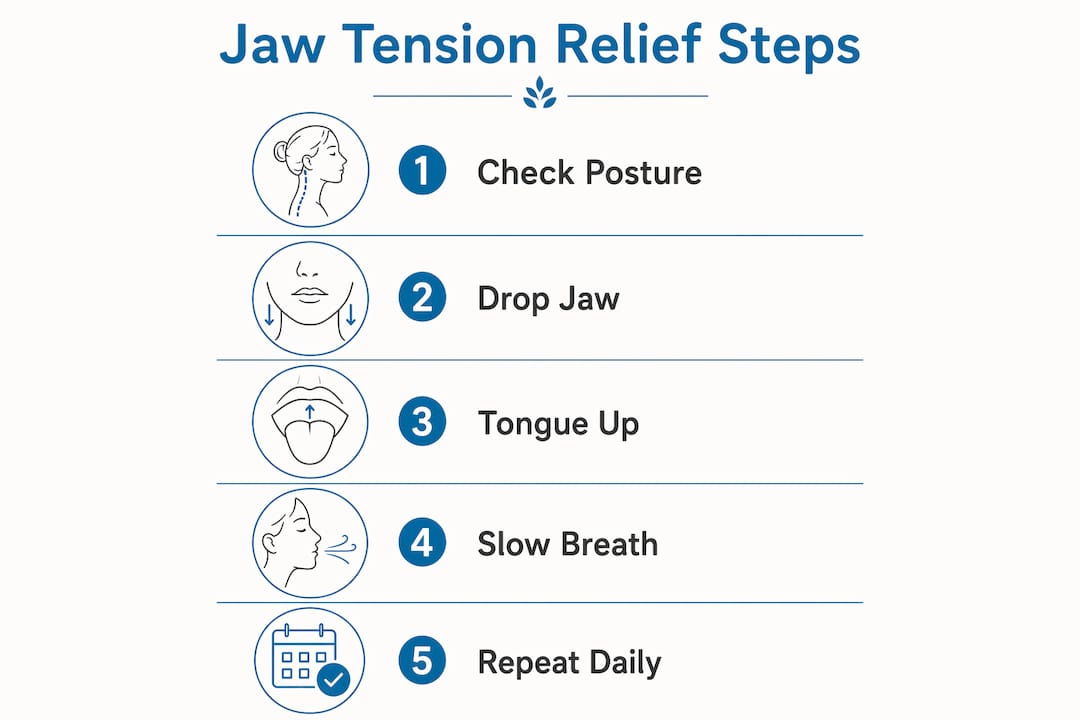
The fastest way to relieve jaw tension from stress is to stop, drop your jaw open slightly, place your tongue on the roof of your mouth, and take three slow nasal breaths. That single reset interrupts the clench reflex immediately. According to Medical News Today, stress and anxiety are among the most common triggers of unconscious jaw clenching and bruxism, and Johns Hopkins Medicine confirms that persistent tension can escalate into a temporomandibular disorder (TMD) if left unaddressed. Evergreenbliss carries a range of tools, from heated massagers to sleep aids, that complement the routines below.
Quick-start routine (do this right now):
- Breathing reset. Inhale slowly through your nose for 4 counts, exhale for 6. Repeat three times.
- Jaw rest posture. Tongue on the roof of your mouth, lips closed, teeth slightly apart. Hold 30 seconds.
- Gentle masseter massage. Press two fingers into the muscle just below your cheekbone and make small circles for 30 seconds per side.
- Warm compress. Apply a warm cloth or heat pack to both sides of your jaw for 2–3 minutes.
- Relaxed jaw stretch. Open your mouth slowly as wide as comfortable, hold 5 seconds, close gently. Repeat 5 times.
Table of Contents
- Why does stress make your jaw so tight?
- Step-by-step relief techniques you can do right now
- Daily habits that stop jaw tension from coming back
- When should you see a clinician about jaw pain?
- Why retraining your jaw posture and breathing works better than stretching alone
- Key Takeaways
- The habit most people skip (and why it matters most)
- Evergreenbliss tools that support your jaw relief routine
- Authoritative sources and further reading
Why does stress make your jaw so tight?
When your brain perceives a threat, real or imagined, it fires the sympathetic nervous system. Adrenaline floods your muscles, your shoulders rise, and your jaw clamps shut. The masseter and temporalis muscles, the two main chewing muscles, are among the first to respond to that fight-or-flight signal. They are also among the last to let go once the stressor passes.
Bruxism, the clinical term for teeth grinding and clenching, is one of the most common physical expressions of chronic stress. You may not even notice it happening. The signs of stress-induced jaw tension include waking with a sore jaw or dull headache, unexplained tooth sensitivity, a clicking or popping sound when you open your mouth, and difficulty opening wide first thing in the morning.
Statistic callout: Stress and anxiety are cited as primary drivers of bruxism and unconscious clenching, with key indicators including morning jaw soreness, unexplained headaches, and restricted mouth opening.
Common signs your jaw tension is stress-driven:
- Jaw feels tight or fatigued when you wake up
- Headaches that start at the temples or behind the eyes
- Clicking, popping, or grinding sounds in the jaw joint
- Neck and shoulder stiffness that worsens with stress
- Tooth sensitivity or visible wear on the biting surfaces
Pro Tip: Do a quick jaw check right now. Are your teeth touching? If yes, that is a clench. Teeth should only touch when you are actively chewing. This simple awareness test tells you immediately whether stress is driving your jaw tension.
Step-by-step relief techniques you can do right now
The 3–5 minute interrupt routine
Use this whenever you catch yourself clenching, before a meeting, after a difficult conversation, or any time you feel tension building.
- Diaphragmatic breath. Sit upright. Breathe in through your nose for 4 counts, letting your belly expand. Exhale slowly for 6 counts. This activates the parasympathetic system before you touch your jaw.
- Jaw hang. Let your jaw drop open naturally, no forcing. Tongue on the roof of your mouth, teeth apart, lips barely closed. Hold for 20 seconds.
- Masseter self-massage. Place two or three fingers on the muscle just below and in front of your ear. Apply gentle circular pressure. Work down toward your chin. Thirty seconds per side is enough.
- Warm compress. A warm, damp cloth held against both sides of the jaw for 2–3 minutes relaxes the muscle fibers and increases blood flow. Masseter massage paired with heat can produce noticeable relief within 10–15 minutes.
- Relaxed jaw stretch. Open slowly until you feel a mild stretch, not pain. Hold 5 seconds, close gently. Five repetitions.
The 10–15 minute deep-relief routine
When tension has built up over a stressful day, this longer sequence works through the full muscle chain.
- Breathing warm-up. Two minutes of slow nasal breathing. Diaphragmatic breathing treats the internal pressure that drives clenching, not just the muscle symptom.
- Goldfish exercise. Place one finger on your chin and one on your TMJ (just in front of your ear). Open and close your mouth slowly, keeping the movement vertical. Six repetitions.
- Resistance mouth opening. Place your thumb under your chin and gently resist as you open your mouth slowly. Hold 5 seconds at maximum comfortable opening. Repeat 6 times. This strengthens the muscles that pull the jaw backward and reduces forward strain.
- Controlled tongue-trace stretch. Close your mouth, rest your tongue tip just behind your upper front teeth, then slowly slide it back toward your soft palate. Hold that position and open your mouth until you feel your tongue being pulled away. Hold 5 seconds, close, relax. Repeat for 5 minutes. This is the exercise protocol recommended by Oxford University Hospitals for TMJ rehabilitation.
- Progressive face relaxation. Scrunch your entire face tightly for 5 seconds, then release completely. Repeat three times. Finish with two minutes of slow breathing.
Safety notes: Stop immediately if you feel sharp or shooting pain, if your jaw locks, or if clicking is accompanied by pain. Never force range of motion. Adapt the intensity so you feel a gentle stretch, not discomfort.
Pro Tip: The 3–5 minute routine works best before high-stress moments (a tough meeting, a commute). The longer routine is most effective at night, when the day’s accumulated tension is at its peak and you have time to let the muscles fully release.
Daily habits that stop jaw tension from coming back

Immediate relief matters, but the real goal is retraining your baseline. Most people who struggle with chronic jaw tension have spent years holding their jaw in a braced position without realizing it. Reversing that takes consistent, small daily actions.
Resting jaw posture
The correct resting position is: tongue on the roof of your mouth, lips closed, teeth slightly apart. That last part is the one most people miss. Teeth should not be touching unless you are chewing. Practicing this position throughout the day gradually lowers the resting tone of your masseter muscle. The Cleveland Clinic describes the jaw as an “indicator muscle” for stress and emphasizes that resting posture retraining is more important than repeated aggressive stretches.

Posture and ergonomics
Your jaw does not live in isolation. Forward head posture, common when staring at a screen, increases the load on the muscles that hold your jaw closed. Raise your monitor to eye level, keep your chin slightly tucked, and check that your shoulders are not creeping toward your ears. Neck tension and jaw tension feed each other.
Habit-stacking for jaw checks
- Tie a jaw check to three fixed moments: when you sit down at your desk, when you pick up your phone, and when you get into bed.
- Set a phone reminder labeled “jaw?” for mid-afternoon, when clenching tends to peak.
- Short body scans and micro-routines can meaningfully reduce the frequency of daytime clenching over time.
Sleep and nighttime measures
Nighttime grinding is harder to control consciously, but several habits reduce it. A custom night guard from your dentist protects your teeth and reduces the muscular load. Sleeping on your back rather than your stomach removes pressure from the jaw joint. A consistent wind-down routine, including the 10–15 minute deep-relief sequence above, lowers overall arousal before sleep. Mouth breathing during sleep also worsens jaw posture and clenching, so nasal breathing aids are worth considering.
Nutrition and hydration
Dehydrated muscles cramp more easily. Aim for adequate daily water intake and limit caffeine and alcohol, both of which increase muscle tension and disrupt sleep. Avoid hard, chewy foods on days when your jaw is already sore. Magnesium, found in leafy greens, nuts, and seeds, supports muscle relaxation, though you should confirm any supplementation with your doctor.
Pro Tip: Habit-stack your jaw check onto something you already do automatically. Every time you unlock your phone, run a two-second check: are my teeth touching? Tongue on the roof? That micro-habit, repeated dozens of times a day, retrains your baseline faster than any single exercise session.
When should you see a clinician about jaw pain?
Self-care works well for most stress-related jaw tension. But some symptoms signal that something structural is happening and that you need a professional evaluation.
Red flags: see a clinician if you have any of these:
- Jaw pain or stiffness that has persisted for more than a few weeks without improvement
- Audible clicking or popping accompanied by pain (painless clicking alone is usually benign)
- Your jaw locks open or closed, even briefly
- Progressive difficulty opening your mouth wide
- Visible tooth wear, chipping, or new sensitivity
- Ear pain, ringing, or a feeling of fullness not explained by an ear problem
- Severe or recurring headaches concentrated at the temples
Which clinician for which problem:
- Dentist: tooth wear, sensitivity, night guard fitting, and initial TMJ screening
- TMD specialist or oral and maxillofacial surgeon: joint clicking with pain, limited opening, or structural joint concerns
- Primary care physician: to rule out systemic causes and manage underlying anxiety or sleep disorders
- Therapist or psychologist: when anxiety, chronic stress, or a mood disorder is clearly driving the clenching
Johns Hopkins Medicine recommends a four-week conservative-care window before seeking referral, unless any of the red flags above are present. If red flags exist, book an appointment sooner. A functional exam, and imaging if indicated, can rule out structural causes quickly and get you on the right treatment path. Cognitive behavioral therapy and biofeedback have strong evidence for anxiety-driven bruxism when self-care alone is not enough. For anxiety-related jaw tension that has a clear psychological component, a therapist specializing in anxiety and physical symptoms can address the root driver directly.
Why retraining your jaw posture and breathing works better than stretching alone
Stretching feels productive, but doing it aggressively or repeatedly without addressing resting posture is like loosening a tight knot and then pulling it tight again. The Cleveland Clinic is explicit: the tongue-on-roof resting position is the most important daily habit, not the number of stretches you do.
The reason goes deeper than muscle mechanics. The trigeminal nerve, the largest cranial nerve, connects jaw proprioception directly to the brainstem’s autonomic control centers. When you deliberately relax your jaw, that nerve sends afferent feedback that shifts your nervous system toward parasympathetic dominance, producing a measurable drop in heart rate and a deepening of the breath. This is why a jaw release often relaxes your shoulders and slows your breathing within seconds. You are not just releasing a muscle; you are signaling your entire nervous system to stand down.
Pairing that jaw release with diaphragmatic breathing amplifies the effect. Slow nasal breathing activates the vagus nerve independently, and the two signals together produce a faster, more durable parasympathetic shift than either alone.
How to build the retraining practice:
- Week 1–2: Focus only on awareness. Use the habit-stacking cues above to catch yourself clenching. Each time you notice, reset to the correct resting position and take one slow breath.
- Week 2–4: Add the 3–5 minute interrupt routine twice daily, morning and evening. Pair it with the tongue-trace stretch from the deep-relief sequence.
- Week 4–6: Most people notice initial benefits within 7–14 days of consistent practice; plan for 4–6 weeks before judging whether the routine is working for recurring functional tension.
Consistency with gentle daily habits is more effective than intermittent aggressive stretches. Forcing range of motion during a pain flare can increase inflammation and set back progress. Gentle and frequent beats hard and occasional, every time.
Key Takeaways
Consistent jaw resting posture retraining, paired with diaphragmatic breathing and daily micro-checks, is the most effective long-term strategy to relieve jaw tension from stress and prevent recurrence.
| Point | Details |
|---|---|
| Immediate reset | Drop your jaw, tongue on roof, teeth apart, and take three slow nasal breaths to interrupt the clench reflex. |
| Daily resting posture | Teeth should never touch at rest; practicing the tongue-on-roof position throughout the day lowers baseline muscle tone. |
| Breathing is foundational | Diaphragmatic nasal breathing reduces the internal pressure that drives clenching and should pair with every exercise. |
| See a clinician at 4 weeks | If pain, clicking with pain, or limited opening persists beyond a few weeks, seek professional evaluation. |
| Evergreenbliss tools | Heated massagers, sleep aids, and nasal breathing supports from Evergreenbliss complement the daily routines above. |
The habit most people skip (and why it matters most)
Most people who search for jaw tension relief go straight for the stretches. They do five minutes of mouth-opening exercises, feel a little better, and then spend the next eight hours clenching right back to square one. The stretch addressed the symptom. The resting posture drives the outcome.
What actually moves the needle is the boring, unsexy habit: checking your jaw position a dozen times a day and resetting it. Tongue on the roof, teeth apart, one breath. That is it. Done consistently, it retrains the nervous system’s default setting for jaw tone. Stretches are useful, but they are maintenance on top of that foundation, not a substitute for it.
A practical mindfulness approach, anchoring that jaw check to three specific daily moments, is one of the most evidence-supported habit-reversal strategies for unconscious physical tension. You do not need a long meditation session. You need a two-second reset, repeated.
Evergreenbliss products fit naturally into this picture. A heated neck and jaw massager makes the 10–15 minute deep-relief routine more effective and easier to stick with. A sleep aid or white noise machine reduces the arousal that drives nighttime grinding. These are not replacements for the habits above; they are the tools that make those habits easier to maintain on hard days.
Evergreenbliss tools that support your jaw relief routine

The routines in this article work on their own. But the right tools make them easier to do consistently, especially on the days when stress is highest and motivation is lowest.
Evergreenbliss offers a curated selection of wellness tools that slot directly into the steps above. A heated massager applied to the jaw and neck area delivers the warmth and pressure that makes the deep-relief routine significantly more effective than a damp cloth alone. Sleep aids, including white noise machines and sleep masks, reduce the nighttime arousal that drives grinding. Nasal breathing supports help retrain mouth-breathing habits that worsen jaw posture during sleep. Posture braces and ergonomic supports address the neck-jaw tension link that desk workers deal with daily.
Browse the stress-relief and relaxation collection at Evergreenbliss to find tools that fit your routine, or explore the sleep and relaxation aids if nighttime clenching is your main concern. Free shipping and easy returns mean there is no friction in trying something new.
Authoritative sources and further reading
The claims in this article draw on clinical guidance and peer-reviewed research. The following sources are worth reading directly for additional depth:
- Bruxism | Johns Hopkins Medicine — clinical overview of bruxism causes, symptoms, and when to seek care
- TMJ massage and jaw relaxation guidance | Cleveland Clinic — practical guidance on resting posture retraining and massage technique
- Anxiety and tight jaw: causes and effective tension relief | Medical News Today — evidence-based overview of the anxiety-jaw connection
- TMJ exercises for pain relief | Colgate — exercise protocols and the role of breathing in TMJ relief
- Jaw relaxation exercises | JUST KFO — seven-exercise sequence with timelines for improvement
- Jaw release for stress and anxiety | Therma — explanation of the trigeminal nerve pathway and parasympathetic effects
- Does anxiety have you clenching your jaw? | Calm Blog — habit-reversal tactics and micro-routine examples
- Why deep breathing reduces stress | Evergreenbliss — science and techniques for diaphragmatic breathing
This article is general health information, not medical advice. If your symptoms are severe, persistent, or worsening, consult a qualified clinician for an evaluation specific to your situation.