Fight or flight is your body’s automatic response to a perceived threat, triggered in a fraction of a second by the sympathetic nervous system and a surge of adrenaline. It exists to help you survive danger, not to make you dread Monday’s inbox, though your body often can’t tell the difference. The moment it fires, several things happen at once:
- Your heart rate and blood pressure spike
- Breathing quickens to pull in more oxygen
- Muscles tense, ready to move
- Digestion and other “non-essential” functions slow down
The fastest way to bring your body back down is slow, paced breathing. If this state shows up constantly, lasts for hours, or comes with chest pain, panic, or thoughts of self-harm, talk to a doctor or mental health professional.
Key Takeaways
Fight or flight is a fast, automatic survival response driven by the sympathetic nervous system and adrenaline, and recovery speed matters more than avoiding triggers altogether.
| Point | Details |
|---|---|
| Definition | Fight or flight is an automatic sympathetic nervous system response that prepares your body to confront or escape danger. |
| Key hormones | Adrenaline drives the immediate surge, while cortisol sustains arousal if the HPA axis engages. |
| Recovery window | Most people return toward baseline within 20 to 30 minutes after a trigger passes. |
| Not everyone fights or flees | Freeze and fawn are equally valid defensive responses shaped by context and personal history. |
| Chronic activation carries risk | Repeated triggering without recovery raises cardiovascular, immune, and sleep-related health risks. |
Where to Read More
- Understanding the stress response, Harvard Health
- Physiology, Stress Reaction, StatPearls (NCBI Bookshelf)
- Fight-or-flight syndrome definition, NCI Dictionary of Cancer Terms
- What happens during fight-or-flight, Cleveland Clinic
Table of Contents
- What Is the Fight-or-Flight Response, and Why Did It Evolve?
- How Does the Fight-or-Flight Mechanism Actually Work?
- What Are the Common Signs of Fight or Flight?
- Beyond Fight or Flight: What Are Freeze and Fawn?
- How Long Does Fight or Flight Last, and What Happens if It Doesn’t Stop?
- What Actually Calms the Fight-or-Flight Response?
- When Should You Get Professional Help for Fight-or-Flight Symptoms?
- The Editorial Take: What People Get Wrong About Fight or Flight
- Frequently Asked Questions
- Sources
What Is the Fight-or-Flight Response, and Why Did It Evolve?
Physiologist Walter Cannon coined the term “fight-or-flight” in the 1920s, describing the body’s rapid mobilization when facing a threat. Researchers today also call it the acute stress response or hyperarousal, but it’s the same mechanism: a fast, full-body shift toward survival mode.
The logic behind it is simple. A body that can suddenly access more oxygen, more blood sugar, and more muscular power has a better shot at escaping a predator or fighting one off. That system worked well for early humans facing physical threats.
The problem is that your brain hasn’t updated its threat detector for 2026. It reacts to:
- A tense email from your boss
- Heavy traffic when you’re already late
- A notification from your bank
- An argument that hasn’t even started yet
None of these require you to sprint or throw a punch, but your body prepares for both anyway. Modern stressors trigger the same cascade that once responded to genuine physical danger, which is exactly why learning to manage it matters so much now.
How Does the Fight-or-Flight Mechanism Actually Work?
The physiology of fight or flight follows a clear sequence, and understanding it helps explain why the symptoms feel the way they do.
- Threat detection. Your amygdala, the brain’s alarm center, flags something as dangerous, often before you’ve consciously registered why.
- Hypothalamus activation. The amygdala signals the hypothalamus, which acts as the command center connecting brain and body.
- Sympathetic nervous system fires. This triggers the adrenal medulla to dump epinephrine (adrenaline) and norepinephrine into your bloodstream within seconds.
- Immediate physical shifts. Heart rate jumps, blood redirects to muscles, and pupils dilate, all within a heartbeat or two.
- HPA axis engages if the threat persists. The hypothalamus releases CRH, which prompts the pituitary to release ACTH, which tells the adrenal cortex to produce cortisol. This is the slower, sustained-arousal system.
- Parasympathetic system eventually intervenes. Once the threat passes, this “brake” system lowers heart rate and restores digestion, but only if it gets the chance to engage.
That last step is where most people get stuck, because modern life rarely gives the parasympathetic system a clean signal that the danger is over.
Recovery timeline: according to Cleveland Clinic, many people begin returning toward their physiological baseline within about 20 to 30 minutes of a triggering event. Staying activated well past that window often signals the stressor hasn’t actually resolved, or that your body is still processing something.

What Are the Common Signs of Fight or Flight?
Recognizing the fight-or-flight response in real time is half the battle. The signs cluster into a few categories, and most people experience some combination rather than all of them at once.
- Cardiovascular: racing heart, palpitations, a noticeable rise in blood pressure
- Respiratory and metabolic: faster, shallower breathing, and a rush of glucose released into the bloodstream for quick energy
- Cognitive and sensory: tunnel vision, heightened senses, and a narrowed focus that blocks out everything except the perceived threat
- Emotional and behavioral: a spike in anxiety, muscle tension, and a strong urge to either confront the situation or get away from it
Pro Tip: When you feel your chest tighten or your thoughts narrow, run a quick three-point check: heart rate, breath pace, and jaw tension. If all three are elevated, you’re almost certainly in an activated state, and that’s your cue to start slowing your breathing before the moment escalates.
Beyond Fight or Flight: What Are Freeze and Fawn?
Not everyone responds to threat the same way, and fight or flight is only part of the picture. Freeze looks like sudden stillness or a feeling of being stuck, often paired with a racing mind trapped inside a motionless body. Fawn shows up as appeasing or people-pleasing behavior, an attempt to defuse a threat by keeping the other person calm rather than fighting or running.
Which response shows up depends on a few things:
- Whether the person believes they have any control over the situation
- Past trauma history, which can prime the nervous system toward freeze or fawn
- The specific context, since the same person might fight in one scenario and freeze in another
Defensive responses extend well beyond the classic two, and recognizing your own pattern makes it easier to choose the right coping strategy or therapy approach.
How Long Does Fight or Flight Last, and What Happens if It Doesn’t Stop?
A single activation is short-lived for most people. The trouble starts when the trigger doesn’t go away, or when your brain keeps sounding the alarm long after the actual danger has passed.
Chronic stress tends to move through recognizable stages: an alarm phase (the initial surge), a resistance phase (the body adapts and keeps pushing cortisol out), and eventually exhaustion, where the system starts to break down. Sustained HPA axis activation during that resistance phase is what turns a helpful survival mechanism into a health liability.
The downstream effects of staying in that state show up across the body:
- Elevated risk for high blood pressure and cardiovascular strain
- Suppressed immune function, leading to more frequent illness
- Disrupted sleep, often from a nervous system that won’t power down
- Higher rates of anxiety and mood disorders with prolonged exposure
If you regularly notice you’re still wound up an hour or more after whatever set you off, that’s worth paying attention to rather than dismissing as normal.
What Actually Calms the Fight-or-Flight Response?
Getting out of an activated state isn’t about willpower. It’s about giving your parasympathetic nervous system a clear, physical signal that it’s safe to power down. A handful of methods have real evidence behind them.
- Paced breathing. Aim for about 4 to 6 breaths per minute, or try cyclic sighing: a double inhale through the nose followed by a long, slow exhale through the mouth. This directly engages vagal tone, which is the mechanism your body uses to apply the brakes.
- Grounding techniques. Naming five things you can see, four you can hear, and three you can touch interrupts the amygdala’s threat loop by redirecting attention to neutral sensory input.
- Sensory regulation tools. Weighted blankets, warmth, or gentle pressure can help settle an overactive nervous system, and Evergreenbliss covers several practical options in its guide to sensory relaxation tools.
- Consistent lifestyle habits. Regular aerobic exercise, a stable sleep schedule, and a scheduled daily relaxation practice, even five minutes, lower your baseline reactivity over weeks and months.
Pro Tip: Don’t wait until you’re activated to practice breathing techniques. Rehearse paced breathing when you’re calm so the pattern becomes automatic before you actually need it under pressure.
Clinical treatment becomes worth considering when self-directed tools stop being enough. Cognitive behavioral therapy, trauma-focused therapy, and in some cases medication can retrain how the nervous system interprets and responds to perceived threats. For a deeper look at the mechanics behind these techniques, Evergreenbliss’s piece on why deep breathing reduces stress walks through the physiology step by step.
When Should You Get Professional Help for Fight-or-Flight Symptoms?
Occasional activation is normal. It’s time to reach out for support when the response starts interfering with daily life, when panic attacks become frequent, when insomnia persists, or when you experience thoughts of self-harm.
- A primary care doctor can rule out medical causes like thyroid issues or heart conditions
- A mental health professional can screen for anxiety disorders or PTSD and provide CBT or trauma-focused therapy
- Emergency services should be your first call if safety is at risk
Author and Source Credentials
This article was written by Cadence, who covers stress physiology and sleep for Evergreenbliss’s wellness content library. Claims here draw on institutional and peer-reviewed sources rather than opinion:
- Harvard Health, Cleveland Clinic, and NCBI/StatPearls physiology entries
- Peer-reviewed reviews from PMC on defensive stress responses
The Editorial Take: What People Get Wrong About Fight or Flight
The biggest misconception isn’t about the mechanism. It’s about the fix. Most advice treats fight or flight like something to eliminate, when the actual research points somewhere different: the goal is recovery speed, not avoidance. You cannot stop your amygdala from firing when a car cuts you off. You can control how fast your parasympathetic system gets the memo that the danger has passed.
Conventional wellness content leans hard on “reduce stress” as a blanket goal, which is vague to the point of useless. The more precise, evidence-backed target is the 20 to 30 minute recovery window Cleveland Clinic describes. If you’re still activated well past that, the problem usually isn’t the trigger itself. It’s a missing off switch, whether that’s breathing practice, sensory tools, or unresolved chronic stress that needs professional attention.
Start with the physical layer before the psychological one. A body still flooded with cortisol won’t respond well to positive thinking. Calm the nervous system first, then deal with what triggered it.
Frequently Asked Questions
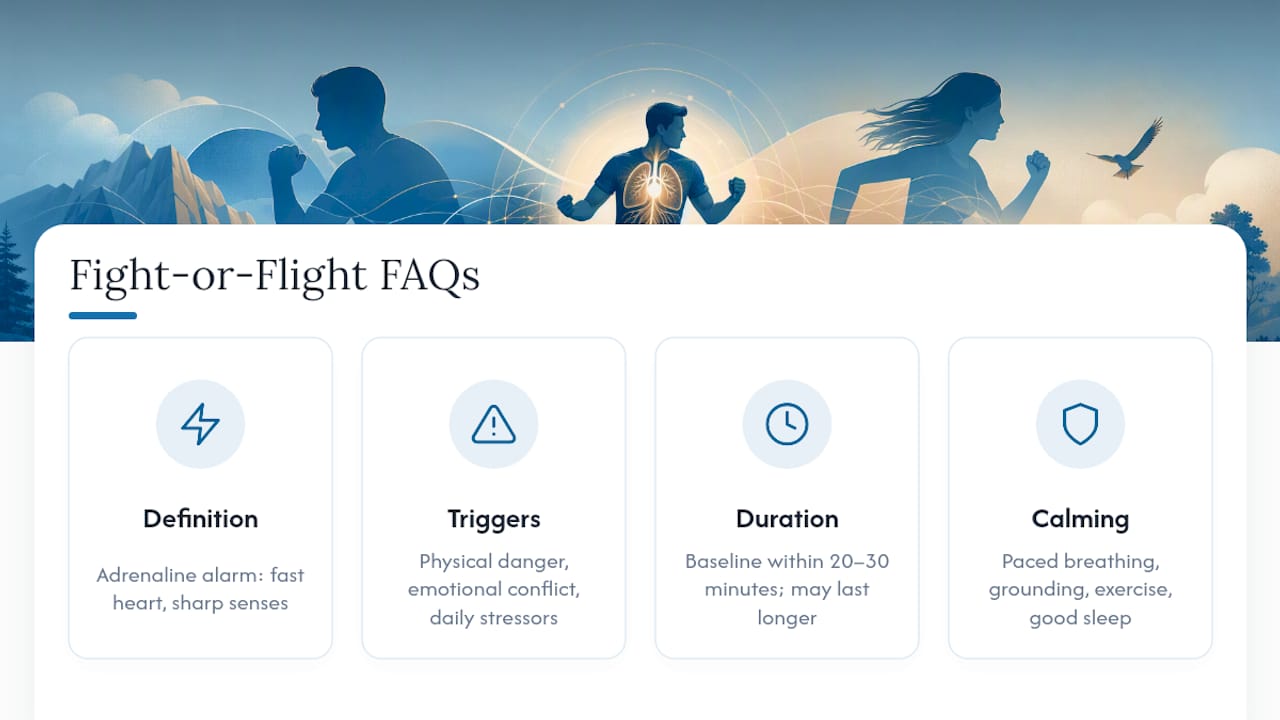
What is fight or flight in simple terms? It’s your body’s automatic alarm system, a rapid release of adrenaline that speeds up your heart, sharpens your senses, and prepares your muscles to either confront a threat or escape it.
What triggers the fight-or-flight response? Anything your brain perceives as a threat, including physical danger, emotional conflict, or everyday stressors like tight deadlines or heavy traffic, can set it off.
How long does the fight-or-flight response last? Most people start returning to baseline within 20 to 30 minutes once the trigger passes, though ongoing stress or unresolved trauma can extend that window considerably.
Is fight or flight the same as an anxiety attack? They overlap heavily. An anxiety or panic attack often involves the same sympathetic surge and cortisol release, just triggered without an obvious external threat.
Can you calm fight or flight without medication? Yes, for many people. Paced breathing, grounding exercises, regular exercise, and consistent sleep can meaningfully lower reactivity, though persistent or severe symptoms warrant professional evaluation.
If your everyday routine leaves your body chronically wound up, small, consistent tools can help support recovery between the bigger lifestyle changes. Evergreenbliss’s personal care and wellness gadgets collection includes options like the neck massager with soothing heat, designed to ease the muscle tension that so often lingers after a stress response fires.
This article is general information, not a substitute for advice from a qualified doctor. Consult a qualified healthcare professional about your own circumstances before acting on anything here.
Sources
- Understanding the stress response - Harvard Health
- Physiology, Stress Reaction - StatPearls (NCBI Bookshelf)
- What Happens During Fight-or-Flight Response? - Cleveland Clinic
- Fight, Flight, or Freeze - Harvard Mindscape
- PMC review on defensive responses