Mouth breathing during sleep is defined as the habitual use of the oral airway instead of the nasal passages to inhale and exhale, and it directly degrades sleep quality by increasing airway resistance and lowering blood oxygen saturation. The effects go well beyond snoring. Chronic mouth breathing fragments sleep cycles, raises the risk of obstructive sleep apnea (OSA), and triggers a chain reaction of symptoms including dry mouth, morning headaches, and daytime fatigue. Children face additional risks: abnormal facial development, speech disorders, and learning difficulties. Understanding how mouth breathing affects sleep is the first step toward doing something about it.
How does mouth breathing affect sleep physiology?
Mouth breathing increases airway resistance by allowing throat tissues to collapse more easily during sleep. The nasal passages are structurally designed to keep the airway open and stable. When you bypass them, the soft tissue at the back of the throat becomes more prone to vibration and obstruction, which is why mouth breathers snore more and wake more often.
The oxygen consequences are real. Mouth breathing lowers blood oxygen saturation, pushing the body into lighter, fragmented sleep stages rather than the deep, restorative cycles your brain and body need. Fragmented sleep means less time in slow-wave sleep and REM sleep, the two stages most critical for memory, immune function, and physical repair. You can read more about why those stages matter in this guide to REM sleep and brain health.

Pediatric research reinforces the connection to OSA. Children with higher mouth-breathing scores show more severe obstructive sleep apnea symptoms, making mouth breathing a clinically useful, non-invasive indicator of OSA severity in kids. The same physiological principle applies to adults: the more consistently you breathe through your mouth at night, the greater your risk of developing or worsening sleep apnea.
Key physiological effects of mouth breathing during sleep:
- Increased throat tissue collapsibility, raising OSA risk
- Reduced blood oxygen saturation, causing lighter sleep
- More frequent micro-arousals, fragmenting sleep architecture
- Dry mouth and throat irritation from unfiltered, unhumidified air
- Higher likelihood of snoring due to airway turbulence
Pro Tip: If you wake up with a dry mouth or a headache most mornings, those two symptoms together are among the most reliable signs of nighttime mouth breathing. Track them for one week before your next doctor’s visit.
What are the health consequences of mouth breathing in children?
Mouth breathing in children causes structural changes that are largely irreversible without early intervention. The condition is clinically associated with a pattern called “adenoid face,” which includes an elongated face, narrowed jaw, high-arched palate, and misaligned teeth. These changes happen because the tongue rests in the wrong position when a child habitually breathes through the mouth, altering the mechanical forces that shape developing bone.
The developmental consequences extend beyond facial structure:
- Speech disorders. Mouth breathing alters tongue posture and lip muscle tone, contributing to articulation problems and lisping.
- Learning difficulties. Fragmented sleep from mouth breathing reduces cognitive performance, attention span, and memory consolidation in school-age children.
- Skeletal malocclusion. Narrow jaw arches create crowded teeth and bite misalignment, often requiring orthodontic treatment.
- Behavioral issues. Sleep-deprived children frequently present with hyperactivity and irritability, symptoms that can be misread as ADHD.
- Increased OSA severity. Adenoidal and tonsillar hypertrophy combined with chronic mouth breathing significantly worsens obstructive sleep apnea in pediatric patients.
Mouth breathing in children is not just a habit. It is a visible clinical sign that something is obstructing the nasal airway, and that obstruction is actively shaping the child’s face, teeth, and brain development. Early evaluation by a pediatric ENT or dentist can prevent years of downstream health problems.
Mouth breathing is recognized as a risk factor for abnormal facial development, including elongated face, narrow jaw, and misaligned teeth. That means the window for intervention is narrow, and waiting to “see if they grow out of it” carries real structural costs.
How does nasal breathing compare to mouth breathing for sleep?
Nasal breathing outperforms mouth breathing on every measurable health outcome during sleep. The nasal passages filter, humidify, and warm inhaled air before it reaches the lungs. Mouth breathing bypasses all three functions, delivering cold, dry, unfiltered air directly to the airway and lungs, which increases irritation, dryness, and infection risk.
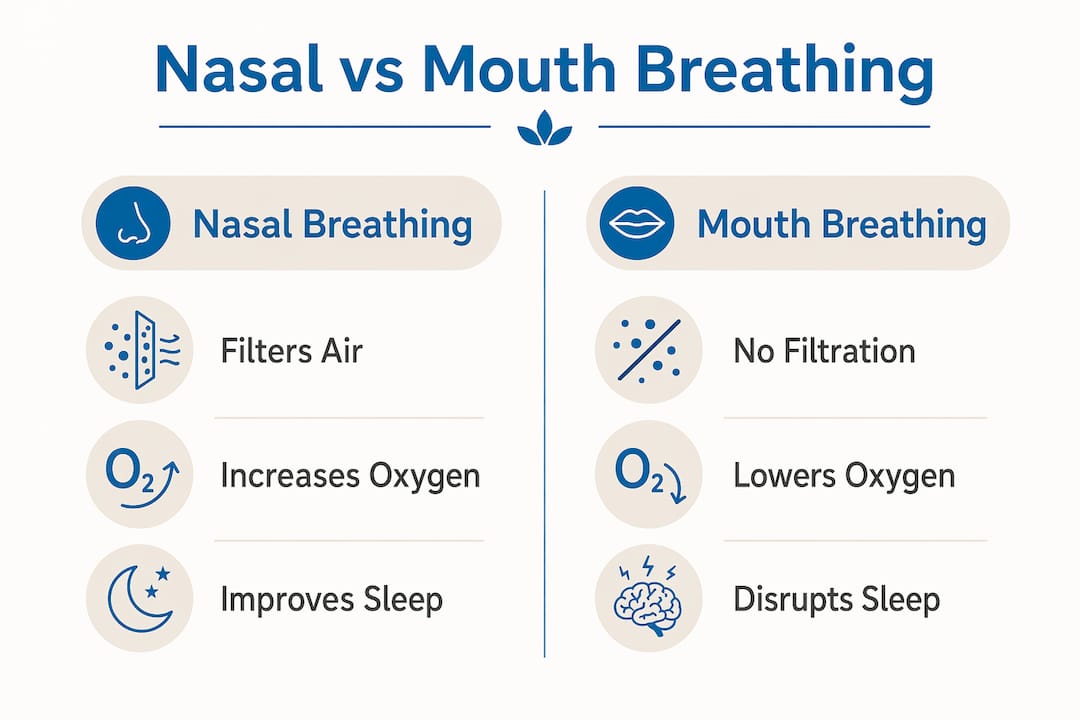
The vascular difference is striking. Research shows that nasal breathing produces a 4.46% increase in brachial artery diameter compared to mouth breathing in healthy young adults. That measurement reflects improved vascular endothelial function, meaning the blood vessels respond better and blood flows more efficiently. Better circulation during sleep supports tissue repair and cardiovascular health overnight.
| Feature | Nasal breathing | Mouth breathing |
|---|---|---|
| Air filtration | Filters particles and pathogens | No filtration |
| Air humidification | Humidifies inhaled air | Delivers dry air |
| Airway resistance | Lower, more stable | Higher, prone to collapse |
| Oxygen delivery | More efficient | Less efficient |
| Vascular function | Improved endothelial response | Reduced vascular benefit |
| Sleep architecture | Deeper, more consolidated | Fragmented, lighter |
| Infection risk | Lower | Higher |
The sleep architecture difference matters most at night. Nasal breathing supports the stable airway pressure needed to cycle through deep sleep stages without interruption. Mouth breathing creates the conditions for micro-arousals, the brief awakenings that most people never consciously notice but that leave them exhausted by morning.
What practical steps reduce mouth breathing and improve sleep quality?
The most important first step is identifying why you breathe through your mouth. Mouth breathing often compensates for nasal congestion caused by allergies, chronic sinusitis, a deviated septum, or enlarged tonsils. Trying to force nasal breathing without addressing the underlying blockage can worsen anxiety and sleep quality. A proper diagnosis from an ENT physician or allergist comes before any behavioral fix.
Once underlying causes are addressed or ruled out, several practical changes make a real difference:
- Treat allergies aggressively. Nasal corticosteroid sprays and antihistamines reduce congestion that forces mouth breathing at night.
- Adjust your sleep position. Side sleeping reduces airway collapse compared to sleeping on your back. It is one of the simplest environmental adjustments with measurable impact.
- Improve indoor air quality. A bedroom humidifier keeps nasal passages moist and reduces the irritation that triggers mouth breathing. HEPA air purifiers reduce allergen load.
- Use nasal strips. Adhesive nasal strips physically widen the nasal passages, reducing resistance and making nasal breathing easier during sleep. Evergreenbliss carries nasal strips for breathing comfort designed specifically for nighttime use.
- Practice nasal breathing during the day. Daytime nasal breathing habits carry over to sleep. This guide on breathing better throughout the day covers the mechanics in detail.
- Document your symptoms. Keep a one-week log of morning symptoms: dry mouth, headaches, and fatigue. That record helps a physician diagnose the severity and cause of your mouth breathing faster.
Pro Tip: Before bed, rinse your nasal passages with a saline solution. It clears allergens and debris from the nasal cavity, making nasal breathing noticeably easier for most people within the first night.
Dry mouth and morning headaches are the most reliable diagnostic signs of nighttime mouth breathing. Treating the underlying cause often relieves those symptoms within weeks of starting the right intervention.
Key Takeaways
Mouth breathing during sleep degrades oxygen delivery, fragments sleep cycles, and raises the risk of obstructive sleep apnea, with consequences that compound over time without treatment.
| Point | Details |
|---|---|
| Airway resistance increases | Mouth breathing collapses throat tissue more easily, raising OSA risk and causing fragmented sleep. |
| Children face structural risks | Chronic mouth breathing in kids causes adenoid face, dental misalignment, and cognitive delays if untreated. |
| Nasal breathing improves vascular health | Nasal breathing produces measurably better vascular endothelial function and more efficient oxygen delivery. |
| Diagnosis must come first | Forcing nasal breathing without treating the underlying blockage can worsen anxiety and sleep quality. |
| Symptoms are trackable | Dry mouth and morning headaches are reliable daily markers of nighttime mouth breathing. |
Why most people miss the signs until the damage is done
Most mouth breathers have no idea they are doing it. The habit develops at night, silently, as the body compensates for a blocked nose. By morning, the evidence is there: a dry, sticky mouth, a dull headache, and a tiredness that coffee does not fix. But those symptoms are so common that most people chalk them up to stress or a bad night rather than a breathing pattern that has been running for years.
What I find most striking is the chain reaction. Mouth breathing triggers dry mouth, which increases cavity risk and bad breath. It fragments sleep, which raises cortisol and impairs decision-making. It reduces oxygen efficiency, which compounds fatigue. Each symptom looks unrelated until you trace them all back to the airway. That is why a single conversation with an ENT or sleep specialist can reframe years of unexplained health complaints.
The other thing most articles miss: forcing yourself to breathe through your nose without fixing the obstruction is counterproductive. I have seen people tape their mouths shut at night based on social media advice, only to wake up more anxious and exhausted. The nose has to be clear first. That means treating the allergy, the polyp, or the structural issue before any behavioral tool will work. Proactive sleep tracking, even just noting your morning symptoms in a phone note, gives a physician the data they need to act fast.
— Cadence
Sleep better with Evergreenbliss wellness tools
Addressing mouth breathing starts with understanding the root cause, but the right tools make the process easier and more comfortable.

Evergreenbliss offers a curated range of sleep and relaxation aids designed to support healthier breathing and more restful nights, from nasal strips that widen the nasal passages to sleep comfort products that help you maintain better posture through the night. The personal care and hygiene gadgets collection includes respiratory aids and wellness tools that complement the medical advice your doctor provides. Every product ships free, with easy returns, so you can find what works for your body without risk.
FAQ
What are the main signs of mouth breathing during sleep?
Dry mouth, morning headaches, and persistent fatigue are the most reliable signs. Snoring and waking with a sore throat are also common indicators of nighttime mouth breathing.
Can mouth breathing cause sleep apnea?
Mouth breathing significantly raises the risk of obstructive sleep apnea by increasing throat tissue collapsibility and reducing airway stability during sleep. It is both a symptom and a contributing factor in OSA development.
Is mouth breathing during sleep dangerous for children?
Chronic mouth breathing in children is linked to abnormal facial development, dental misalignment, speech disorders, and worsened obstructive sleep apnea. Early evaluation by a pediatric ENT is the recommended course of action.
Does nasal breathing actually improve sleep quality?
Nasal breathing supports deeper, more consolidated sleep by maintaining stable airway pressure and delivering better-humidified, filtered air to the lungs. Research shows it also improves vascular endothelial function compared to mouth breathing.
How do I stop breathing through my mouth at night?
Start by identifying the cause, whether allergies, a deviated septum, or enlarged tonsils, and treat it medically. Supportive measures like nasal strips, side sleeping, and improved indoor air quality can then reinforce nasal breathing during sleep.