For active recovery, most people do best with a massage once a week or every other week for a short course of two to six sessions, then space sessions out to every four to eight weeks for maintenance; see bodies by Mahmood’s general services for practitioner guidance on scheduling norms. The right pace depends on how severe the injury is, what your body is telling you between sessions, and what your therapist sees on the table.
TL;DR:
- Active recovery massage sessions should be scheduled twice a week during the first 2 to 4 weeks for injuries, athletes, or chronic pain, then tapered based on progress.
- Research indicates that biweekly 40 to 60 minute sessions provide better recovery outcomes than sporadic or less frequent treatments.
- Timing massage sessions around workouts is crucial: gentle work 24 to 72 hours before competitions and a full recovery session 2 to 3 days after intense activity.
- Tapering frequency depends on objective markers like pain levels and range of motion, with a safe shift to every 4 to 8 weeks once stability improves.
- Massage is unsafe with active infections, blood clots, certain fractures, or early post-surgical phases; medical clearance is necessary in these cases.
Table of Contents
- Massage Frequency for Recovery by Goal and Situation
- What Does the Research Say About Massage and Recovery Timing?
- When Should You Schedule Massage Around Workouts?
- How to Taper Massage Frequency as You Recover
- When Is Massage Not Safe, and When Should You See a Clinician?
- What Can You Do Between Massage Sessions to Extend the Benefits?
- A Starter Plan Worth Testing
- Building a Recovery Routine Between Sessions
- Sources
Massage Frequency for Recovery by Goal and Situation
The right schedule changes depending on what you’re recovering from. A sprained ankle needs a different plan than a marathoner’s Tuesday training block, and neither looks like the once-a-month tune-up a desk worker might need for tight shoulders.
Here’s how frequency typically breaks down by goal:
- Acute injury (first 2 to 4 weeks): Two sessions per week, 30 to 45 minutes each, using gentler techniques while swelling and inflammation are active. Post-surgical cases should follow a clinician’s specific timeline rather than a general rule.
- Athletes in heavy training: Weekly or biweekly sessions of 45 to 60 minutes, often sports massage or deep tissue work, timed around the training calendar rather than random open slots.
- Chronic pain (neck, low back, migraine-related tension): A concentrated course, often weekly for four to six weeks, before dropping to a maintenance interval once symptoms stabilize.
- Maintenance and desk-bound stiffness: Every four to eight weeks, 30 to 60 minutes, Swedish or light deep tissue, mainly to keep chronic tightness from building back up.
Watch three signals to decide whether to add or subtract sessions: your pain rating (is it trending down or plateauing?), functional movement (can you do the thing you couldn’t do two weeks ago?), and how your training load feels the day after a hard session. If soreness lingers past 72 hours or pain climbs instead of falling, that’s your cue to slow the pace and talk to your therapist, not push through on the same schedule.
What Does the Research Say About Massage and Recovery Timing?
The clinical evidence backs a fairly specific rhythm, and it’s more consistent than you’d expect for something as variable as hands-on therapy. A systematic review and meta-analysis covering 47 studies and 3,284 participants found massage therapy meaningfully reduced pain, improved range of motion, and lowered creatine kinase, a blood marker of muscle damage. The strongest outcomes for sports-related muscle injuries came from biweekly 40 to 60 minute sessions, not daily or occasional ones.
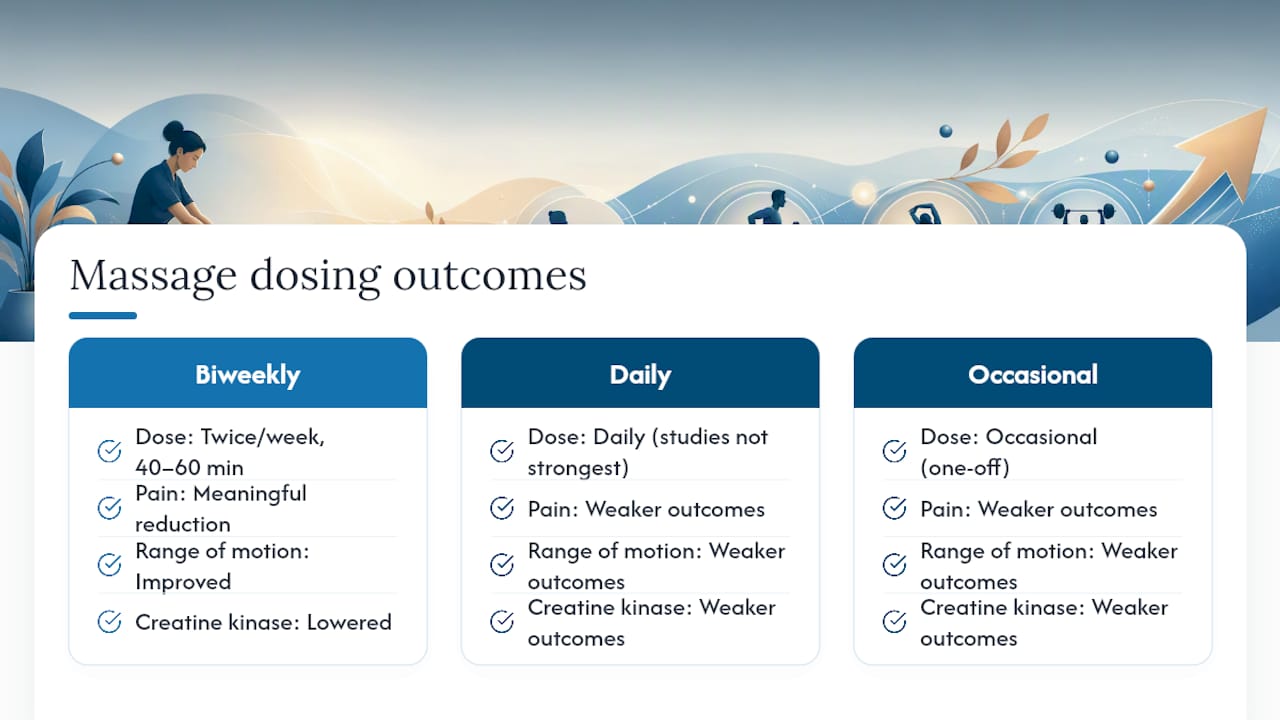
Sessions twice per week lasting around 40 to 60 minutes showed more favorable recovery outcomes across a large participant group in sports-injury research.
That biweekly finding lines up with a separate strand of evidence on dosage. The National Center for Complementary and Integrative Health reviewed randomized controlled trials on chronic nonspecific neck pain and found a four-week course of 60-minute sessions, done multiple times weekly, outperformed shorter or less frequent dosing. More time on the table, delivered more often over a defined window, produced better results than the same total time spread thin.
Condition-specific trials tell a similar story. One trial found weekly massage over eight weeks reduced migraine frequency, and a separate trial using twice-weekly trigger-point work cut tension headache frequency compared to a wait-list control group. None of this amounts to a universal formula. Study designs vary, sample sizes are modest, and headache trials don’t necessarily generalize to hamstring strains. The practical takeaway holds up anyway: short, concentrated courses beat sporadic, one-off sessions when you’re actively recovering from something specific.
When Should You Schedule Massage Around Workouts?
Timing massage around training or competition matters almost as much as frequency. Get the window wrong and you can blunt performance or delay the exact recovery you’re chasing.
- Before a competition or hard session: Keep it light. Schedule gentle work 24 to 72 hours out, and skip deep tissue the day before. Aggressive pressure right before an event can leave muscles feeling flat rather than primed.
- After intense exercise or an event: The most effective window for reducing delayed onset muscle soreness sits at 24 to 72 hours post-activity, which is roughly when DOMS peaks and inflammation is most responsive to manual work.
- Routine post-workout recovery: For regular training rather than a big event, a lighter session within 2 to 24 hours can help, depending on how hard you pushed.
- Race or event blocks: Build light work into the week before, then plan a fuller recovery session two to three days after, rather than immediately at the finish line.
How to Taper Massage Frequency as You Recover
Tapering isn’t guesswork if you track the right markers. Most people can follow a simple three-step down-shift.
- Weeks 1 to 3: Weekly or twice-weekly sessions while symptoms are active.
- Weeks 4 to 8: Space out to every two to four weeks once pain drops and range of motion improves.
- Beyond week 8: Shift to a four to eight week maintenance rhythm if function is stable and training load isn’t spiking.
Objective markers matter more than how you feel on any given day: pain scores, range of motion, and whether your training volume is climbing without new soreness. Subjective markers count too. Better sleep and a sense of “recovered” rather than “wrecked” the morning after training both suggest you can space sessions further apart. If any of those markers reverse, especially a return of sharp pain or reduced motion, step back to a more frequent schedule rather than waiting it out.
When Is Massage Not Safe, and When Should You See a Clinician?
Massage isn’t right for every situation. Active infection, suspected blood clots, certain fractures, and early post-surgical phases usually require medical clearance before any hands-on work begins. Skin conditions, unexplained bruising, or fever are also reasons to check with a doctor first rather than book a session.
Tell your therapist exactly what you’re recovering from and how the last session felt, including anything that got worse afterward. That feedback loop is how frequency and pressure get adjusted safely over time.
Pro Tip: If soreness after a session lasts more than 48 hours, or you notice numbness, sharp pain, or swelling that wasn’t there before, stop the current schedule and get it checked out before your next appointment.
What Can You Do Between Massage Sessions to Extend the Benefits?
The gains from a good massage don’t have to fade by the time your next appointment rolls around. Sleep, hydration, and light mobility work all extend what a session accomplishes, and sleep quality in particular has an outsized effect on how fast tissue repairs itself.
- Foam roll or use a spiky massage roller for five to ten minutes on non-session days, easing off if an area feels raw or bruised.
- Stretch major muscle groups gently after workouts, not before.
- Stay hydrated. Dehydrated tissue feels tighter and responds less well to manual pressure.
- Use an acupressure mat or a neck massager for localized tension on days without a scheduled session, but skip aggressive self-massage directly over acute injuries.
A Starter Plan Worth Testing
For general soft-tissue recovery, try weekly sessions for three weeks, then taper to every two to three weeks. Tell your therapist your specific goal, log how you feel 48 hours later, and adjust based on that feedback plus whatever your clinician recommends if anything’s medically complicated.
— Cadence
Building a Recovery Routine Between Sessions
Weekly or biweekly massage works best when it’s part of a routine, not an isolated fix. Between professional sessions, the right at-home tools help maintain what a therapist’s hands accomplished, especially on the days your calendar doesn’t allow a full appointment.

Evergreenbliss stocks a home fitness recovery collection built specifically to bridge the gap between sessions: a massage foam roller for self-myofascial work on non-appointment days, a neck massager with a soothing heating mode for localized tension that flares up at a desk, and a palm sleep massager to help wind down before bed, since sleep quality drives how well tissue repairs itself between visits. None of these replace a licensed therapist, particularly for acute injuries or anything a clinician needs to clear first. They’re built to hold the line between appointments so your next session isn’t starting from scratch. Browse the personal care and hygiene gadgets collection to find the right fit for your recovery schedule, and check with a clinician before adding aggressive self-massage on top of any existing injury.
This article is general information, not a substitute for advice from a qualified doctor. Consult a qualified healthcare professional about your own circumstances before acting on anything here.
Sources
- The Effectiveness of Massage Therapy in Treating Sports-Related Muscle Injuries: An Evidence-Based Systematic Review and Meta-Analysis
- Massage therapy for health: what the science says (NCCIH)
- PubMed indexed RCTs on massage frequency and headache outcomes