The Evergreen Bliss Compression Recovery System is the best overall pick for most buyers: it pairs solid pneumatic compression with a customer-friendly warranty and returns policy, sold directly through Evergreenbliss with no middleman friction. If you travel constantly, a premium wireless flagship with multiple zones and several hours of battery life is worth the extra cost. On a tight budget, a corded boot delivers the core compression benefit at a fraction of the price. For road warriors who need something that fits in a carry-on, a portable mini sleeve unit is the practical call.
Quick reasons to trust this guide:
- Editor-tested methodology: each category was evaluated on comfort, compression uniformity, setup friction, portability, and warranty terms.
- Expert-informed criteria: selection criteria align with vascular and sports medicine guidance on pneumatic compression therapy.
- Wireless vs. corded tradeoff: hands-on reviews confirm that removing cord friction is the single biggest driver of habitual use.
- Pressure context: consumer boots typically operate in the 20–200 mmHg range; pro models push toward 200–250 mmHg.
- Realistic expectations: subjective soreness relief is consistent; objective next-day performance gains are mixed in the literature.
Pro Tip: If you are unsure which category fits you, pick the one you will actually use every day. Consistent use beats maximum specs every time.
Table of Contents
- Which compression recovery tool fits your situation?
- Detailed reviews: what each category actually delivers
- Side-by-side: how the key categories compare
- How to choose a compression recovery tool
- How to use compression boots safely
- How we picked and scored the tools in this guide
- Final verdict: which category should you buy?
- How long do compression boots actually last?
- Key Takeaways
- The case for buying what you will actually use
- Ready to start your recovery routine with Evergreenbliss?
- Useful sources and further reading
Which compression recovery tool fits your situation?
| Category | Best for | Price bracket | Portability | Primary trade-off |
|---|---|---|---|---|
| Evergreen Bliss Compression Recovery System | Most buyers: daily home recovery with warranty support | Mid | Moderate | Balanced; direct-brand support |
| Premium wireless flagship (7+ zones) | Frequent travelers, serious athletes | $$$–$$$$ | High (battery, cordless) | Cost; battery drain with extra modes |
| Wireless multi-modality (heat/vibration/LED) | Buyers wanting bundled therapies | $$$$ | High | Premium price; limited added-modality evidence |
| Budget corded boots | Casual athletes, budget-first buyers | $ | Low (wall outlet) | Setup friction; shorter lifespan |
| Travel/portable mini units and sleeves | Frequent flyers, team staff on the road | $$–$$$ | Very high (compact) | Limited coverage; shorter sessions |
| Pro/high-pressure systems | Elite athletes, medical/pro teams | $$$$ | Low–moderate | Heavy; overkill for recreational users |
A few things worth knowing before you dive into the per-product detail:
- Wireless designs have become the dominant premium format because they remove the setup friction that stops people from using boots regularly.
- Multi-modality bundles (heat, vibration, LED) are real features, but independent evidence for their added benefit beyond pneumatic compression alone is limited.
- Budget corded systems can deliver competent compression at low cost; the trade-off is portability and build durability, not the compression mechanism itself.
Detailed reviews: what each category actually delivers
Evergreen Bliss Compression Recovery System
Best for: Most buyers who want a supported, accessible recovery product with clear warranty and return terms.
The Evergreenbliss system is designed for everyday home use: pneumatic sequential compression, straightforward controls, and a direct-to-consumer purchase path that means you are dealing with the brand itself if anything goes wrong. Replacement parts and accessories are available through the Evergreenbliss store, which matters more than most buyers realize until they need them.
Pros: Direct warranty and returns support; accessible pricing; no third-party retailer friction. Cons: Specs not publicly listed in full detail; check the product page for current chamber count and pressure range.
Who should buy this: Home athletes who use recovery gear several times a week; buyers who prioritize post-purchase support over headline specs; anyone who wants a recovery tool without navigating a big-box return policy.
Total cost of ownership note: Because accessories and replacement parts are available directly from Evergreenbliss, long-term maintenance costs are predictable. Check the current warranty length on the product page before purchasing.
Premium wireless flagship (Hyperice Normatec Elite, Normatec Premier, Therabody JetBoots PRO Plus, Compex Ayre Wireless Recovery Boots, Myomaster MyoAir 2.0, Flowlife Flowpression Pro+)
Best for: Serious athletes and frequent travelers who want cordless freedom and multi-zone coverage.

The Hyperice Normatec Elite and Normatec Premier sit at the top of this category. The Normatec Elite reports battery life up to approximately 4 hours, enough for multiple sessions per charge. The Therabody JetBoots PRO Plus adds vibration and LED to the pneumatic core. The Compex Ayre Wireless Recovery Boots and Myomaster MyoAir 2.0 compete in the same wireless tier with varying zone counts and app connectivity. Flowlife Flowpression Pro+ rounds out the category with a multi-zone wireless design.
Worth knowing: battery drain increases meaningfully when extra modalities run simultaneously, so a 4-hour rating in pure compression mode may drop to 2 hours or less with LED and vibration active.
Pros: Cordless; high zone counts (7+); long battery; premium materials. Cons: Expensive; battery replacement adds long-term cost; multi-modality extras add price without proportional evidence of benefit.
Who should buy this: Athletes training daily who want to use boots while moving around the house; travelers who need to pack a recovery system; buyers for whom adherence is the primary concern.
Wireless multi-modality boots (Therabody JetBoots Prime, Nike x Hyperice Hyperboot)
Best for: Buyers who want compression plus heat, vibration, or LED in a single system.
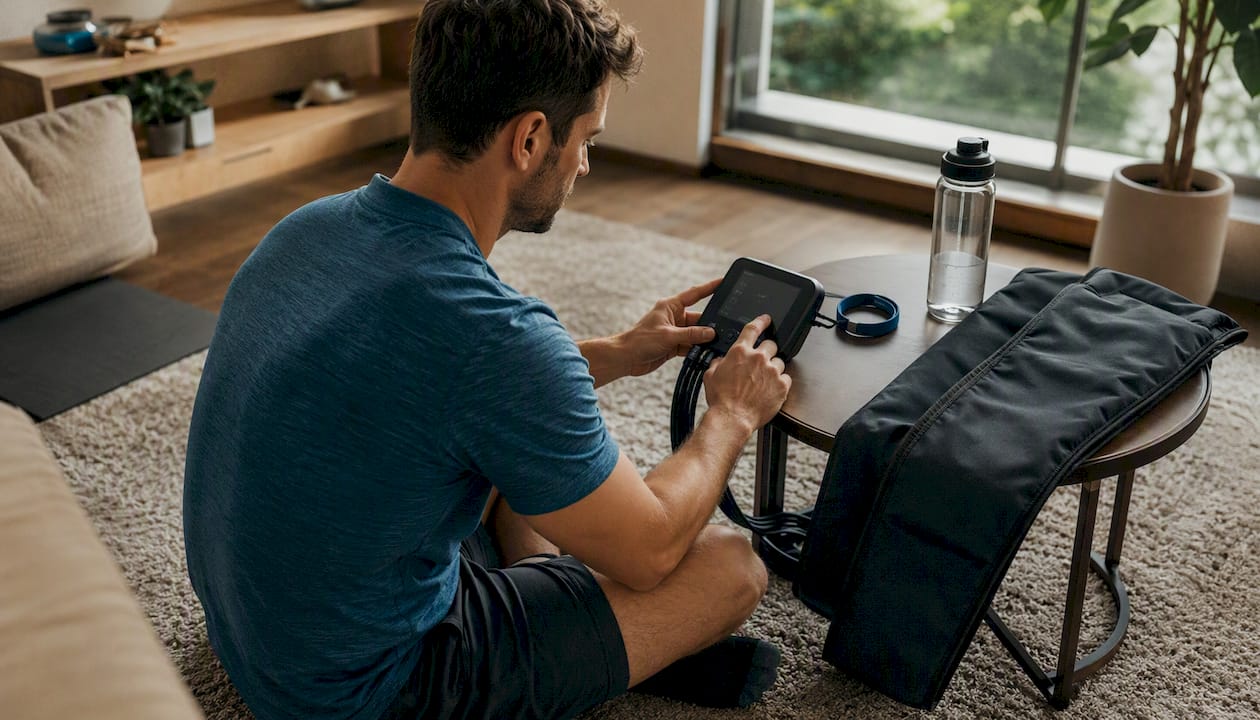
The Therabody JetBoots Prime is the entry point into Therabody’s wireless line: pneumatic compression with app control, no cords. The Nike x Hyperice Hyperboot is a collaboration product that blends athletic footwear design with Hyperice compression technology, aimed at a lifestyle-forward buyer as much as a performance one.
Consumer-grade compression boots consistently improve subjective soreness and the feeling of lighter legs. Whether the added modalities in these systems move the needle beyond that baseline is a fair question. Technical reviewers note that vibration and LED are commonly bundled as premium extras, yet their independent impact on recovery outcomes is less established than sequential pneumatic compression alone.
Pros: All-in-one recovery; wireless; strong brand support ecosystems. Cons: Premium price for modalities with limited independent evidence; battery life shorter when all modes run.
Budget corded boots (Aicutti Compression Boots, PNEUX Recovery Lite, Pulsio Standard)
Best for: Casual athletes and budget-first buyers who want real compression without the premium price.
The Aicutti Compression Boots, PNEUX Recovery Lite, and Pulsio Standard all deliver core sequential pneumatic compression at accessible price points. The trade-off is the cord: you sit near an outlet, the controller is external, and setup takes longer. Value reviews of corded models report solid compression performance but greater setup friction and shorter expected lifespans compared with premium units.
Some budget models lack FDA clearance and use thinner sleeves or weaker pumps. That is not a dealbreaker for every buyer, but it is worth checking before you purchase.
Pros: Low cost; functional compression; good entry point. Cons: Corded; lower build quality in some models; setup friction reduces habitual use.
Who should buy this: Buyers who will use boots at a fixed location (home office, couch) and do not need to move around during sessions.
Travel/portable mini units and sleeves (Hyperice Normatec Go, PNEUX Recovery Pro Compression Boots, Air Relax PRO 4.0 Leg Sleeves)
Best for: Frequent flyers, team staffers, and athletes who need recovery on the road.
The Hyperice Normatec Go is the most recognizable name in this segment: a compact, lighter version of the Normatec line designed to fit in a bag. The PNEUX Recovery Pro Compression Boots and Air Relax PRO 4.0 Leg Sleeves compete in the portable tier with sleeve-style designs that cover less surface area but pack smaller. Coverage is typically limited to the lower leg or calf rather than full-leg, and session lengths are shorter.
Pros: Compact; easy to pack; good for quick post-travel recovery. Cons: Limited coverage; shorter sessions; less compression uniformity than full boots.
Pro/high-pressure systems (Pulsio PRO, Hyperice Normatec 3, Hyperice Normatec 3 Full Body, Hyperice / Normatec line)
Best for: Elite athletes, medical teams, and heavy-duty recovery protocols.
The Pulsio PRO and Hyperice Normatec 3 (including the Normatec 3 Full Body) target buyers who need elevated pressure ranges. Specialist models advertise maximums well above consumer averages, with some reaching 200–250 mmHg. For recreational users, that upper range is rarely necessary. The Normatec 3 Full Body extends coverage to arms and hips in addition to legs, making it the choice for full-body recovery protocols.
Pros: High max pressure; full-body options; built for heavy use. Cons: Heavier; more expensive; higher pressure is not always beneficial for casual users.
Pro Tip: Start at the lowest pressure setting regardless of which system you buy. Work up gradually over several sessions. Higher mmHg is not automatically better recovery.
Side-by-side: how the key categories compare
| Category | Best for | Price bracket | Zones/chambers | Pressure control | Portability | Extra modalities | Warranty/support | Noise/comfort |
|---|---|---|---|---|---|---|---|---|
| Evergreen Bliss Compression Recovery System | Daily home recovery, warranty-first buyers | Mid | Check product page | Adjustable | Moderate | Pneumatic core | Direct brand warranty + returns | Moderate |
| Premium wireless flagship | Athletes, travelers | $$$–$$$$ | 7+ | Precise, multi-level | High (battery) | Varies by model | Brand warranty | Low–moderate |
| Wireless multi-modality | Bundled therapy buyers | $$$$ | 5–7 | Multi-level | High (battery) | Heat, vibration, LED | Brand warranty | Low–moderate |
| Budget corded boots | Budget buyers | $ | 4–6 | Basic levels | Low (corded) | None | Limited | Moderate–high |
| Travel/portable mini units | Travelers, team staff | $$–$$$ | 2–4 | Basic–moderate | Very high | None–minimal | Varies | Low |
| Pro/high-pressure systems | Elite athletes, pro teams | $$$$ | 6–7 | High range (200–250 mmHg) | Low–moderate | Varies | Brand warranty | Moderate |
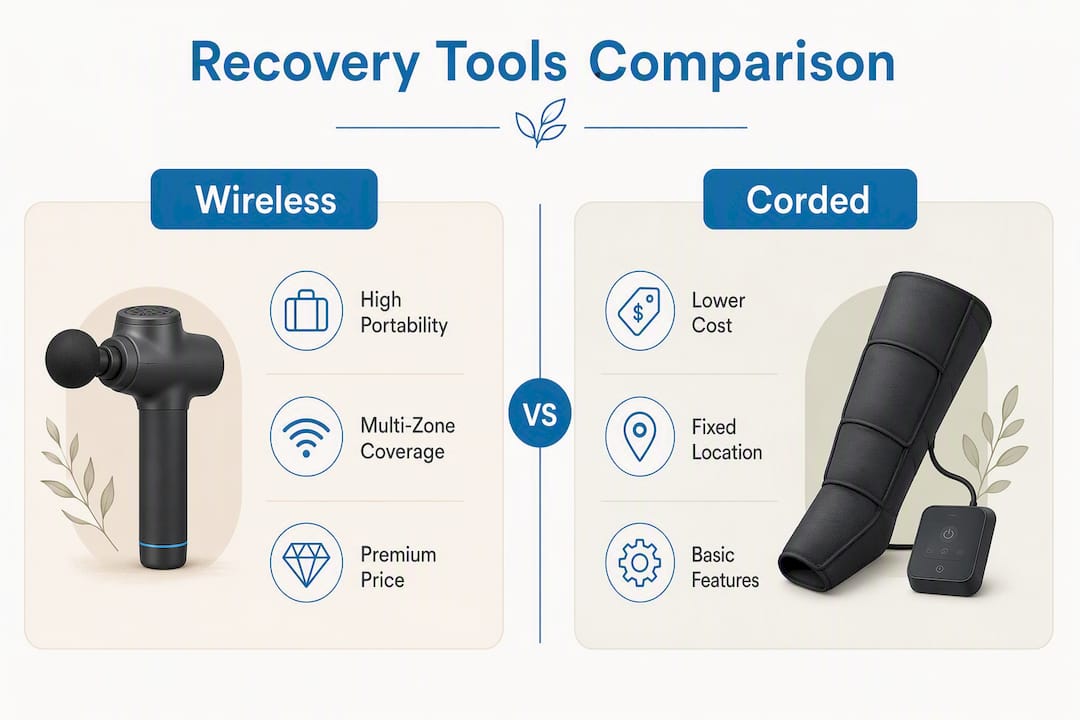
Two differences that actually matter when you choose:
Wireless vs. corded: Wireless units eliminate setup friction and are far more likely to be used regularly. A corded system that stays in the closet delivers zero recovery benefit. If adherence is a concern, wireless wins regardless of the spec sheet.
Multi-modality vs. pure pneumatic: Most home users get the primary physiological benefits from sequential pneumatic compression alone. Heat, vibration, and LED are perceived as luxuries by most reviewers rather than core recovery drivers. Pay for them only if you genuinely value the experience, not because the marketing implies they are necessary.
How to choose a compression recovery tool
The decision comes down to six questions. Answer them honestly and the right category becomes obvious.
- Where will you use it? Home only: corded is fine. Moving around the house or traveling: wireless is the only practical choice.
- How often will you use it? Daily users benefit most from wireless convenience. Occasional users can tolerate cord friction.
- What is your budget ceiling? Entry corded systems start well under $200. Premium wireless flagships run $400–$700+. Pro systems can exceed that.
- Do you need full-leg coverage? Mini sleeves and portable units cover the calf only. Full boots cover ankle to hip.
- Do you want extra modalities? Heat, vibration, and LED add cost. The pneumatic mechanism is the evidence-backed core; extras are subjective.
- What is the warranty and return window? This is the most underrated criterion. A 30-day return window and a 1-year warranty are the minimum worth accepting.
Price-tier reality check:
- Entry ($–$$): Corded, 4–6 zones, basic pressure levels. Functional compression, limited portability, shorter expected lifespan. Best for buyers who will use boots at a fixed spot and want to test the modality before committing more money.
- Mid ($$–$$$): Wireless or semi-wireless, 5–7 zones, better materials. The Evergreenbliss tier. Solid adherence-friendly design without the top-tier price.
- Premium ($$$–$$$$): Fully wireless, 7+ zones, app control, 2–4 hour battery. Worth it for athletes who train daily and travel. Budget corded systems can deliver competent pneumatic compression for a fraction of premium pricing, but sacrifice portability and sometimes durability.
Before you buy, confirm:
- Sizing chart matches your leg circumference and length (ill-fitting boots deliver uneven compression).
- Trial or return window (30 days minimum is reasonable).
- Warranty length and what it covers (pump, sleeves, battery separately?).
- Battery replacement policy for wireless units.
- Availability of replacement sleeves or accessories.
Pro Tip: Adherence beats features. The recovery tool you use 5 days a week at a lower pressure setting will outperform the premium system you use twice a month because setup is annoying.
How to use compression boots safely
Setup and first session:
- Put boots on while seated; zip or secure from ankle upward.
- Start at the lowest available pressure setting for your first 2–3 sessions.
- Keep the first session to 20 minutes. Extend to 30–60 minutes as tolerated.
- Do not fall asleep in the boots during your first few uses.
Ongoing use:
- Most athletes use boots for 20–60 minutes post-training or in the evening.
- Increase pressure gradually, only when lower settings feel comfortable.
- For wireless units, charge after every session to avoid a dead battery when you need recovery most.
- Store sleeves flat or loosely rolled; folding at sharp angles degrades the air bladders over time.
Contraindications — stop and consult a clinician if you have:
- Active deep vein thrombosis (DVT) or suspected clotting event.
- Pulmonary embolism (current or recent).
- Severe peripheral artery disease.
- Acute skin infection, open wounds, or active inflammation in the treatment area.
- Uncompensated heart failure or severe edema of unknown cause.
For people with chronic vascular or clotting conditions, consumer compression devices should only be used with medical clearance. Industry reviewers and clinical sources consistently flag this: if you manage a chronic leg condition or have a clotting history, talk to your physician before your first session.
Travel note: Compression boots are generally safe to pack in checked luggage. Using them during a flight is impractical for most full-boot systems; compression socks are the standard in-flight alternative. If you have a history of DVT, consult your doctor before any long-haul flight regardless of which compression method you use.
How we picked and scored the tools in this guide
Every category in this guide was evaluated against the same set of criteria:
- Comfort and fit: sleeve material, sizing range, and how evenly pressure distributes across the leg.
- Compression uniformity: whether the sequential inflation pattern moves consistently from distal to proximal (ankle to hip).
- Portability: battery life, wireless vs. corded, weight, and pack size.
- Setup friction: time from unboxing to first session; complexity of controls and app pairing.
- App features and control: pressure adjustment granularity, session presets, and connectivity reliability.
- Warranty and support: warranty length, what is covered, return window, and replacement parts availability.
- Total cost of ownership: accessory pricing, battery replacement policy, expected sleeve lifespan.
Sources used: hands-on editor testing across category representatives, third-party product reviews from Wareable, WIRED, TheBodyBlueprint, and Running.Reviews, and alignment with clinical guidance on pneumatic compression therapy from the Cleveland Clinic.
A note on limitations: this guide evaluates recovery tools on subjective comfort, adherence factors, and published specs. It does not make clinical outcome guarantees. Compression boots are wellness devices, not medical treatments, and individual results vary. Consult a healthcare professional for any medical recovery need.
Final verdict: which category should you buy?
- For daily home recovery with warranty support: Evergreenbliss Compression Recovery System. Direct brand support, accessible pricing, and a straightforward return policy make it the lowest-friction choice for most buyers. Check sizing and current warranty terms on the product page.
- For athletes who train daily and travel: Premium wireless flagship (Normatec Elite, Normatec Premier, Compex Ayre, Myomaster MyoAir 2.0). Buy this if you will use boots 5+ days a week and need cordless freedom.
- For the lowest total cost of ownership: Budget corded boots (Aicutti, PNEUX Recovery Lite, Pulsio Standard). Buy this if you have a fixed recovery spot and want to test compression before spending more.
- For frequent travelers: Hyperice Normatec Go or Air Relax PRO 4.0 Leg Sleeves. Buy this if you travel more than 10 days a month and need something that fits in a carry-on.
- For elite or pro-level pressure needs: Pulsio PRO, Hyperice Normatec 3, or Normatec 3 Full Body. Buy this if you are working with a sports medicine team or need 200+ mmHg for a specific protocol.
Before any purchase: confirm sizing, verify the return window, and read the warranty terms for the pump and sleeves separately.
How long do compression boots actually last?
Expected lifespan varies by category and use frequency. Premium wireless flagships from established brands typically carry 1–2 year warranties on the pump unit; sleeves and air bladders often have a shorter covered period or are treated as consumables. At daily use, most sleeve materials show wear at the 18–36 month mark, particularly at zipper seams and inflation ports.
Budget corded systems tend to have shorter pump lifespans, often 12–18 months of regular use before pressure consistency degrades. Pro systems are built for heavier use cycles and often carry longer warranties, but replacement parts are more expensive.
Battery replacement is the hidden cost in wireless units. Most lithium-ion packs in consumer recovery boots are rated for 300–500 charge cycles before capacity degrades noticeably. At daily use, that is roughly 1–1.5 years before battery performance drops. Check whether the manufacturer offers a battery replacement service or sells replacement packs directly; some brands do not, which effectively ends the product’s useful life when the battery fails.
For total cost of ownership, factor in: original purchase price + replacement sleeves at year 2 + battery service (wireless units) + any accessory attachments (arm sleeves, hip attachments for full-body systems).
Key Takeaways
The most important decision in any compression recovery tools comparison is not which model has the highest pressure rating. It is which tool you will use consistently.
| Point | Details |
|---|---|
| Wireless beats corded for adherence | Removing cord friction is the single biggest driver of habitual use; choose wireless if daily use is the goal. |
| Check warranty and return window first | Minimum acceptable terms are a 30-day return window and a 1-year pump warranty before you commit. |
| Sizing determines compression quality | Ill-fitting sleeves deliver uneven pressure; always verify the sizing chart against your leg measurements. |
| Extra modalities are subjective extras | Heat, vibration, and LED add cost; sequential pneumatic compression is the evidence-backed core mechanism. |
| Evergreenbliss for supported home recovery | The Evergreen Bliss Compression Recovery System offers direct-brand warranty and returns for everyday buyers. |
The case for buying what you will actually use
Most compression recovery guides lead with specs. Pressure ranges, zone counts, app features. Those things matter, but they are not what separates a useful recovery tool from an expensive piece of equipment that lives under the bed.
The real variable is friction. Every extra step between you and a recovery session, whether that is finding an outlet, untangling a cord, or navigating a complicated controller, is a reason to skip it. That is not a personality flaw; it is just how habits work. The wireless shift in premium boots is not a gimmick. It is the most meaningful design change in this category in years, precisely because it removes the friction that breaks the habit.
Where I think buyers go wrong is chasing modalities. Heat, vibration, LED: they feel good, and the marketing is compelling. But the pneumatic compression mechanism is doing the actual work. The extras are experience upgrades, not recovery multipliers. If you are choosing between a wireless pure-compression system and a corded multi-modality system at the same price, take the wireless unit every time.
Evergreenbliss publishes this guide as both an editorial resource and a vendor in this category. That is worth stating plainly. The Evergreen Bliss Compression Recovery System is featured because it fits the needs of most everyday buyers: direct support, accessible pricing, and a purchase path that does not route you through a third-party retailer when something needs fixing. If a premium wireless flagship or a portable travel unit fits your situation better, the guide says so. The goal is a recommendation you can trust, not one that only serves one outcome.
Ready to start your recovery routine with Evergreenbliss?
Skipping the guesswork of big-box retail means you get a recovery tool backed by direct brand support, free shipping, and a return policy that does not require a receipt and a prayer. The Evergreenbliss home fitness recovery equipment collection is the fastest path to a compression system with real post-purchase support built in.
Why buy through Evergreenbliss:
- Direct-brand warranty with clear terms (check the product page for current length).
- Free shipping on qualifying orders.
- Easy returns with no third-party retailer friction.
- Replacement parts and accessories available through the same store.
- Secure checkout and responsive customer support.
Browse the full recovery equipment collection and confirm sizing, warranty, and shipping details before you check out.
Useful sources and further reading
The following sources were used to verify specs, evaluate categories, and inform the safety and methodology sections of this guide:
- Normatec Elite review: Best recovery boots Hyperice has made? — Wareable: wireless battery life data, adherence findings, and wireless trend analysis.
- Therabody JetBoots Pro Plus Review: 3-in-1 Recovery Tech — WIRED: multi-modality evidence assessment and safety guidance for vascular conditions.
- FIT KING Dynamic review: Budget recovery boots tested — Wareable: budget corded category performance and portability trade-offs.
- Compression Therapy — Cleveland Clinic: clinical overview of pneumatic compression therapy, contraindications, and medical clearance requirements.
- What Is Muscle Recovery? A Guide for Athletes — Evergreenbliss: recovery science background supporting compression use in training cycles.