Nasal dilators work, but only for a specific kind of breathing problem: physical narrowing at the nasal valve or lateral nasal wall. When that’s the cause, the evidence is genuinely solid. Randomized studies show external strips increasing nasal cross-sectional area with statistical significance (P<0.001) while reducing nasal resistance (P<0.01), and internal dilators have produced measurable gains in both nasal patency and aerobic performance in athletes with obstruction (p < 0.001 and p < 0.05, respectively), according to clinical research on internal nasal dilators. What they won’t do is fix snoring or sleep apnea caused by tongue or throat collapse, which no amount of nasal widening reaches.
Here’s what matters most before you buy one:
- Who benefits most: people with nasal valve collapse, chronic rhinitis, or a deviated septum causing daytime and nighttime obstruction.
- Main limitation: most supporting trials are small, and dilators do very little for obstructive sleep apnea driven by throat-level collapse.
- Next step: try one device for one to two weeks while tracking snoring time or airflow, and see an ENT if symptoms persist or worsen.
Key Takeaways
Nasal dilators improve airflow and reduce snoring most reliably in people whose obstruction originates at the nasal valve, not the throat.
| Point | Details |
|---|---|
| Verdict depends on cause | Dilators help nasal valve and nasal-obstruction-driven snoring, not throat-based sleep apnea. |
| Internal often outperforms external | Internal dilators tend to produce larger PNIF gains by stenting the lateral nasal wall directly. |
| Sizing drives results | A poorly sized dilator causes irritation or falls out, undermining both comfort and effect. |
| Trial before judging | Track snoring or airflow for one to two weeks before deciding a device doesn’t work. |
| Evergreenbliss offers both formats | Its nose clip and adhesive strip options let you match device type to your trial results. |
This article is general information, not a substitute for advice from a qualified doctor. Consult a qualified healthcare professional about your own circumstances before acting on anything here.
Table of Contents
- Nasal Dilator Benefits Start With Choosing the Right Type
- How Do Nasal Dilators Improve Airflow?
- What Do Clinical Studies Say About Nasal Dilators for Snoring?
- When Are Nasal Dilators Most Likely to Work?
- Who Should Use Caution or Avoid Nasal Dilators?
- How to Fit, Wear, and Care for a Nasal Dilator
- What Side Effects Should You Expect?
- What Are the Alternatives to Nasal Dilators?
- A Practical Take on Trying a Nasal Dilator
- Try a Nasal Dilator Starter Option From Evergreenbliss
- Sources
Nasal Dilator Benefits Start With Choosing the Right Type
Not all nasal dilators solve the same problem, and picking the wrong one is the most common reason people give up on the category entirely. There are two main families, and they work on different parts of the nose.
External nasal strips (ENDs) sit on the outside of the nose, across the bridge, using an adhesive backing with a flexible plastic or spring-steel band underneath. When applied, the band pulls the skin (and the underlying nasal valve) outward, mechanically opening the narrowest point in the nasal airway. They’re disposable, single-use, and require no fitting process. This makes them the easiest entry point for someone who wants to test whether nasal dilation helps at all before committing to a reusable product.
Internal dilators work from inside the nostril. These come as cones, stents, or spring-loaded clips made of silicone, medical-grade plastic, or flexible metal, sized to sit just inside each nostril and press the lateral nasal wall outward from within. Because they stent the nasal wall directly rather than pulling from the outside, internal devices frequently produce larger gains on objective airflow tests like peak nasal inspiratory flow (PNIF) than external strips do, according to comparative research on internal versus external dilators.
The trade-offs run in predictable directions:
- External strips: cheap, zero learning curve, but single-use and less effective for people with significant internal wall collapse.
- Internal dilators: reusable for weeks or months, generally stronger objective effect, but require correct sizing and a short adjustment period.
- Skin irritation is the top complaint with adhesive strips; fit and comfort are the top complaints with internal devices, according to user experience reporting on anti-snoring devices.
Pro Tip: Buy a starter pack with two or three sizes before committing to one device. Sizing is the single biggest factor in both comfort and effectiveness. A dilator that’s too small falls out during sleep; one that’s too large causes pressure sores and gets abandoned within days.
How Do Nasal Dilators Improve Airflow?
Nasal dilators work by mechanically widening the nasal valve, the narrowest, most collapsible segment of the nasal airway, located just past the nostril opening. It contributes more airflow resistance than almost any other point in the respiratory tract, so a small physical increase in its width produces an outsized improvement in how easily air moves through.
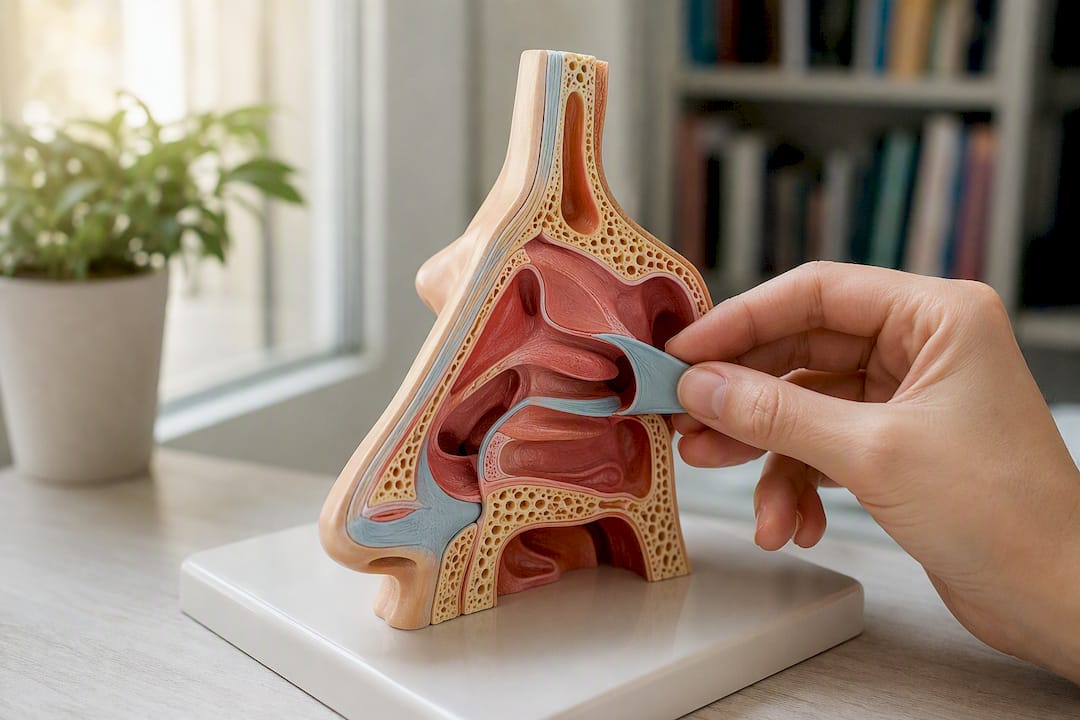
Researchers measure this with three main tools. Peak nasal inspiratory flow (PNIF) clocks how much air you can pull through your nose in a single sharp inhale, using a handheld meter. Acoustic rhinometry maps the actual cross-sectional area of the nasal passage at different points using sound wave reflection. Oxygen saturation and polysomnography track downstream effects on sleep and blood oxygen levels overnight. These aren’t just academic measures. PNIF results correlate closely with how obstructed people say they feel, making it one of the more practical, validated tools for tracking device benefit in both research and everyday use.
The numbers back up the mechanism. In one polysomnography study of 18 participants, external nasal dilators increased nasal cross-sectional area with high statistical significance (P<0.001), while also reducing stage 1 sleep (P=0.034) and oxygen desaturation events (P=0.04) during the night. That’s a small sample, but it’s a controlled, objective demonstration that stenting the nasal valve open changes real physiological outcomes, not just how someone feels about their own breathing.
What Do Clinical Studies Say About Nasal Dilators for Snoring?
The clinical picture is consistent on one point: both device types measurably reduce nasal resistance and snoring in people whose obstruction originates in the nose. Where the evidence gets more nuanced is in how much benefit each device type delivers, and to whom.
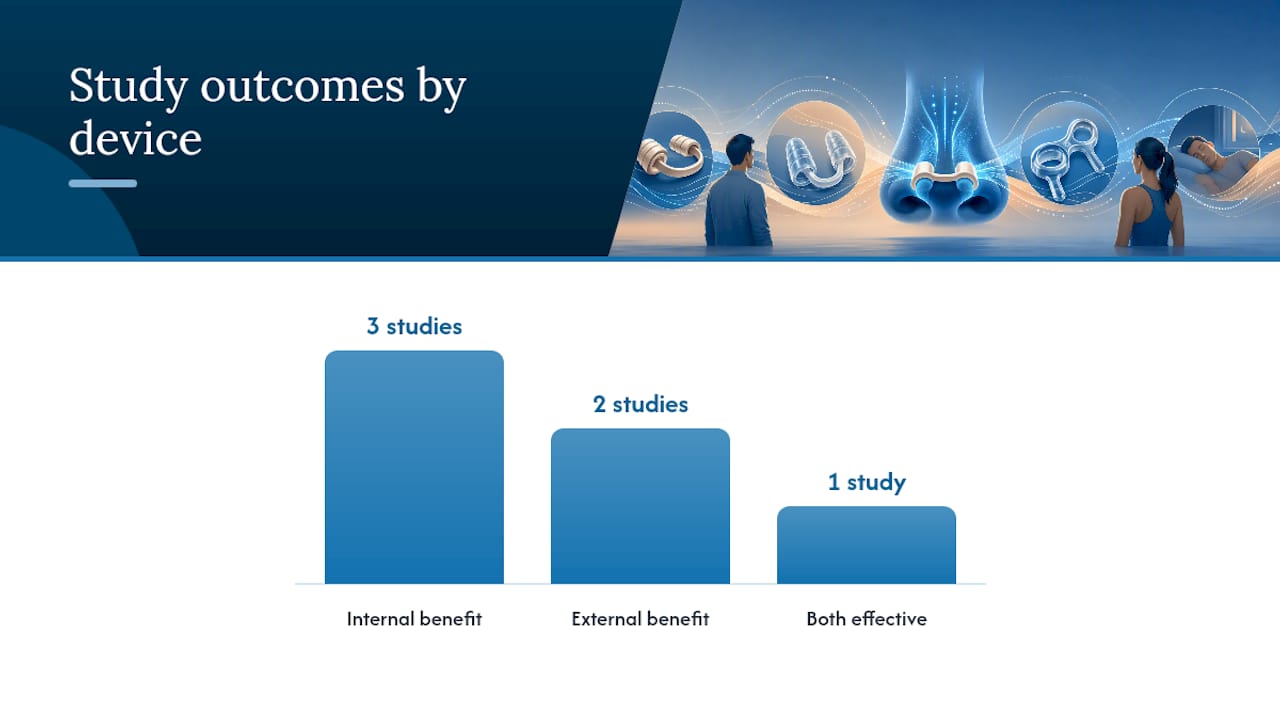
A clinical practice comparison of an internal dilator (Nas-air) against an external strip found both significantly cut snoring time relative to baseline. But the internal device worked in a larger share of the study’s patients and produced better self-reported sleep quality, according to research comparing internal and external nasal dilators in real clinical settings. That’s a meaningful data point for anyone choosing between the two: if snoring is your main complaint and you don’t mind a short fitting process, the internal option has a stronger track record in head-to-head testing.
Athletic performance research tells a related but distinct story. In cohorts of athletes with diagnosed nasal obstruction, internal dilators produced statistically significant gains in both nasal patency (p < 0.001) and aerobic performance measures (p < 0.05). That’s a narrower population than “athletes in general,” and the effect doesn’t reliably extend to people with normal nasal airflow who are just hoping for a performance edge.
Here’s how the major evidence lines up:
| Study focus | Device type | Primary endpoint | Headline result |
|---|---|---|---|
| Athlete cohort with nasal obstruction | Internal dilator | Nasal patency, aerobic performance | p < 0.001 (patency), p < 0.05 (performance) |
| Snoring patients, clinical practice | Internal (Nas-air) vs. external strip | Snoring time vs. baseline | Both reduced snoring; internal device effective in more patients |
| Polysomnography cohort (n=18) | External strip | Nasal cross-sectional area, oxygen desaturation | Area increased (P<0.001); desaturation reduced (P=0.04) |
| Comparative airflow studies | Internal vs. external | Peak nasal inspiratory flow | Internal devices often show larger PNIF gains |
The limitations matter as much as the results. Most of these trials involve small cohorts, sometimes fewer than 20 participants, and they don’t all measure the same endpoints, which makes pooling results into a single effect size difficult. Improvements are most reliable for people with obstruction rooted in the nose itself. For obstructive sleep apnea driven by tongue or soft-palate collapse, the evidence for nasal dilators is far weaker, since the device never reaches the actual site of the blockage.
When Are Nasal Dilators Most Likely to Work?
The pattern across the research is specific enough to act on. Nasal dilators consistently help people whose obstruction happens above the throat, and they consistently underperform for people whose obstruction happens below it.
You’re in the strong-response group if you have any of the following:
- Nasal valve collapse or a visibly narrow nostril opening that worsens with inhalation.
- Chronic rhinitis or allergy-driven nasal swelling that isn’t fully controlled by medication.
- A mild to moderate deviated septum contributing to one-sided airflow restriction.
- Snoring that a bed partner or sleep-tracking app confirms is loudest when you’re lying on your back with nasal congestion present.
You’re unlikely to see much change if your snoring or sleep apnea stems primarily from throat-level or soft-palate collapse, which is common in moderate to severe obstructive sleep apnea. A dilator can’t stent a structure it doesn’t touch. Severe septal deviation that physically blocks the passage regardless of valve width also tends to need a surgical fix rather than a mechanical aid.
The most useful thing you can do before drawing conclusions either way is run a short, tracked trial. Wear a device for one to two weeks, and use a smartphone snoring app or ask your sleep partner to log frequency and volume changes.
Who Should Use Caution or Avoid Nasal Dilators?
Most healthy adults can try a nasal dilator with no issues, but a few conditions call for a slower approach or a skip straight to your doctor.
Good candidates typically report a stuffy or one-sided nose that worsens with exercise or lying flat, or snoring that a partner notices only on certain nights (usually tied to congestion or sleeping position). Signs you’ll likely respond include a family history of nasal valve narrowing or previous nasal trauma that changed your breathing pattern.
Caution is warranted, and in some cases a device should be avoided entirely, if you have:
- Recent nasal or facial surgery, including septoplasty or rhinoplasty within the past few months.
- A history of frequent or unexplained nosebleeds.
- Known allergies to adhesives, silicone, or medical-grade plastics.
- Active nasal infection, significant nasal trauma, or an undiagnosed nasal mass.
Certain symptoms are red flags that belong with an ENT, not a home device. Recurrent nosebleeds, obstruction on only one side that doesn’t resolve, and signs of moderate to severe sleep apnea, like loud gasping, witnessed pauses in breathing, or heavy daytime sleepiness despite a full night’s sleep, all warrant a proper workup rather than a trial-and-error approach at home.
How to Fit, Wear, and Care for a Nasal Dilator
Getting the fit right is what separates people who stick with a dilator from people who give up on the category after one bad night.
For internal dilators:
- Start with the medium size in a multi-size starter pack unless your nostrils are visibly small or large.
- Insert gently, angling slightly outward to match the natural curve of the nostril, never straight back.
- Check that it sits comfortably without pinching or falling loose when you breathe deeply through your nose.
- Wear it for a full night before judging comfort. Some pressure the first night is normal and usually fades.
For external strips:
- Clean and dry the bridge of your nose first. Oil and sweat weaken the adhesive.
- Apply just above the flare of the nostrils, pressing the center down before smoothing the ends outward.
- Remove gently in the morning, pulling toward the center of your face rather than straight off, to reduce skin stress.
A few habits improve outcomes regardless of device type:
- Clean reusable internal dilators with mild soap and water daily; replace them every few weeks depending on wear.
- Switch sizes if you notice pressure marks, sneezing fits, or the device slipping out overnight.
- Give any new device a fair two-week trial before deciding it doesn’t work, since comfort and fit issues are the top reason people quit too early.
What Side Effects Should You Expect?
Most side effects from nasal dilators are minor and temporary. Adhesive strips can cause mild skin irritation or redness along the bridge of the nose, especially with daily use, and some people notice a few extra sneezes as the nasal lining adjusts to the new airflow pattern.
Internal dilators occasionally cause pressure discomfort or a sensation of fullness for the first night or two, which usually resolves once the correct size is found. Less common but more serious issues include nosebleeds, localized infection from an unwashed reusable device, or persistent pain that doesn’t ease after a few days.
Stop using any dilator and check in with a doctor if you notice:
- Bleeding that doesn’t stop quickly or happens repeatedly.
- Pain that gets worse rather than better over several nights.
- Signs of skin infection around an adhesive strip site.
- Persistent congestion or worsening obstruction despite correct sizing.
Simple fixes solve most complaints. Try a different size, apply a thin skin barrier under adhesive strips if you’re prone to irritation, and clean internal devices on a regular schedule to avoid buildup.
What Are the Alternatives to Nasal Dilators?
Dilators sit at the conservative end of a much longer treatment pathway, and they’re often a reasonable first step precisely because they carry so little risk. Low-risk, nonpharmacologic options like this are worth trying before moving to medication or surgery, especially when the goal is simply reducing nighttime congestion or mild snoring.
Other conservative approaches worth trying alongside or instead of a dilator include:
- Nasal steroid sprays for allergy or inflammation-driven congestion.
- Saline rinses to clear irritants and reduce swelling.
- Positional therapy or a wedge pillow if snoring worsens specifically when sleeping on your back.
- Oral appliances that reposition the jaw, useful when throat-level collapse is the main driver.
When symptoms persist despite these steps, or when a structural problem is clearly to blame, medical and surgical options come into play. Septoplasty corrects a deviated septum, turbinate reduction shrinks swollen internal tissue, and functional rhinoplasty can rebuild a genuinely collapsed nasal valve. An ENT workup for any of these typically includes nasal endoscopy, PNIF testing, acoustic rhinometry, and, if sleep apnea is suspected, a formal sleep study. If you’ve tried a dilator for a couple of weeks with no change, that combination of tests is the logical next step.
A Practical Take on Trying a Nasal Dilator
The biggest mistake I see people make with nasal dilators is treating them as a snoring cure rather than a diagnostic tool. Try one for two weeks, track the results honestly, and let the data tell you whether nasal obstruction was ever your real problem. If a dilator meaningfully cuts your snoring or opens up your breathing, you’ve learned something useful about where your obstruction lives. If it does nothing, that’s useful too. It tells you the problem is probably further back in your airway, and no amount of nasal widening will fix that.
Evergreenbliss stocks both reusable internal clips and adhesive strips specifically because the right starting point differs from person to person, and sizing matters more than most people expect going in. Don’t guess. Track your snoring with an app or ask whoever shares your bed to keep notes for a week. If two honest weeks pass with no improvement, that’s your signal to loop in an ENT rather than cycling through five more devices hoping one finally works.
Try a Nasal Dilator Starter Option From Evergreenbliss
If you’ve read this far, you already know the real obstacle isn’t whether nasal dilators work. It’s finding the right size and type without buying three products before landing on one that fits. Evergreenbliss carries both formats side by side: a reusable snoring relief nose clip for anyone who wants the stronger objective airflow gains internal devices tend to produce, and adhesive nasal strips for a lower-commitment first test.

Both options are built for exactly the two-week trial approach outlined above: wear one, track your snoring or airflow, and decide from real results instead of guesswork. If nasal congestion is part of your nightly routine, our broader personal care and hygiene gadget collection also covers complementary tools for breathing comfort. Pick a starter size, give it a fair two-week run, and check back in with your own notes before deciding what’s next.
Sources
- External nasal dilators: definition, background, and current uses
- Clinical studies indicate that internal nasal dilators can improve nasal patency and aerobic performance
- Internal devices often outperform external strips on PNIF
- Managing nasal valve compromise patients with nasal dilators: objective vs. subjective parameters