Mouth tape may quiet minor snoring and ease morning dry mouth for a narrow slice of healthy, nasal-breathing sleepers. It is not a proven therapy for obstructive sleep apnea (OSA), and it can be genuinely dangerous for anyone with nasal obstruction or undiagnosed OSA. That’s the whole verdict in one breath, and everything below explains why.
Before you buy a roll of tape, know where you stand:
- You might be a reasonable candidate if you already breathe comfortably through your nose all day, have no diagnosed sleep disorder, and just want to test a low-stakes habit.
- Do not try this without medical clearance if you snore loudly, have ever been told (or suspect) you have sleep apnea, deal with chronic nasal congestion, or have asthma, COPD, or GERD.
- Talk to a doctor first if you’re unsure which group you fall into. Mouth taping is a comfort tweak for some people and a real risk for others, and the tape itself can’t tell the difference.
TL;DR:
- Most small studies showing benefits in mild OSA or snoring involve participants with no nasal obstruction, limiting applicability to broader cases.
- People with nasal congestion, suspected sleep apnea, respiratory conditions, or GERD should avoid mouth taping due to significant safety risks.
- Evidence supporting mouth taping’s effectiveness is low quality, with inconsistent results and short-term follow-ups in select, healthy nasal breathers.
- Safer alternatives like nasal strips, chin straps, or professionally fitted mandibular devices offer similar benefits with lower risk.
- A gradual, daytime nasal breathing test and using hypoallergenic, breathable tapes are recommended before attempting overnight mouth taping.
Table of Contents
- What Is Mouth Taping and Why Do People Try It?
- Does Mouth Taping Actually Work? What the Research Shows
- Who Should Avoid Mouth Taping? Key Risks and Warning Signs
- How to Try Mouth Tape Safely, Step by Step
- Safer Alternatives Worth Trying First
- Evergreenbliss’s Take on Mouth Taping and Better Nasal Airflow
- The Trend Outpaced the Evidence
- Try a Gentler Way to Support Nasal Airflow Tonight
- Key Takeaways
- Sources
What Is Mouth Taping and Why Do People Try It?
Mouth taping means placing a strip of adhesive, usually skin-safe porous tape or a purpose-made mouth strip, over the lips before bed to keep the mouth closed through the night. The idea is simple: force nasal breathing, and the supposed downstream benefits follow.
The logic goes like this. Breathing through the nose warms and filters air, and it’s thought to support steadier oxygen exchange than mouth breathing does. Sealing the lips is meant to stop the mouth from taking over when the airway relaxes during sleep, which is a common trigger for snoring.
People trying it report a mix of outcomes, and it’s worth separating what’s documented from what’s mostly word of mouth:
- Reduced snoring — reported by some users and shown in a handful of small studies, but not consistent across trials.
- Less morning dry mouth — a plausible mechanical effect of keeping lips closed, though rarely measured directly in research.
- Better oral health — a common claim online, largely anecdotal, with no strong clinical backing.
The physiologic rationale isn’t nonsense. Nasal breathing is linked to calmer autonomic nervous system activity, and less mouth breathing does tend to mean less dry mouth. The gap is between a reasonable mechanism and proof that taping your mouth shut actually delivers it.
Does Mouth Taping Actually Work? What the Research Shows
The most comprehensive look at this practice is a systematic review published in PLOS One, which pooled the available trials on mouth taping for mouth breathing, snoring, and OSA. Its conclusion is blunt: the overall evidence is low quality, and most studies are too small or too narrow to support broad claims.
The review found only a handful of small studies showed meaningful improvement in the apnea-hypopnea index (AHI) or snoring, and those improvements appeared almost exclusively in tightly selected participants with mild OSA, not in the general population of snorers or mouth breathers.
That review, which examined 10 studies with a combined sample of roughly 200 participants, routinely excluded people with nasal obstruction from enrollment. That’s a critical detail, because it means the “positive” results come from people whose airways were already working well enough to breathe through the nose. Extending those findings to someone with a deviated septum or chronic congestion isn’t supported by the data at all.
Smaller pilot studies with sample sizes in the 20 to 50 range have reported drops in snoring index for some participants, but other trials, including some involving people with asthma, found null or negative results. One recurring finding across case reports is something clinicians call “mouth puffing,” where the mouth strains against the tape trying to open when the nasal airway isn’t cooperating, a sign the body is fighting the tape rather than adapting to it, according to Houston Methodist.
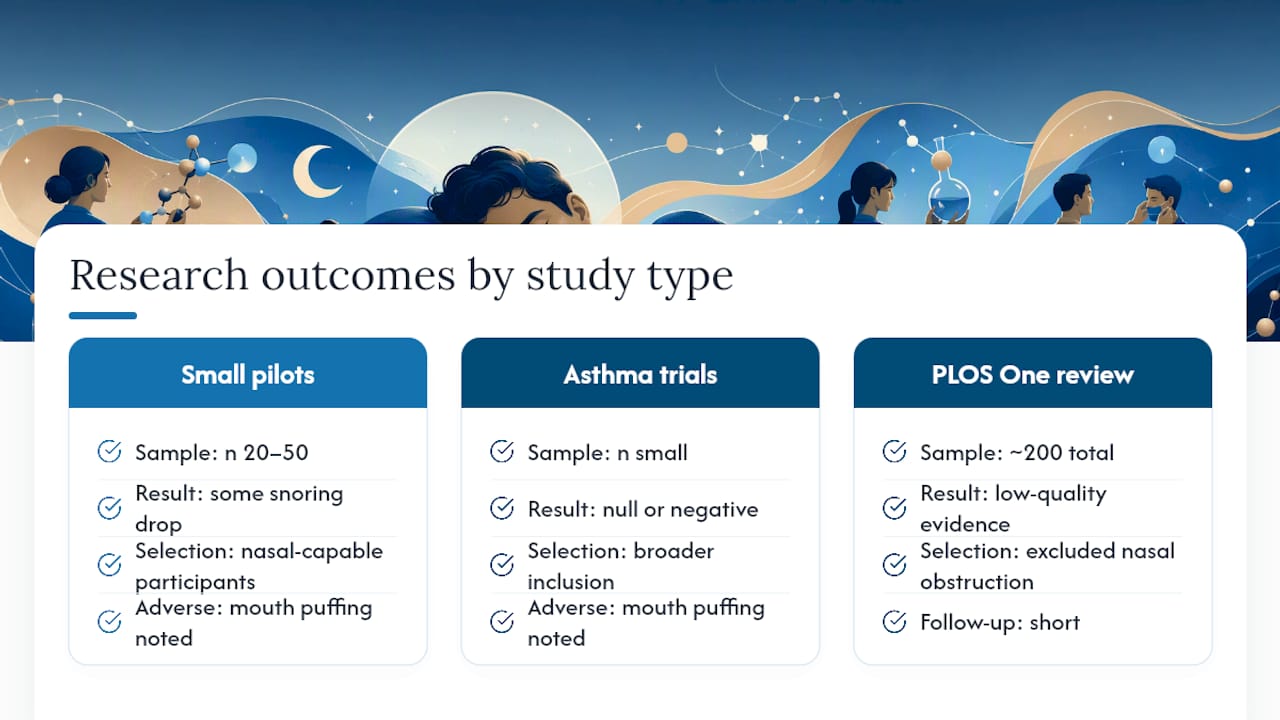
The honest summary: short follow-up periods, small samples, and selection bias toward people who could already breathe well through their nose mean this evidence can’t tell you how mouth taping performs for moderate or severe sleep-disordered breathing. It only tells you what happens in a best-case subgroup.
Who Should Avoid Mouth Taping? Key Risks and Warning Signs
Some conditions make mouth taping a genuine hazard rather than a minor inconvenience. Here’s who needs to skip it, or get cleared by a doctor first:
- Suspected or diagnosed OSA. Sealing the mouth removes a backup airway exactly when the nose might already be struggling. Cleveland Clinic specifically advises against mouth taping for snoring that could be apnea-related.
- Nasal obstruction of any kind — a deviated septum, chronic sinusitis, or a bad cold. If your nose is blocked, taping your mouth doesn’t redirect airflow; it restricts it.
- GERD. Acid reflux that reaches the throat overnight can trigger coughing or choking, which is far riskier with a taped mouth.
- Asthma or COPD. Airway sensitivity plus a sealed mouth is a combination several small trials have flagged as producing null or negative results, not neutral ones.
- A recent respiratory infection. Congestion from a cold or sinus infection is temporary nasal obstruction, and the same rule applies.
Watch for night-time red flags too: witnessed pauses in breathing, gasping or choking awake, snoring loud enough to wake a partner, or daytime sleepiness that feels disproportionate to your sleep hours. Any of these warrant a sleep evaluation before you try tape, not after.
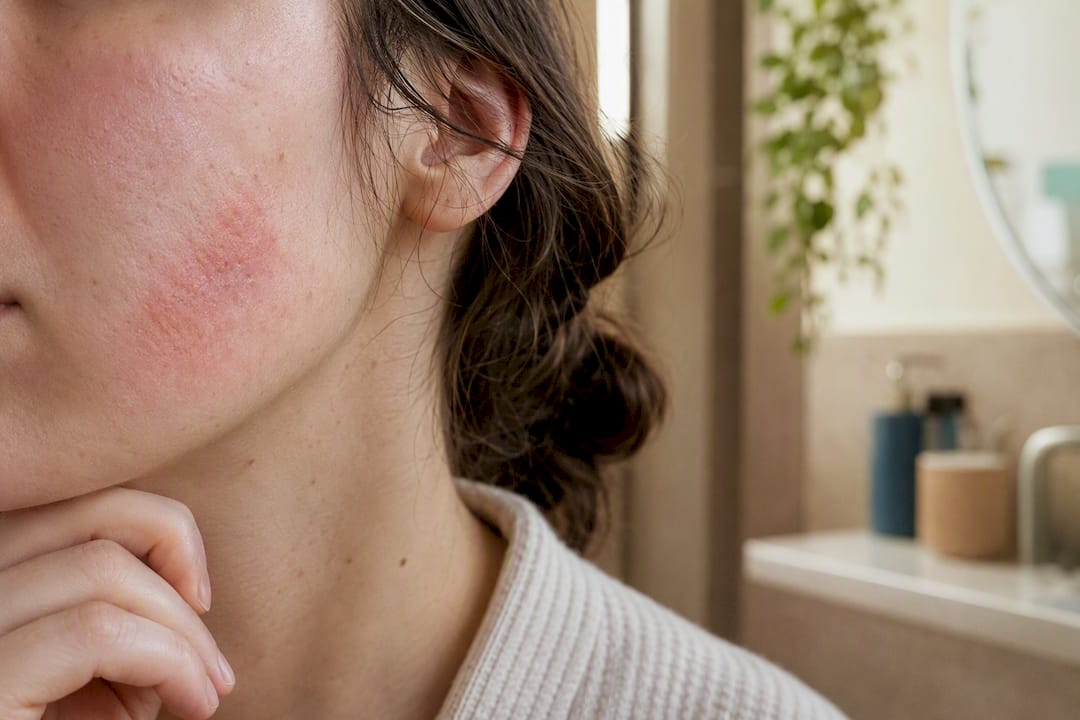
Pro Tip: Even people with none of the above sometimes react badly. Skin irritation, allergic reactions to adhesive, and a spike of claustrophobic anxiety at the feeling of a sealed mouth are common enough that a daytime trial run is worth doing before you ever try it overnight.
How to Try Mouth Tape Safely, Step by Step
If your clinician has cleared you and you fall into the lower-risk group, a slow, deliberate approach cuts the risk considerably.
- Do a daytime nasal check first. Sit quietly and breathe through your nose only for several minutes. If that feels effortless, you’re a reasonable candidate. If you find yourself gasping for mouth air within a minute, stop here.
- Choose the right tape. Use a breathable, hypoallergenic, porous tape or a purpose-made mouth strip, never household adhesives like duct tape, which can trap moisture and irritate skin.
- Apply a small central strip, not a full seal across both lips, and fold a small tab at one end so you can peel it off quickly without fumbling in the dark.
- Test it during a nap first, not your first full night’s sleep. A 20 to 30 minute daytime trial tells you a lot about comfort and anxiety response with minimal risk.
- Only progress to overnight use gradually, and stop immediately if you feel breathless, panicky, or notice new congestion.
Pro Tip: Keep the tab loose enough to remove with one hand, half asleep, without needing to fully wake up. If removing it feels hard even when calm, the tape is too aggressive for nightly use.
Seek medical care right away for chest tightness, prolonged breathlessness, or a skin reaction that spreads or blisters.
Safer Alternatives Worth Trying First
Several lower-risk options address the same goals as mouth taping, often with a clearer evidence trail:
- Nasal strips or internal nasal dilators, which open the nostrils without covering the mouth at all, making them worth trying before anything occlusive.
- Chin straps, which support the jaw to discourage mouth opening without sealing the lips shut.
- Dentist-fit mandibular advancement devices, a well-documented CPAP alternative for diagnosed OSA that repositions the jaw to keep the airway open, and one that should always be fitted by a professional.
- A sleep study or ENT evaluation if you suspect OSA or have chronic congestion, since these identify the actual cause rather than masking a symptom.
- CPAP therapy when sleep testing confirms moderate to severe OSA; nothing sold over the counter replaces this.
- Basic behavioral fixes — sleeping on your side, treating allergies, and improving nasal hygiene and breathing habits often reduce mouth breathing without any adhesive at all.
Evergreenbliss’s Take on Mouth Taping and Better Nasal Airflow
Evergreenbliss curates recovery and sleep-support products with a bias toward the lowest-risk option that still addresses the problem. Mouth taping’s biggest flaw isn’t the concept; it’s that it removes a backup airway instead of opening the primary one.
- A snoring relief nose clip works on the nasal passage directly, without sealing the mouth, making it a gentler starting point for people who haven’t been cleared for tape.
- Our post on how mouth breathing affects sleep covers why the habit forms in the first place, which matters more than the tape itself.
None of this replaces a sleep evaluation if you have real warning signs.
The Trend Outpaced the Evidence
Mouth taping got popular because it’s cheap, visual, and simple enough to explain in a fifteen second video. That’s exactly why the caution matters: a habit this easy to adopt is also easy to adopt for the wrong reason, and the PLOS review makes clear that most of the supportive data comes from people who were already good nasal breathers to begin with.
The conventional advice online treats mouth taping as a universal sleep hack. It isn’t. It’s a narrow behavioral nudge that occasionally helps a specific subgroup and does nothing to fix tongue posture, pharyngeal muscle tone, or a blocked airway, the actual mechanics behind most snoring and OSA. If you snore loudly or feel exhausted no matter how much you sleep, the right first move is a conversation with a doctor about sleep testing, not a strip of tape.
What this article’s evidence actually supports is modest: try safer, non-occlusive options first, treat mouth tape as a low-stakes experiment only after nasal breathing is confirmed comfortable, and never let a viral trend substitute for a real diagnosis.
— Cadence
Try a Gentler Way to Support Nasal Airflow Tonight
If mouth taping feels like more risk than you want to take on, or your doctor has flagged it as unsafe for you, Evergreenbliss offers a different starting point: nasal support tools that open the airway instead of sealing the mouth shut.

The Snoring Relief Nose Clip works with your nose’s own airflow rather than overriding your mouth’s ability to open in an emergency, which makes it a more forgiving option for a first trial. It sits alongside other personal care and hygiene gadgets built for the same goal: better sleep without an all-or-nothing bet on one habit. If you’ve read this far and decided tape isn’t worth the risk for your situation, check out the nose clip’s product page and see if it fits your nightly routine better.
Key Takeaways
Mouth tape offers modest, unproven benefits for healthy nasal breathers and poses real risks for anyone with nasal obstruction, suspected OSA, or respiratory conditions.
| Point | Details |
|---|---|
| Not a therapy for OSA | Evidence supports narrow use in mild cases only, never as a substitute for sleep apnea treatment. |
| Evidence quality is low | A systematic review of 10 studies covering roughly 200 people found mostly low-quality, inconsistent results. |
| Contraindications are serious | Nasal obstruction, suspected OSA, GERD, asthma, and COPD all make mouth taping unsafe without clearance. |
| Test before committing | Try nasal breathing during the day and nap with tape before any overnight use. |
| Evergreenbliss offers a gentler option | The Snoring Relief Nose Clip supports nasal airflow without sealing the mouth shut. |
This article is general information, not a substitute for advice from a qualified doctor. Consult a qualified healthcare professional about your own circumstances before acting on anything here.
Sources
- PLOS One systematic review: Breaking social media fads and uncovering the safety and efficacy of mouth taping
- Is Mouth Tape Safe To Use While Sleeping? — Cleveland Clinic
- Mouth taping for sleep: Does it work? — Sleep Foundation
- Can mouth tape during sleep be dangerous? — Houston Methodist