Daily routine is defined as a set of repeated behaviors that create predictability, and the role of routine in stress management is to give your brain a reliable structure that lowers its threat response. Without predictability, the brain treats uncertainty as danger. UCLA Health confirms that automating mundane choices conserves mental energy for critical problem-solving, which means a simple morning sequence can free up real cognitive resources. Behavioral health research from BestMind Behavioral Health shows that consistent routines act as regulatory mechanisms that buffer the stress response and improve emotional resilience. The result is lower anxiety, steadier mood, and a stronger sense of control over your day.
How does routine reduce stress biologically and psychologically?
Routine reduces stress by cutting the number of decisions your brain must make each day. Every choice, from what to eat to when to exercise, draws on a limited pool of mental energy. When behaviors become automatic, that energy stays available for real problems. UCLA Health describes this as reduced decision fatigue, and it explains why people with structured days often feel calmer even when their circumstances have not changed.
The biological side is equally clear. Uncertainty is experienced by the brain as a threat signal. BestMind Behavioral Health notes that uncertainty triggers the stress response the same way physical danger does. Routine interrupts that cycle by making the next hour predictable. When your brain knows what comes next, it stops scanning for threats and shifts into a lower-alert state.
Routine also supports your body’s natural biological rhythms. Consistent sleep and wake times regulate cortisol, the primary stress hormone. Regular meal times stabilize blood sugar, which directly affects mood and irritability. These are not abstract benefits. They are measurable shifts in how your body manages stress hour by hour.

Pro Tip: Pick one anchor behavior, such as waking at the same time every day, and build everything else around it. That single consistent point does more for your stress levels than a packed schedule ever will.
Core biological and psychological benefits of a structured daily routine include:
- Reduced cortisol spikes from predictable sleep and wake cycles
- Lower decision fatigue through automated daily behaviors
- Decreased threat scanning when the brain anticipates what comes next
- Steadier blood sugar and mood through consistent meal timing
- Improved emotional resilience from repeated, calming behavioral patterns
What types of daily routines most effectively support stress management?
The most effective stress-reducing routines combine physical activity, sleep consistency, digital boundaries, and moments of genuine rest. No single habit carries all the weight. The power comes from stacking several small, consistent behaviors that reinforce each other.
Physical activity is the most evidence-backed stress relief technique available. The CDC recommends at least 150 minutes of moderate physical activity per week, broken into 20–30 minute daily segments. That threshold is achievable for most people and produces measurable reductions in anxiety and depression. A post-lunch walk or a morning stretch session counts. The key is regularity, not intensity.
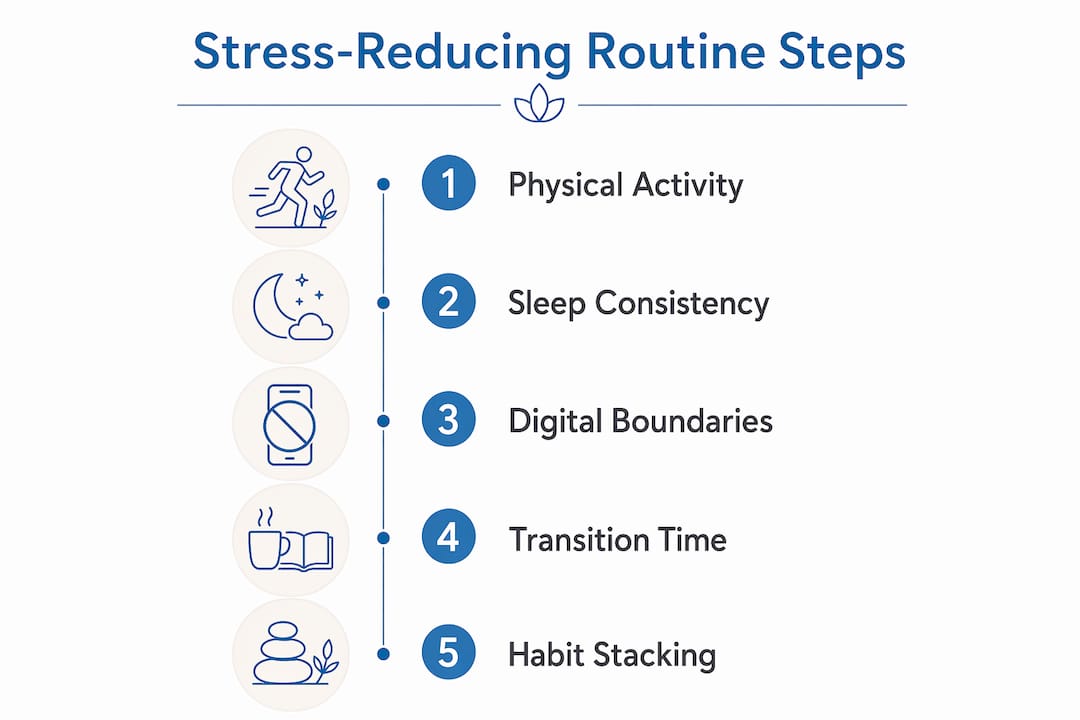
Sleep consistency deserves equal priority. Going to bed and waking at the same time every day, including weekends, stabilizes your circadian rhythm and improves emotional regulation. Poor sleep amplifies every stressor. You can read more about the connection between stress and sleep quality and why protecting your sleep window is one of the highest-return habits you can build.
Digital boundaries are a less obvious but critical piece. Adolescents who spend 2+ hours daily on devices double their anxiety risk and are four times more likely to experience emotional difficulties. Adults face the same pressure at a lower gradient. Scheduling screen-free periods, especially in the hour before bed, directly reduces anxiety and improves sleep onset. Strategies for managing nighttime anxiety and sleep often start with this single boundary.
Companion animal interaction rounds out the picture in a way most people underestimate. Spending time with a pet can reduce stress levels by nearly 50%. That is not a minor effect. Building even 10 minutes of pet interaction into your day qualifies as a legitimate stress relief technique, not a luxury.
Effective daily routine categories for stress management:
- Sleep anchor: Fixed wake time, consistent bedtime, no screens 60 minutes before sleep
- Movement block: 20–30 minutes of physical activity, any form, at least five days per week
- Nutrition rhythm: Three meals at consistent times to stabilize blood sugar and mood
- Digital boundary: Scheduled offline periods, especially morning and evening
- Rest moment: Pet time, a short walk outside, or five minutes of quiet breathing
What are the common pitfalls when building a stress-reducing routine?
The biggest mistake people make is treating routine-building as an all-or-nothing project. Overhauling your entire schedule in one week creates its own stress. Behavioral health research is clear that consistency matters more than perfection, and that small daily changes build lasting neural pathways over time.
Rigidity is the second trap. A routine that leaves no room for disruption becomes a source of anxiety rather than relief. When you miss a workout or sleep in on Saturday, a rigid routine turns that into a failure. A flexible one treats it as a normal variation and continues the next day without drama.
Transition time is the most overlooked element in routine design. Rigid schedules without buffer zones between tasks can cause burnout because the brain needs brief recovery periods between demands. Moving directly from a work call to a workout to cooking dinner with no pause in between keeps your nervous system in a reactive state. Even five minutes of unscheduled time between blocks makes a measurable difference.
Pro Tip: When your routine breaks down, do not restart from scratch. Resume the single most important habit, usually your wake time or your movement block, and let the rest follow naturally over the next few days.
Common pitfalls to avoid:
- Overhauling your full schedule at once instead of adding one habit at a time
- Treating a missed day as a failed routine rather than a normal variation
- Scheduling tasks back-to-back with no transition time between them
- Setting unrealistic expectations that require perfect conditions to maintain
- Letting the routine itself become a rigid obligation that generates anxiety
How do you build a sustainable stress management routine that actually sticks?
Sustainable routines are built on systems, not willpower. A system is a set of conditions that makes the desired behavior easy and automatic. Vittenberg School describes effective routines as automatic watering systems that conserve life energy by removing the need for constant choices. That framing is useful because it shifts the goal from “doing more” to “making good behaviors effortless.”
Start with habit stacking
Habit stacking anchors a new behavior to an existing one. If you already make coffee every morning, add two minutes of deep breathing while it brews. If you already walk to your car after work, extend that walk by ten minutes. The existing habit acts as a trigger, and the new behavior rides along without requiring separate motivation. This approach improves long-term adherence and reduces the overwhelm of starting something new.
Use anchor points, not full schedules
An anchor point is one fixed behavior that organizes the rest of your day. A consistent wake time is the most powerful anchor available. Everything else, your exercise block, your first meal, your wind-down routine, can be timed relative to that single point. This gives your day structure without requiring a rigid hour-by-hour schedule.
Plan for disruptions before they happen
Every routine faces disruption. Travel, illness, and unexpected work demands will interrupt your schedule. The solution is a backup version of your routine, a simplified set of two or three core behaviors you can maintain even in difficult weeks. Keeping your wake time and one movement habit intact during a disrupted week preserves the neural pattern and makes recovery faster.
Respect the timeline for change
Neural adaptation to new routines takes months, not days. Early stress improvements are real but can be transient if the routine is abandoned before it becomes automatic. Most people quit during the first three weeks because the behavior still requires conscious effort. Pushing through that window, with patience and self-compassion, is what separates a lasting habit from a short experiment.
| Approach | What it does for stress |
|---|---|
| Habit stacking | Reduces effort to start new behaviors by linking them to existing ones |
| Anchor point scheduling | Provides daily structure without rigid hour-by-hour planning |
| Backup routine | Maintains neural patterns during disruptions and speeds recovery |
| Buffer time between tasks | Lowers nervous system reactivity and prevents burnout |
| Gradual habit layering | Builds sustainable change without overwhelming the system |
Key Takeaways
A structured daily routine reduces stress by making predictable what the brain would otherwise treat as uncertain, lowering cognitive load, stabilizing biological rhythms, and building emotional resilience over time.
| Point | Details |
|---|---|
| Predictability lowers threat response | Routine signals safety to the brain, reducing cortisol and anxiety throughout the day. |
| Physical activity is non-negotiable | The CDC recommends 150 minutes of movement per week as a core stress management tool. |
| Consistency beats perfection | Missing one day does not break a routine; resuming the next day is what builds lasting habits. |
| Buffer time prevents burnout | Transition periods between tasks protect emotional regulation and keep the routine sustainable. |
| Neural change takes months | Early improvements are real but require consistent practice before new behaviors become automatic. |
Routines as sanctuaries, not schedules
I have worked with enough people navigating chronic stress to know that the word “routine” triggers resistance. It sounds like more obligation, more structure, more things to fail at. That reaction is understandable, and it is also the exact reason so many people stay stuck.
What I have seen consistently is that the people who manage stress best are not the ones with the most disciplined schedules. They are the ones who have identified two or three behaviors that reliably calm their nervous system and protected those behaviors even when everything else fell apart. A morning walk. A consistent bedtime. Ten minutes without a screen before sleep. That is the whole system for many of them.
The mistake I see most often is rushing the process. Someone reads about the benefits of structured days and builds a 12-item morning routine in one weekend. By Thursday, it has collapsed under its own weight. The frustration that follows is worse than the original stress.
Routine-building is a form of self-care, not self-discipline. The goal is to make your day feel less effortful, not more controlled. Start with one habit. Protect it for 30 days. Then add another. That patience is not weakness. It is the only approach that actually works.
— Cadence
Tools that support your stress-relief routine

Building a stress management routine is easier when your environment supports it. Evergreenbliss offers a curated range of mental wellness and stress-relief products designed to complement the habits you are building, from acupressure mats that ease tension after a long day to neck massagers that make your wind-down routine something you actually look forward to. For people working on sleep consistency, the sleep and relaxation aids collection includes targeted tools that support better sleep onset and deeper rest. If physical activity is part of your routine, the home fitness recovery equipment range helps your body recover faster so you can stay consistent. Every product ships free with easy returns.
FAQ
What is the role of routine in stress management?
Routine reduces stress by creating predictability that lowers the brain’s threat response and reduces decision fatigue. Consistent daily behaviors stabilize biological rhythms like sleep and appetite, which directly supports emotional regulation.
How long does it take for a routine to reduce stress?
Neural adaptation to new routines takes months of consistent practice. Early stress improvements can appear within weeks, but they become stable only after the behaviors have become automatic.
What is the most effective daily habit for stress relief?
Regular physical activity is the most evidence-backed stress relief technique available. The CDC recommends at least 150 minutes of moderate movement per week, which translates to 20–30 minutes most days.
Can a routine become a source of stress itself?
Yes. Rigid schedules without buffer time between tasks can cause burnout and increase anxiety. Building transition periods and allowing flexibility prevents the routine from becoming another obligation.
How do I restart a routine after a disruption?
Resume the single most important anchor habit, typically your wake time or movement block, and let the rest follow over the next few days. Consistency after disruption matters more than restarting the full routine at once.