REM sleep is defined as the stage of the sleep cycle when the brain is most active, consolidating memories, processing emotions, and running the neurological maintenance your waking mind depends on. Understanding why REM sleep matters is not just academic. It directly affects how well you think, how you handle stress, and how long you stay healthy. Adults typically need 1.5–2 hours of REM sleep each night, roughly 20% of total sleep time. Infants spend up to 50% of their sleep in REM, which reflects how critical this stage is for brain development at every age.
Why REM sleep matters more than most people realize
REM stands for Rapid Eye Movement, named for the distinctive side-to-side eye movements that occur during this stage. The brain during REM looks almost identical to a waking brain on an EEG scan. Neural firing rates are high, the hippocampus is actively transferring information to long-term storage, and the prefrontal cortex is working through emotional experiences from the day.
What makes REM biologically unique is a combination of three things happening at once:
- Muscle atonia: The body becomes temporarily paralyzed, preventing you from acting out dreams. This is a protective mechanism, not a malfunction.
- Norepinephrine shutdown: The brain shuts down norepinephrine, the stress neurochemical, during REM. This allows emotional memories to be processed and filed without the original fear or distress attached to them.
- Active dreaming: The brain recombines memories, experiences, and ideas in ways that generate new connections and creative insights.
The norepinephrine shutdown is the mechanism behind what neuroscientist Matthew Walker calls “overnight therapy.” Your brain revisits difficult experiences from a chemically calm state, which is why you often feel more settled about a problem after sleeping on it.
Pro Tip: If you wake up mid-dream and feel emotionally raw, that is your brain mid-process. Give yourself a few minutes before checking your phone. The emotional charge fades as REM completes its work.
How does REM sleep support memory, learning, and emotional health?
REM sleep is the primary driver of memory consolidation for two distinct types of memory. Declarative memory covers facts and events. Procedural memory covers skills and habits. Both benefit from REM, but in different ways.

For declarative memory, the hippocampus replays the day’s experiences during REM and transfers key information to the neocortex for long-term storage. For procedural memory, REM strengthens the neural pathways built during practice. Musicians, athletes, and language learners all show measurable skill gains after REM-rich sleep compared to equivalent waking rest periods.
The emotional benefits are equally significant. REM sleep enables creative integration by recombining unrelated memories, which is why many people report solving problems or generating ideas in dreams. This is not mystical. It is the brain running pattern-matching algorithms without the constraints of focused, logical thought.
The consequences of skipping REM are measurable and fast. Research shows a 60% increase in amygdala reactivity to negative emotional stimuli after REM deprivation. That means your brain’s threat-detection center becomes dramatically more reactive when you are short on REM sleep. Everyday frustrations feel like genuine threats. Emotional regulation collapses.
“REM sleep acts as a form of overnight emotional first aid, stripping the painful charge from difficult memories so they can be stored without ongoing psychological damage.” — Matthew Walker, neuroscientist and author of Why We Sleep
Four cognitive functions that REM sleep directly protects:
- Working memory: The ability to hold and manipulate information in real time, critical for decision-making and complex tasks.
- Emotional regulation: The capacity to respond rather than react, which depends on a well-functioning prefrontal cortex refreshed by REM.
- Creative problem-solving: The brain’s ability to find non-obvious connections between ideas, a process that peaks during REM.
- Learning retention: The transfer of new skills and knowledge from short-term to long-term storage, which happens primarily during REM cycles.
What are the health risks of insufficient REM sleep?
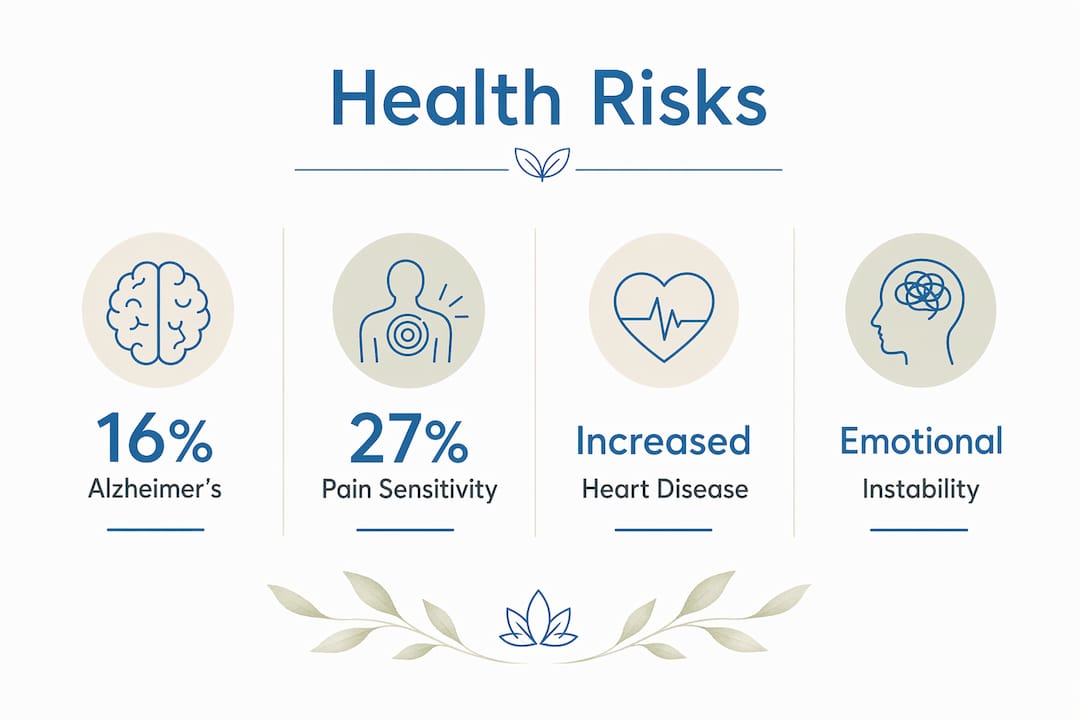
The health consequences of chronic REM deprivation extend well beyond feeling tired. The research connecting poor REM sleep to serious disease is specific and alarming.
| Health Risk | What the Research Shows |
|---|---|
| Alzheimer’s disease | Delayed REM onset is linked to 16% more amyloid and 29% more tau protein in the brain |
| Cardiovascular mortality | Reduced REM duration is independently associated with higher all-cause mortality in heart disease patients |
| Pain sensitivity | REM deprivation reduces pain threshold by 27%, making chronic pain conditions significantly worse |
| Emotional volatility | A 60% spike in amygdala reactivity after REM loss increases anxiety and mood instability |
| Metabolic dysfunction | Chronic REM disruption is linked to hypertension and impaired glucose regulation |
The Alzheimer’s connection deserves particular attention. Amyloid and tau proteins are the hallmark biomarkers of Alzheimer’s disease. The fact that delayed REM onset alone correlates with measurably higher levels of both suggests REM sleep plays an active role in clearing neurotoxic waste from the brain. This is not a distant risk. It accumulates over years of poor sleep.
The RICCADSA study, which examined adults with coronary artery disease and obstructive sleep apnea, found that reduced REM sleep independently predicted higher mortality. That finding positions REM duration as a potential clinical marker for cardiovascular risk, not just a wellness metric.
Pain sensitivity is another underappreciated consequence. A 27% reduction in pain threshold means that people already managing chronic pain conditions face significantly worse symptoms when their REM sleep is compromised. Poor sleep and pain form a reinforcing cycle that is difficult to break without addressing both.
How much REM sleep do different age groups need?
REM sleep requirements shift significantly across the lifespan, and the reasons are rooted in neuroscience.
| Age Group | Approximate REM Percentage | Primary Function |
|---|---|---|
| Newborns (0–3 months) | Up to 50% of sleep | Rapid brain circuit development |
| Infants (3–12 months) | ~40–50% of sleep | Sensory and motor learning |
| Children (1–12 years) | ~20–25% of sleep | Language, memory, emotional development |
| Adults (18–64 years) | ~20% (~1.5–2 hours) | Memory consolidation, emotional regulation |
| Older adults (65+) | Slightly reduced | Maintenance of cognitive function |
The timing of REM within the night matters as much as the total amount. Most REM sleep occurs in the final third of the night. If you sleep six hours instead of eight, you are not losing a proportional slice of each sleep stage. You are cutting off the period when REM is most concentrated. The result is a disproportionate loss of REM even when total sleep feels close to adequate.
Sleep trackers from brands like Fitbit, Garmin, and Oura Ring can estimate REM duration using heart rate variability and movement data. These estimates are not clinical-grade, but they are useful for spotting trends. If your tracker consistently shows less than 90 minutes of REM, that is worth investigating.
Pro Tip: Going to bed 30–60 minutes earlier on weeknights is one of the most effective ways to increase REM sleep. Since REM is concentrated late in the night, extending sleep from the front end gives your brain more time to reach those final REM-rich cycles.
What practical steps can improve REM sleep quality?
Improving REM sleep starts with protecting total sleep duration, because REM cannot occur if you are not sleeping long enough to reach it.
- Keep a consistent sleep schedule. Going to bed and waking at the same time every day, including weekends, stabilizes your circadian rhythm and makes REM cycles more predictable and complete.
- Limit caffeine after noon. Caffeine has a half-life of roughly 5–7 hours. An afternoon coffee can still be active in your system at midnight, suppressing the deep and REM sleep stages.
- Reduce alcohol before bed. Alcohol is a common REM suppressant. It may help you fall asleep faster, but it fragments REM cycles in the second half of the night.
- Manage screen exposure in the evening. Blue light from screens delays melatonin release, pushing back sleep onset and compressing the time available for REM.
- Address sleep debt deliberately. Cutting sleep short by even 60–90 minutes disproportionately reduces REM. Recovery requires multiple full nights of sleep, not a single long weekend sleep-in.
- Seek professional evaluation for sleep disorders. Conditions like sleep apnea and REM sleep behavior disorder directly disrupt REM architecture. A sleep study can identify these issues when lifestyle changes alone do not improve REM quality.
Good sleep hygiene practices form the foundation of consistent REM sleep. They are not optional extras. They are the conditions your brain needs to run its nightly maintenance cycle properly.
Key Takeaways
REM sleep is the most cognitively and emotionally critical stage of the sleep cycle, and protecting it requires both sufficient sleep duration and consistent sleep timing.
| Point | Details |
|---|---|
| REM is active brain time | The brain during REM consolidates memories, processes emotions, and clears neurotoxic waste. |
| Timing matters as much as duration | Most REM occurs in the final third of the night, so cutting sleep short eliminates it disproportionately. |
| Deprivation has serious health consequences | Low REM is linked to Alzheimer’s biomarkers, cardiovascular mortality, and a 27% drop in pain threshold. |
| Adults need roughly 1.5–2 hours nightly | That equals about 20% of total sleep, a target that requires 7–9 hours of total sleep to reach. |
| Consistent schedules protect REM | A stable sleep-wake schedule is the single most effective behavioral tool for maintaining REM quality. |
REM sleep is the part of the night most people are unknowingly skipping
Most people focus on total sleep hours and assume they are covered if they hit seven or eight. That thinking misses the point. You can sleep eight hours and still be chronically REM-deprived if your schedule is inconsistent, your alcohol intake is high, or an undiagnosed sleep disorder is fragmenting your cycles.
What I find most striking about the research is the Alzheimer’s connection. The idea that delayed REM onset, not just total sleep loss, correlates with measurably higher amyloid and tau levels reframes REM as a neurological cleaning cycle. Your brain is not just resting during REM. It is actively clearing out the biological debris that accumulates during waking hours.
The emotional regulation finding is equally underappreciated. A 60% spike in amygdala reactivity after REM deprivation explains a lot about why sleep-deprived people are irritable, reactive, and prone to anxiety. It is not a character flaw. It is a measurable neurological state. Treating it as a willpower problem is the wrong approach entirely.
The practical implication is straightforward. Prioritize sleep duration, keep your schedule consistent, and address anything that fragments your sleep architecture. REM is not a bonus feature of sleep. It is the reason sleep exists.
— Cadence
Better sleep starts with the right support
Quality REM sleep depends on more than good intentions. The physical and mental conditions you create before bed shape how deeply and consistently you sleep each night.

Evergreenbliss carries a curated range of sleep and relaxation aids designed to help you wind down effectively, from acupressure mats that release physical tension to stress relief sleep supplements formulated to support natural melatonin production. These tools work alongside the behavioral habits covered above, not as replacements for them. If your evenings are tense and your mind is still running at full speed when you get into bed, the right recovery product can make the difference between a fragmented night and one that actually delivers the REM sleep your brain needs.
FAQ
What is REM sleep, exactly?
REM (Rapid Eye Movement) sleep is the stage of the sleep cycle characterized by high brain activity, rapid eye movements, vivid dreaming, and temporary muscle paralysis. It is the stage most responsible for memory consolidation and emotional processing.
How do I know if I am getting enough REM sleep?
Adults need roughly 1.5–2 hours of REM sleep per night, about 20% of total sleep. Consumer sleep trackers from brands like Fitbit, Garmin, and Oura Ring can provide estimates, though a clinical sleep study gives the most accurate picture.
What happens to your brain without enough REM sleep?
REM deprivation produces a 60% increase in amygdala reactivity to negative stimuli, impairs memory consolidation, reduces pain tolerance by 27%, and is linked to higher levels of Alzheimer’s-related proteins in the brain.
Does alcohol affect REM sleep?
Alcohol suppresses REM sleep, particularly in the second half of the night when REM cycles are most concentrated. Even moderate drinking before bed can significantly reduce total REM duration.
Can you recover lost REM sleep?
Partial recovery is possible over multiple full nights of sleep, but a single long sleep-in does not fully restore lost REM. Consistent sleep schedules over time are more effective than occasional extended sleep sessions.