Sleep hygiene is defined as the set of behavioral and environmental practices that promote consistent, restorative sleep. The CDC and Harvard Health both recognize poor sleep hygiene as a primary driver of sleep difficulties in American adults. Over a third of U.S. adults don’t get enough sleep, with 14.5% struggling to fall asleep and 17.8% unable to stay asleep through the night. That means roughly one in six people reading this right now are losing sleep to problems that behavioral changes can directly address. The Cleveland Clinic describes sleep hygiene as “sleep prep,” a foundation that shapes every other aspect of your health.
What is sleep hygiene and why does it matter?
Sleep hygiene is the clinical term used by organizations like the American Academy of Sleep Medicine (AASM) and the National Sleep Foundation to describe habits that align your body’s natural sleep systems with your daily schedule. Think of it as the operating conditions your brain needs to power down correctly.
Your body regulates sleep through two overlapping systems. The circadian system (Process C) tracks time of day using light and temperature cues. The homeostatic system (Process S) tracks how long you’ve been awake and builds sleep pressure accordingly. Both processes work together to determine when you feel sleepy and how deeply you sleep. When your daily habits disrupt either system, sleep quality drops even if you’re spending eight hours in bed.

The importance of sleep hygiene extends well beyond feeling rested. Chronic poor sleep is linked to increased risk of cardiovascular disease, metabolic disorders, and impaired cognitive function. Good sleep practices don’t just fix tiredness. They protect long-term health in ways that no supplement or gadget can replicate on its own.
What are the core components of good sleep hygiene?
Good sleep hygiene covers two categories: what you do during the day and how you set up your sleep environment. Both matter, and neither works well without the other.
Behavioral practices that directly affect sleep quality:
- Keep a consistent sleep and wake time every day, including weekends. Your circadian rhythm is anchored by repetition, not intention.
- Avoid caffeine after 2 p.m. Caffeine has a half-life of five to seven hours, meaning a 3 p.m. coffee still has half its stimulant effect at 9 p.m.
- Finish meals at least three hours before bed to prevent digestive activity from disrupting sleep onset.
- Limit alcohol in the evening. Even moderate consumption suppresses REM sleep, the stage most critical for memory consolidation and emotional regulation.
- Get natural light exposure within an hour of waking. Morning light is the strongest signal your brain uses to set its internal clock.
- Exercise regularly, but finish intense workouts at least three hours before bed to allow your core body temperature to drop.
- Build a 20 to 30 minute wind-down routine before bed using low-stimulation activities like reading, light stretching, or a warm shower.
Environmental practices that shape sleep conditions:
Your bedroom should be cool, dark, and quiet. The National Sleep Authority identifies 60°F to 67°F as the optimal temperature range for sleep onset, because your body needs to drop its core temperature to initiate deep sleep. Blackout curtains, white noise machines, and removing screens from the bedroom all reduce the sensory input that keeps your brain alert.
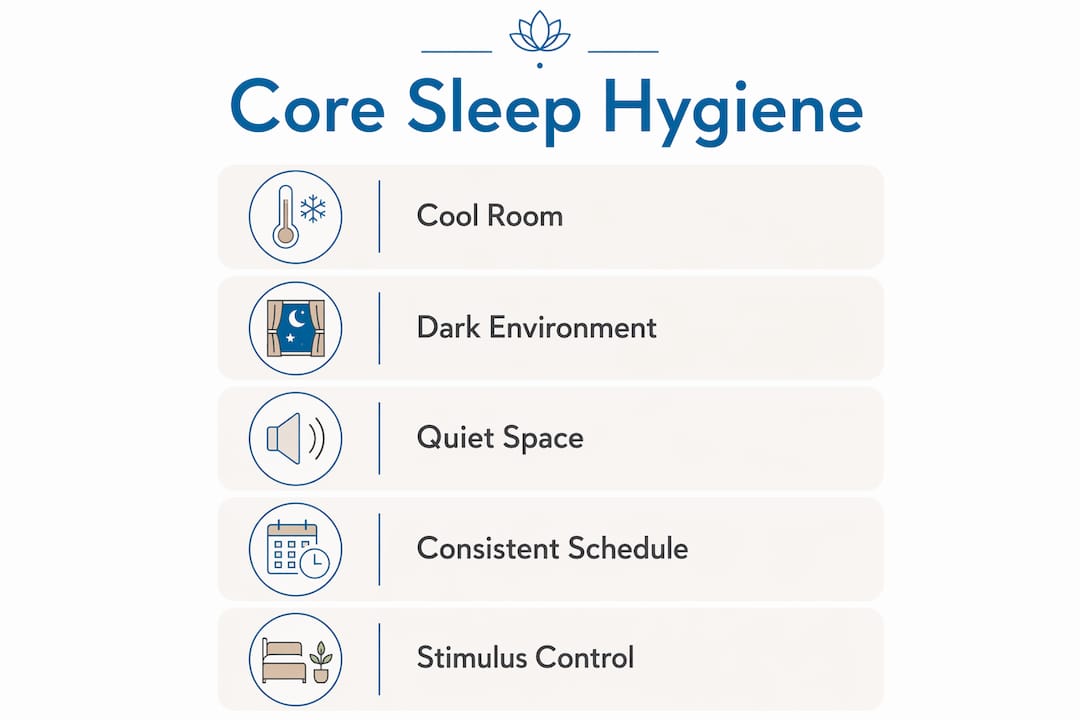
Stimulus control is one of the most clinically supported practices in sleep hygiene. Using your bed only for sleep and sex conditions your brain to associate the bed with rest rather than wakefulness. Reading, scrolling your phone, or watching TV in bed weakens that association over time, making it harder to fall asleep even when you’re tired.
Pro Tip: Master the behavioral basics before spending money on sleep gadgets or supplements. Northwell Health’s sleep specialists consistently emphasize that consistent schedules and stimulus control outperform most over-the-counter sleep aids.
How does scientific research support sleep hygiene practices?
The biological case for sleep hygiene is grounded in the two-process model of sleep regulation. Process C and Process S work like two clocks running simultaneously. When your habits align with both, sleep comes easily and stays deep. When they conflict, you get fragmented, unrefreshing rest.
Temperature control is one of the most well-documented mechanisms. Your body’s core temperature must fall by one to two degrees Fahrenheit to initiate sleep. Keeping your bedroom in the thermoneutral zone of 60°F to 67°F accelerates that drop. A warm shower or bath 90 minutes before bed works through the same mechanism: it draws blood to the skin surface, which then radiates heat away from the body after you get out.
| Practice | Biological mechanism | Primary benefit |
|---|---|---|
| Consistent wake time | Anchors circadian rhythm (Process C) | Reduces sleep onset time |
| Cool bedroom (60°F–67°F) | Facilitates core body temperature drop | Faster sleep initiation |
| Avoiding alcohol | Prevents REM sleep suppression | Improves sleep architecture |
| Stimulus control | Conditions brain-bed association | Reduces wakefulness in bed |
| Morning light exposure | Resets circadian clock via melatonin suppression | Stabilizes sleep-wake cycle |
Alcohol deserves special attention because it’s widely misunderstood as a sleep aid. A glass of wine may help you fall asleep faster, but moderate evening alcohol at roughly 0.5 g/kg body weight measurably suppresses REM sleep in the second half of the night. You wake up feeling unrefreshed even after a full night in bed. That’s not a mystery. It’s chemistry.
The AASM’s clinical guidelines position sleep hygiene as a behavioral component of insomnia treatment, most effective when combined with cognitive behavioral therapy for insomnia (CBT-I). Sleep hygiene alone resolves mild sleep difficulties. For chronic insomnia, it’s a necessary foundation, not a complete solution.
Pro Tip: Identify whether your main problem is falling asleep (sleep latency) or waking during the night (WASO, or wake after sleep onset). The two issues respond to different interventions. Latency problems respond best to stimulus control and temperature. WASO responds better to sleep restriction and consistent wake times.
What common mistakes undermine good sleep practices?
Most people who try to improve their sleep hygiene fail not because the practices don’t work, but because they approach it wrong. Here are the five most common mistakes and how to correct them.
-
Overhauling everything at once. Changing your sleep schedule, diet, bedroom setup, and evening routine simultaneously creates cognitive overload. You can’t track what’s working. Start with one change, specifically your wake time, and hold it for two weeks before adding anything else.
-
Developing orthosomnia. Anxiety about rigid sleep rules can paradoxically worsen sleep by creating performance pressure. Checking your sleep tracker obsessively, catastrophizing a bad night, or feeling like you’ve “failed” your sleep hygiene checklist activates the same stress response that keeps you awake. Flexibility is not a weakness in sleep hygiene. It’s a requirement.
-
Using the bed for non-sleep activities. Watching TV, working from a laptop, or scrolling social media in bed trains your brain to stay alert in that environment. Weakening sleep associations is one of the fastest ways to create chronic insomnia from a mild sleep problem.
-
Ignoring wake-up time consistency. Most people focus on bedtime, but inconsistent wake-up times disrupt circadian rhythm more than almost any other variable. Your wake time is the anchor. Set it and protect it even after a bad night.
-
Relying on gadgets before mastering basics. Sleep trackers, weighted blankets, and melatonin supplements all have their place. But they work best when layered onto a solid behavioral foundation, not used as substitutes for it.
How can you personalize your sleep hygiene over time?
Sleep hygiene recommendations work best when tailored to individual challenges rather than applied as a universal checklist. A person who can’t fall asleep needs different adjustments than someone who wakes at 3 a.m. and can’t get back to sleep.
Start by tracking your sleep for one week without changing anything. Note when you go to bed, when you actually fall asleep, how many times you wake up, and how you feel in the morning. That data tells you which system is failing: your circadian rhythm, your homeostatic drive, or your sleep environment.
| Sleep challenge | Primary strategy | Supporting tool |
|---|---|---|
| Can’t fall asleep (latency) | Stimulus control, cool bedroom | White noise machine, blackout curtains |
| Waking during the night (WASO) | Consistent wake time, limit alcohol | Sleep restriction protocol |
| Waking too early | Delay morning light exposure | Eye mask, later alarm |
| Feeling unrefreshed despite full sleep | Reduce alcohol, improve sleep architecture | Evaluate for sleep apnea |
| Irregular schedule (shift work) | Anchor wake time, use light therapy | Light therapy lamp |
Gradual habit change focused on wake-time consistency first produces better long-term adherence than attempting multiple simultaneous changes. Once your wake time is locked in, add one environmental change, then one behavioral change, spacing each adjustment by at least two weeks.
Monitor daytime symptoms as your primary quality indicator. If you’re alert without caffeine by 10 a.m. and not crashing in the afternoon, your sleep hygiene is working. Subjective sleep quality matters more than any number on a tracker.
Key takeaways
Consistent wake time and stimulus control are the two highest-leverage sleep hygiene practices, and both cost nothing to implement.
| Point | Details |
|---|---|
| Sleep hygiene definition | Behavioral and environmental habits that align with your body’s circadian and homeostatic sleep systems. |
| Wake time is the anchor | Inconsistent wake times disrupt circadian rhythm more than any other single variable. |
| Stimulus control matters | Using the bed only for sleep and sex conditions the brain to associate the bed with rest. |
| Avoid orthosomnia | Rigid rule-following creates sleep anxiety that worsens the problem it’s meant to solve. |
| Personalize your approach | Tailor practices to whether your issue is falling asleep, staying asleep, or feeling unrefreshed. |
Sleep hygiene works, but only if you stop treating it like a performance
I’ve spent years reading the clinical literature on sleep, and the pattern I keep seeing is this: the people who improve their sleep the most are not the ones who follow every rule perfectly. They’re the ones who pick two or three practices and hold them consistently for months.
The obsession with optimization is the enemy here. I’ve seen people buy $400 sleep trackers, take five different supplements, and still lie awake at 1 a.m. because they never fixed their wake time or stopped using their phone in bed. Those two free behavioral changes outperform almost everything else in the research.
Sleep hygiene is foundational, not curative. If you have chronic insomnia, CBT-I with a trained therapist is the gold standard. Sleep hygiene is what you do to make that therapy work better and to prevent the problem from returning. Treating it as a standalone cure for serious sleep disorders sets you up for frustration.
What I’d tell anyone starting out: set your wake time, protect it for 30 days, and stop doing anything in bed that isn’t sleep or sex. That’s it. Add complexity only after those two habits are automatic. The science is clear, and the cost is zero.
— Cadence
Better sleep starts with the right environment
Building good sleep habits is the behavioral foundation. Creating the right physical environment is what makes those habits stick night after night. Evergreenbliss carries a curated selection of sleep and relaxation aids designed to complement the practices covered in this article, from tools that support your wind-down routine to products that help you maintain the cool, calm bedroom conditions your body needs.

For anyone managing stress that bleeds into sleep, the stress-relief collection at Evergreenbliss includes acupressure mats, massage devices, and relaxation tools that address the tension that keeps your nervous system activated at bedtime. Every order ships free, with easy returns if something doesn’t work for you.
FAQ
What is sleep hygiene in simple terms?
Sleep hygiene is the set of daily habits and bedroom conditions that help you fall asleep faster, stay asleep, and wake up feeling rested. It covers everything from your wake time and caffeine intake to your bedroom temperature and how you use your bed.
How long does it take to improve sleep hygiene?
Most people notice measurable improvement within two to four weeks of consistently applying core practices like a fixed wake time and stimulus control. Chronic insomnia may require longer-term behavioral work, including CBT-I.
What is the most important sleep hygiene tip?
Consistent wake time is the single highest-priority practice according to behavioral medicine research, because it anchors your circadian rhythm more effectively than any other change.
Can sleep hygiene help with common sleep disorders?
Sleep hygiene is a recommended component of treatment for insomnia and is used alongside CBT-I in AASM clinical guidelines. It is less effective as a standalone treatment for disorders like sleep apnea, which require medical evaluation.
What affects sleep quality the most?
Circadian rhythm disruption from inconsistent schedules, bedroom temperature outside the 60°F to 67°F range, evening alcohol use, and weakened stimulus control from non-sleep bed activities are the four most clinically documented factors affecting sleep quality.