Sleep is the primary anabolic trigger for muscle growth, activating the hormonal and biochemical pathways that training alone cannot produce. The role of sleep in muscle growth centers on two processes: the pulsed release of growth hormone (GH) during deep sleep and the testosterone surge during REM sleep, both of which drive muscle protein synthesis (MPS). Recent randomized controlled trials now quantify what coaches have long suspected. Just five nights of restricted sleep reduces MPS by up to 27%, even when protein intake stays constant. If you train hard but sleep poorly, you are leaving a significant portion of your gains on the table.
How does sleep biologically impact muscle repair and growth?
Sleep is not passive downtime. It is the phase where your body executes the repair instructions written during training. The two most anabolically active stages are N3 (slow-wave or deep sleep) and REM sleep, and each serves a distinct function in muscle recovery.
During N3, the pituitary gland releases the largest GH pulse of the day. Deep sleep accounts for roughly 70 to 75% of total daily GH secretion. GH activates IGF-1 (insulin-like growth factor 1), which signals muscle cells to synthesize new contractile proteins. Without sufficient N3, this pulse is blunted, and the anabolic drive that should follow a hard training session simply does not materialize.
REM sleep handles a different but equally critical job. Testosterone secretion peaks during REM-rich sleep cycles, which are concentrated in the final two hours of a full night’s sleep. Testosterone amplifies MPS, supports satellite cell activation, and maintains the androgen receptor sensitivity that makes your muscles responsive to training. Cut your sleep short and you cut off this testosterone window entirely.
Beyond GH and testosterone, sleep also governs cortisol and insulin sensitivity. Cortisol, the primary catabolic hormone, follows a circadian rhythm that keeps it suppressed during the night. Sleep disruption breaks this suppression, elevating cortisol at times when it should be low. Elevated nighttime cortisol promotes protein breakdown and impairs the anabolic signaling that GH and testosterone depend on.
| Sleep stage | Hormonal event | Muscle benefit |
|---|---|---|
| N3 (deep sleep) | Peak GH pulse (70-75% of daily output) | Drives MPS and tissue repair |
| REM sleep | Peak testosterone secretion | Amplifies anabolic signaling and motor consolidation |
| N2 (light sleep) | Cortisol suppression maintained | Reduces catabolic activity overnight |
| Sleep onset (N1) | Core temperature drop, HR reduction | Prepares body for anabolic hormone release |
Pro Tip: If you wake up feeling flat and unrecovered despite adequate protein intake, disrupted N3 is the most likely culprit. Alcohol, late-night eating, and inconsistent bedtimes are the top three suppressors of slow-wave sleep.
What happens to muscle growth when sleep is insufficient?
The evidence here is direct and quantified. One night of total sleep deprivation reduces MPS by 18%, and chronic restriction to four or five hours per night for a week drives that deficit to 27%. This is not a marginal effect. A 27% reduction in MPS means your muscles are rebuilding at less than three-quarters of their normal capacity, regardless of how much protein you eat or how well you train.
Testosterone takes a measurable hit as well. Sleeping five to six hours per night for one week lowers testosterone by 10 to 15% in healthy young men. The researchers behind this finding noted that the hormonal deficit is equivalent to aging 10 to 15 years in terms of androgen output. For a bodybuilder, that is a significant and entirely avoidable drag on hypertrophy.
Strength gains are where the numbers become most striking for gym-focused athletes:
- Lifters sleeping 7 or more hours gain approximately 25% more 1RM strength over 12 weeks compared to those sleeping under 6 hours on identical programs.
- Submaximal rep performance and power output decline before absolute strength does, meaning your working sets suffer before your one-rep max does.
- Injury risk rises sharply. Athletes sleeping under eight hours per night face 1.7 times higher injury risk, which compounds training disruption over a full season.
One important nuance: exercise does not fully rescue the deficit. HIIT during sleep restriction partially restores MPS but cannot return it to baseline. Training harder to compensate for poor sleep is a losing strategy. The anabolic environment that sleep creates simply cannot be replicated through extra volume or intensity.
How do different sleep stages contribute to muscle recovery?
Understanding sleep architecture helps you protect the stages that matter most for hypertrophy. A full night of sleep cycles through roughly four to six 90-minute cycles, each containing varying proportions of N1, N2, N3, and REM.
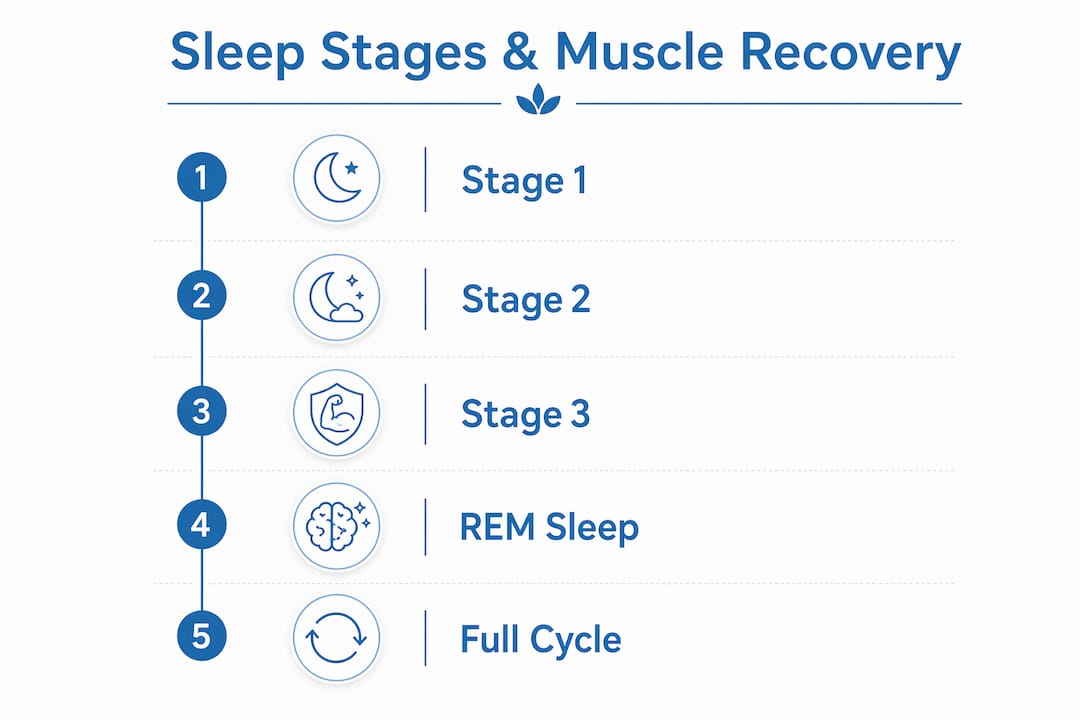
N3 dominates the first half of the night. This is where the majority of GH release occurs, and it is also the stage that collapses first under sleep restriction. When you cut sleep from eight hours to six, you lose a disproportionate amount of N3 relative to other stages. The non-REM deep sleep phase is not passive rest. It is an active rebuilding phase, and losing it elevates cortisol and shifts the body toward catabolism rather than anabolism.
REM sleep loads toward the second half of the night, particularly in cycles four through six. This is why truncating sleep by even 90 minutes can eliminate one or two full REM cycles. The testosterone surge associated with REM sleep is not spread evenly across the night. It is concentrated in those later cycles, which means early wake-ups or inconsistent bedtimes consistently rob you of peak androgen output.
| Stage | Timing in night | Key hormone | Muscle-specific benefit |
|---|---|---|---|
| N3 (deep sleep) | First 3-4 hours | Growth hormone | Protein synthesis, tissue repair |
| REM | Final 2-3 hours | Testosterone | Anabolic signaling, motor learning |
| N2 (light sleep) | Throughout | Cortisol suppression | Catabolic protection |
Light sleep (N2) is often dismissed, but it serves as the connective tissue between deeper stages. It maintains the cortisol suppression that protects the anabolic work done during N3 and REM. Disrupting N2 through fragmented sleep, such as from sleep apnea or environmental noise, undermines the hormonal architecture of the entire night.
How much sleep do bodybuilders actually need for muscle growth?
The American Academy of Sleep Medicine recommends 7 to 9 hours for adults, but that baseline assumes average activity levels. For athletes under significant training loads, the target shifts upward. Most sports science practitioners working with strength athletes recommend 8 to 10 hours, particularly during hypertrophy-focused training blocks or after high-volume sessions.
Chronic under-sleeping carries compounding costs. The testosterone suppression from five to six hours of sleep per night does not reset after one good night. Hormonal deficits accumulate across weeks, which means the lifter who averages six hours on weekdays and tries to catch up on weekends is still operating in a state of partial hormonal suppression most of the time.
Practical targets for different training phases:
- Maintenance or light training: 7 to 8 hours, consistent nightly schedule
- Hypertrophy blocks: 8 to 9 hours, with attention to bedtime consistency
- High-volume or competition prep: 9 to 10 hours, with strategic naps if needed
- Deload weeks: 8 to 9 hours, prioritizing recovery of accumulated sleep debt
Timing matters as much as duration. Going to bed at 11 PM and waking at 7 AM gives you a fundamentally different hormonal profile than sleeping midnight to 8 AM, even though both are eight hours. Earlier sleep onset aligns your N3 window with the natural GH pulse that peaks in the first half of the night.
Pro Tip: Consistency beats duration. Sleeping 7.5 hours at the same time every night produces better hormonal outcomes than sleeping 9 hours on irregular schedules. Your endocrine system runs on a clock, not a cumulative total.
What practical strategies improve sleep quality for muscle growth?
Optimizing sleep for gains requires treating your sleep environment and pre-sleep routine with the same deliberateness you apply to training programming.
Environment and habits:
- Keep your bedroom between 65 and 68 degrees Fahrenheit. Core temperature must drop to initiate N3, and a cool room accelerates this process.
- Block light completely. Even low-level light exposure suppresses melatonin and delays sleep onset.
- Set a fixed wake time seven days a week. This anchors your circadian rhythm and stabilizes the timing of your GH and testosterone pulses.
- Avoid alcohol within three hours of sleep. Alcohol fragments N3 and suppresses REM, directly cutting into both your GH pulse and testosterone window.
Supplementation and nutrition:
Magnesium glycinate (200 to 400 mg before bed) supports slow-wave sleep by activating GABA receptors. Glycine (3 g before bed) lowers core temperature and has shown measurable improvements in sleep quality in clinical trials. Creatine monohydrate, already standard in most bodybuilding stacks, also supports cellular energy during sleep-based repair. Casein protein taken 30 to 60 minutes before sleep enhances overnight MPS by providing a slow-release amino acid supply during the anabolic window that GH and testosterone create. For a deeper look at how protein interacts with recovery, the role of protein in recovery is worth understanding alongside your sleep strategy.
Recovery tools: Devices that reduce physical tension and lower sympathetic nervous system activity before bed, such as neck massagers or acupressure tools, help shift your body into the parasympathetic state that sleep requires. Improving breathing during sleep also directly protects N3 and REM architecture by reducing micro-arousals.
Sleep is the anabolic lever most athletes ignore
I have worked with enough serious lifters to know that sleep is the last variable they address and the first one they sacrifice. The logic seems reasonable: you can always sleep later, but you cannot always get to the gym. The problem is that this calculus is completely backwards.
The hormonal modulation that happens during sleep, specifically the GH pulse in N3 and the testosterone surge in REM, cannot be replicated by any supplement stack currently available. Protein intake, creatine, and even exogenous hormones work through the same pathways that sleep activates. Sleep is not a recovery tool sitting alongside nutrition and training. It is the substrate on which both of those things operate.
What I find most underappreciated is the cumulative nature of sleep debt in a training context. A lifter who runs a 16-week hypertrophy block on six hours of sleep per night is not just leaving gains on the table each night. They are progressively suppressing the hormonal environment that makes the entire block productive. By week 12, they are training hard into a catabolic state and wondering why their progress has stalled.
The athletes who make the most consistent long-term progress are not the ones with the best programs or the most expensive supplements. They are the ones who treat sleep as a non-negotiable training variable, schedule it with the same discipline they apply to their workouts, and protect it during high-stress periods rather than sacrificing it. Treat sleep as a skill you practice and a habit you build, not a luxury you earn after a good training week.
— Cadence
Rest better, recover harder with Evergreenbliss
If your training is dialed in but your recovery is not, the gap is almost always sleep quality. Evergreenbliss carries a curated range of sleep and relaxation aids designed to help you reach and sustain the deep, restorative sleep your muscles need to grow. From the Deep Sleep Neck Massager that releases physical tension before bed to stress relief sleep supplements that support melatonin and cortisol balance, every product is selected to protect your anabolic sleep architecture. Pair these with the home fitness recovery equipment collection to cover both the training and recovery sides of your program.

Free shipping, easy returns, and a product lineup built around one goal: helping you recover as hard as you train.
Key takeaways
Sleep drives muscle growth through GH and testosterone pulses that cannot be replicated by nutrition or training alone, making consistent, high-quality sleep the most underutilized anabolic tool in any bodybuilder’s program.
| Point | Details |
|---|---|
| Sleep deprivation cuts MPS sharply | Five nights of short sleep reduces muscle protein synthesis by up to 27%, stalling hypertrophy regardless of protein intake. |
| N3 deep sleep drives GH release | Slow-wave sleep produces 70 to 75% of daily growth hormone, making it the most anabolically critical sleep stage. |
| REM sleep protects testosterone | Cutting sleep short eliminates late-night REM cycles where testosterone peaks, reducing androgen output by 10 to 15%. |
| Duration target for athletes | Bodybuilders in hypertrophy blocks should target 8 to 10 hours, with consistent bedtimes to anchor hormonal rhythms. |
| Casein before bed enhances recovery | Slow-digesting protein taken 30 to 60 minutes before sleep feeds MPS during the overnight anabolic window. |
FAQ
How does sleep affect muscle protein synthesis?
Sleep directly regulates MPS through GH and IGF-1 signaling during N3 deep sleep. One night of total sleep deprivation reduces MPS by 18%, and chronic short sleep drives that reduction to 27%.
Can you make up for lost sleep on weekends?
Catch-up sleep partially restores performance but does not fully reverse the hormonal deficits accumulated during the week. Consistent nightly sleep produces better anabolic outcomes than irregular long sleep sessions.
How much sleep do bodybuilders need for optimal gains?
The American Academy of Sleep Medicine recommends 7 to 9 hours for adults, but athletes in active hypertrophy training benefit from 8 to 10 hours to fully support GH and testosterone output.
Does poor sleep increase injury risk for athletes?
Athletes sleeping under eight hours per night face 1.7 times higher injury risk compared to those meeting sleep targets, compounding training disruption over time.
What supplements support better sleep for muscle recovery?
Magnesium glycinate, glycine, and casein protein before bed are the best-supported options. Casein specifically enhances overnight MPS by providing slow-release amino acids during the anabolic sleep window.