Sleep supplements work by supporting the body’s own biological systems that regulate the sleep-wake cycle, rather than forcing sedation through chemical override. The science behind sleep supplements centers on two core mechanisms: circadian rhythm regulation and neurotransmitter pathway support. Compounds like melatonin, L-theanine, magnesium, and tryptophan each target a distinct point in your sleep biology. A 2025 systematic review of randomized controlled trials confirmed that dietary supplements improve sleep across multiple quality metrics, including sleep latency, nighttime awakenings, and subjective sleep disturbance. Understanding why these compounds work helps you choose the right one for your specific sleep problem.
Why sleep supplements work: the biological foundation
Sleep supplements work because they interact with the same biological systems your body already uses to regulate sleep. This is the key distinction between supplements and sedatives. Prescription sedatives suppress the central nervous system broadly. Supplements like melatonin, tryptophan, and magnesium work with your existing circadian and neurochemical architecture.
Your circadian rhythm is a roughly 24-hour internal clock governed by light exposure and hormone release. Melatonin, produced by the pineal gland, signals the onset of darkness and tells your brain it is time to prepare for sleep. Neurotransmitters like GABA slow neural activity to allow the transition from wakefulness to sleep. When these systems are disrupted by stress, shift work, travel, or aging, sleep quality degrades. Supplements address those specific disruptions rather than overriding the whole system.

The science behind sleep supplements frames them as biological support tools, not replacements for natural sleep function. That framing matters because it explains both their benefits and their limits.
How melatonin works as a natural sleep regulator
Melatonin is the most studied sleep supplement and also the most misunderstood. It is a hormone, not a sedative. Its job is to signal nighttime to your brain, shifting your internal clock toward sleep onset. It does not knock you out. This distinction explains why taking a high dose does not produce proportionally deeper sleep.
The effects of melatonin supplements are most pronounced for circadian disruptions: jet lag, delayed sleep phase syndrome, and shift work. For people with these conditions, melatonin shortens the time it takes to fall asleep and realigns the sleep-wake cycle with the target schedule. For general insomnia without a circadian component, the effect is milder.
Dosing is where most people go wrong. Johns Hopkins Medicine recommends low-dose melatonin of 1 to 3 mg taken about two hours before your target bedtime. A 2026 umbrella review confirmed that 0.3 to 0.5 mg taken one to three hours before bed is often sufficient, with higher doses producing more side effects without better outcomes. More melatonin does not mean better sleep. It means a higher chance of morning grogginess, headache, or nausea.
Pro Tip: Set a consistent melatonin timing alarm two hours before your intended sleep time. Consistency in timing matters as much as dose because melatonin works by shifting your clock, and irregular timing sends mixed signals.
Key facts about melatonin use:
- Start at the lowest effective dose (0.3 to 0.5 mg) and increase only if needed
- Take it one to three hours before your target bedtime, not right before lying down
- Use it short-term. If you see no improvement within one to two weeks, stop and reassess
- Melatonin precautions include pregnancy, autoimmune disorders, seizure conditions, and interactions with blood thinners or diabetes medications
- It affects blood sugar and blood pressure, so people managing those conditions need medical guidance before use
Do amino acids and vitamins help you sleep better?
Amino acids and vitamins address a different layer of sleep biology: neurotransmitter synthesis and neural relaxation. These compounds do not regulate your clock directly. They reduce the mental and physical tension that prevents sleep onset and maintenance.
L-theanine, found naturally in green tea, increases GABA activity and reduces cortisol-driven alertness without causing sedation. It lowers sleep latency, meaning you fall asleep faster, and improves sleep architecture by supporting deeper sleep stages. L-theanine and magnesium both show moderate clinical evidence for improving sleep quality by reducing anxiety and physical tension. That is meaningful because anxiety-driven insomnia is one of the most common sleep failure modes.
Tryptophan is an amino acid that serves as a direct precursor to serotonin and then melatonin. Supplementing with tryptophan supports the entire downstream chain of sleep-regulating neurochemistry. It is particularly useful for people who struggle with sleep maintenance rather than sleep onset. Vitamin B6 acts as a cofactor in the enzymatic conversion of tryptophan to serotonin, and Vitamin D influences the genetic expression of circadian clock genes. Deficiency in either can quietly degrade sleep quality without an obvious cause.
| Supplement | Mechanism | Best for | Evidence level |
|---|---|---|---|
| L-theanine | Increases GABA, reduces cortisol | Anxiety-driven insomnia, sleep onset | Moderate |
| Tryptophan | Precursor to serotonin and melatonin | Sleep maintenance, mood-related disruption | Moderate |
| Magnesium | GABA modulation, muscle relaxation | Physical tension, nighttime awakenings | Moderate |
| Vitamin B6 | Cofactor for tryptophan conversion | Low melatonin production, mood disruption | Supportive |
| Vitamin D | Circadian gene expression | Seasonal or deficiency-related sleep issues | Emerging |
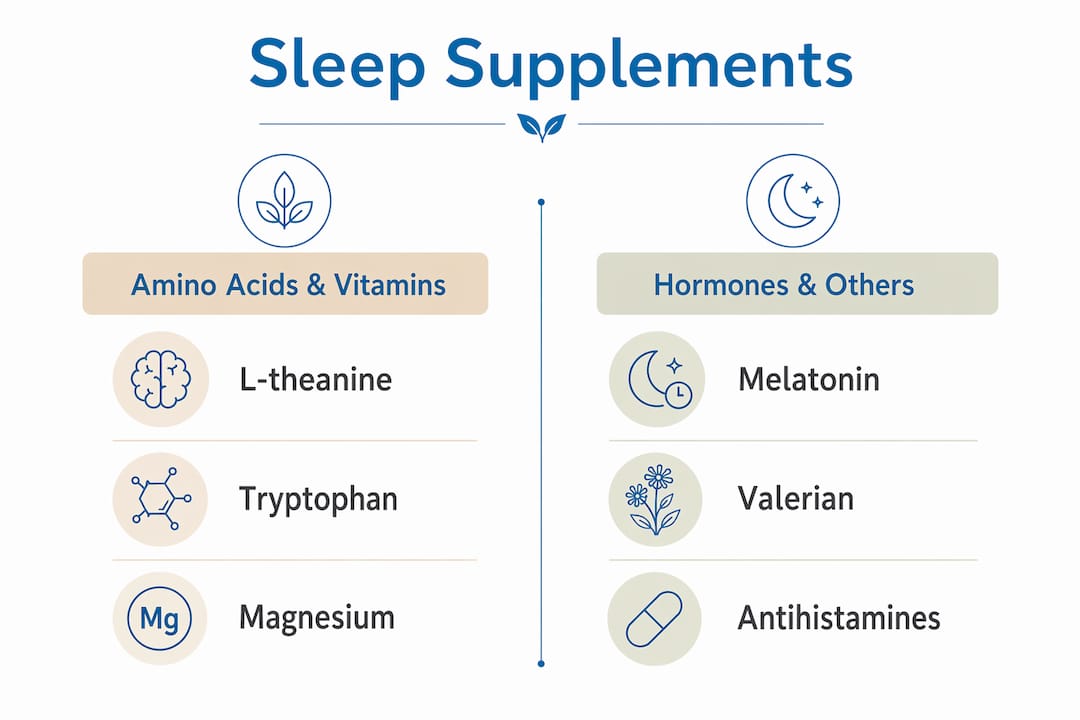
Pro Tip: If you wake frequently during the night rather than struggling to fall asleep, tryptophan or magnesium glycinate may serve you better than melatonin. Matching the supplement to your specific sleep failure mode is the most underused strategy in self-directed sleep care.
Comparing sleep supplements: which one fits your situation?
Not all sleep aids work the same way, and choosing the wrong one for your sleep problem is the most common reason people conclude that supplements do not work. The benefits of sleep supplements depend entirely on matching the compound to the mechanism behind your specific sleep disruption.
Here is how the most common options compare:
| Supplement | How it works | Best use case | Key risk |
|---|---|---|---|
| Melatonin | Circadian timing signal | Jet lag, shift work, delayed sleep phase | Dose-dependent side effects |
| Magnesium | GABA modulation, muscle relaxation | Tension, nighttime waking | Loose stools at high doses |
| Valerian root | Possible GABA enhancement | Mild anxiety, sleep onset | Mixed evidence, mild side effects |
| Passionflower | GABA-A receptor activity | Anxiety-related insomnia | Generally well tolerated |
| OTC antihistamines | Histamine blockade, sedation | Short-term only | Tolerance, next-day grogginess |
OTC antihistamines like diphenhydramine (found in ZzzQuil and Unisom SleepTabs) deserve specific attention because they are widely used but frequently misused. Antihistamine tolerance develops within days, meaning the sedating effect diminishes rapidly with repeated use. Mayo Clinic’s 2026 guidance explicitly warns against prolonged use and flags cognitive decline risks in adults over 65. Repeated antihistamine use can actually worsen insomnia over time by disrupting the sleep pressure balance your brain relies on.
Valerian and passionflower show mixed but generally positive evidence for mild sleep onset issues. Neither carries significant safety concerns for healthy adults at standard doses. Magnesium glycinate stands out as a well-tolerated option with a clear mechanism and consistent results across recent meta-analyses.
How to use sleep supplements safely and effectively
The benefits of sleep supplements are real, but they are conditional on correct use. Timing, dose, duration, and supplement selection all determine whether you get results or frustration.
Follow these steps to use sleep aids responsibly:
-
Identify your sleep failure mode. Are you struggling to fall asleep, waking during the night, waking too early, or dealing with jet lag? Each pattern points to a different supplement. Melatonin fits circadian disruption. L-theanine and magnesium fit anxiety and tension. Tryptophan fits sleep maintenance issues.
-
Start with the lowest effective dose. For melatonin, that is 0.3 to 0.5 mg. For magnesium glycinate, 200 to 400 mg is a standard starting range. Higher doses do not reliably produce better outcomes and increase side effect risk.
-
Time your supplement correctly. Melatonin works best one to three hours before your target bedtime, not immediately before lying down. L-theanine can be taken 30 to 60 minutes before bed. Timing affects how well the compound integrates with your natural sleep biology.
-
Limit duration and reassess. If you see no meaningful improvement within two weeks, stop and consult a healthcare provider. Supplements are not designed for indefinite use, and continued use without benefit signals a deeper issue that needs professional evaluation.
-
Check for interactions and contraindications. People on blood thinners, diabetes medications, immunosuppressants, or seizure medications need medical clearance before using melatonin. For guidance on supplement interactions with medications, a pharmacist or physician is the right resource.
Pro Tip: Combine any sleep supplement with consistent sleep hygiene practices: fixed wake times, reduced blue light after 8 PM, and a cool bedroom. The science of sleep hygiene shows that behavioral foundations amplify supplement effects significantly.
For chronic insomnia, cognitive behavioral therapy for insomnia (CBT-I) remains the first-line clinical recommendation. Supplements work best as adjuncts to behavioral strategies, not replacements.
Key takeaways
Sleep supplements work by supporting specific biological mechanisms, and their effectiveness depends on matching the right compound to the right sleep problem.
| Point | Details |
|---|---|
| Mechanism over sedation | Sleep supplements support circadian timing and neurotransmitter pathways rather than forcing sedation. |
| Melatonin is a timing tool | Use melatonin at 0.3 to 0.5 mg, one to three hours before bed, for circadian disruptions like jet lag. |
| Match supplement to sleep problem | L-theanine and magnesium fit anxiety and tension; tryptophan fits sleep maintenance; melatonin fits circadian issues. |
| Antihistamines carry real risks | OTC antihistamine sleep aids build tolerance quickly and pose cognitive risks in adults over 65. |
| Supplements complement behavior | CBT-I is the first-line treatment for chronic insomnia; supplements work best alongside good sleep hygiene. |
What I’ve learned from watching people use sleep supplements wrong
Most people reach for a sleep supplement the same way they reach for a pain reliever: take it, wait for it to work, repeat if it does not. That approach fails with sleep supplements almost every time, and I have seen it play out repeatedly.
The single biggest mistake is treating melatonin as a sedative. People take 10 mg right before bed and wonder why they feel groggy the next morning but did not sleep any better. Melatonin does not make you sleepy in the way a sedative does. It shifts your clock. If your clock is not the problem, melatonin will not fix your sleep.
The second mistake is defaulting to OTC antihistamine products because they are cheap and familiar. They work the first night. Sometimes the second. By the end of the first week, the sedating effect is largely gone, but the next-day fog remains. I have spoken with people who used these products nightly for months and genuinely believed their insomnia was worsening when the product was actually contributing to the cycle.
What actually works is specificity. L-theanine for the person whose mind races at bedtime. Magnesium glycinate for the person who wakes at 3 AM with muscle tension. Melatonin at a low dose for the traveler or the night-shift worker. The natural supplements with the best track records are the ones used with a clear rationale, not as a general sleep fix.
Supplements are not a substitute for addressing what is actually disrupting your sleep. But when used correctly, they are a legitimate, evidence-supported tool that can meaningfully improve your nights.
— Cadence
Support your sleep with products that actually fit the science
If the research in this article has you thinking more carefully about your sleep routine, Evergreenbliss has put together a curated collection of sleep and relaxation aids built around the same principles: targeted support, quality ingredients, and products designed for real results.

The stress relief melatonin supplements at Evergreenbliss are formulated with the dosing science in mind, giving you a starting point that aligns with clinical guidance rather than marketing hype. Beyond melatonin, the full sleep and relaxation collection includes tools and products that support the behavioral side of better sleep as well. Free shipping, easy returns, and a focus on wellness you can actually feel make Evergreenbliss a practical next step for anyone ready to take their sleep seriously.
FAQ
What do sleep supplements actually do in the body?
Sleep supplements support the biological systems that regulate sleep, including circadian rhythm signaling and neurotransmitter activity, rather than sedating the brain directly. Melatonin signals nighttime onset, while amino acids like L-theanine and tryptophan support GABA activity and serotonin production.
How long does it take for sleep supplements to work?
Most supplements show effects within one to two weeks of consistent, correctly timed use. If no improvement occurs within that window, the supplement may not match your specific sleep issue, or the dose or timing may need adjustment.
Is it safe to take melatonin every night?
Melatonin is generally safe for short-term nightly use, but Johns Hopkins Medicine recommends stopping after one to two weeks if no benefit appears. Long-term nightly use is not well-studied, and people with autoimmune conditions, seizure disorders, or those on certain medications should consult a physician before use.
Why do OTC sleep aids stop working so quickly?
OTC antihistamine sleep aids like diphenhydramine build tolerance within days because the brain compensates for histamine blockade by increasing histamine receptor sensitivity. This is why the sedating effect fades rapidly with repeated use, while next-day grogginess often persists.
Can sleep supplements replace good sleep habits?
No. CBT-I and consistent sleep hygiene practices remain the most effective long-term solutions for chronic insomnia. Sleep supplements work best as short-term adjuncts to behavioral strategies, not as standalone fixes for ongoing sleep difficulties.