Sleep pressure is the biological drive to fall asleep that builds continuously from the moment you wake up, regulated primarily by adenosine accumulation in the brain. Technically called Process S, this homeostatic mechanism is one of the two master systems controlling when and how deeply you sleep. Understanding sleep pressure explains why you feel groggy after a poor night, why a late-afternoon coffee can wreck your sleep, and why lying in bed at 11 PM sometimes feels oddly energizing. This guide breaks down the science, the interactions, and the practical steps that let you work with your biology instead of against it.
What is sleep pressure explained: the adenosine mechanism
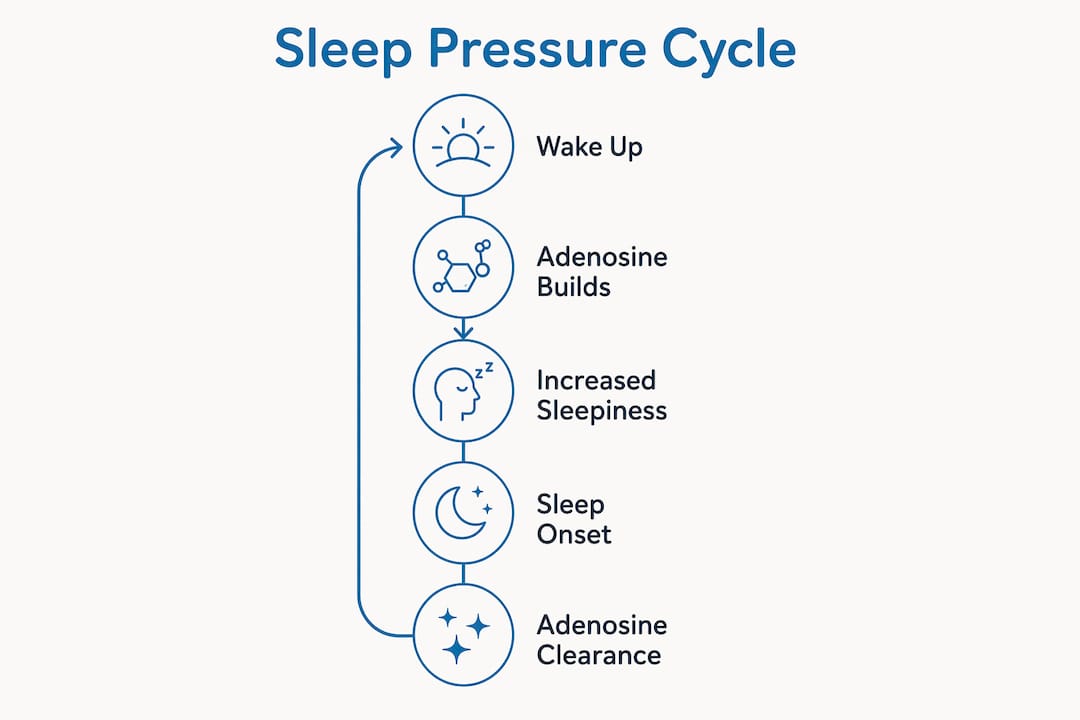
Sleep pressure, technically called Process S, is the homeostatic drive for sleep that accumulates during wakefulness due to adenosine buildup in the basal forebrain. Adenosine is a byproduct of cellular energy use. Every hour your neurons fire, adenosine levels rise, and your brain reads that accumulation as a signal to rest. Process S increases linearly with time awake, ideally reaching its peak after 16 or more hours of wakefulness, then dissipates during deep N3 sleep.
Here is what makes this mechanism so precise. Adenosine does not just make you feel tired in a vague, general way. It binds to specific receptors in the basal forebrain and suppresses the arousal systems that keep you alert. The longer you stay awake, the more receptor sites are occupied, and the stronger the pressure to sleep becomes. This is why pulling an all-nighter does not just make you tired. It creates a physiological debt that your body will collect on, often with interest.

The dissipation of sleep pressure happens almost exclusively during deep restorative N3 sleep. Lighter sleep stages clear adenosine far less efficiently. This is why six hours of fragmented sleep leaves you feeling worse than five hours of consolidated, deep sleep. Quality matters as much as quantity when it comes to resetting your sleep drive.
Key mechanisms of sleep pressure buildup:
- Adenosine accumulates in the basal forebrain throughout the waking day
- Process S increases linearly with each hour of wakefulness
- Deep N3 sleep is the primary stage where adenosine clears and sleep pressure resets
- Fragmented or shallow sleep fails to fully discharge accumulated sleep pressure
- The cycle repeats daily, making consistency in sleep timing critical
Pro Tip: If you wake up feeling unrefreshed despite a full night in bed, the problem is often sleep architecture, not sleep duration. Fragmented sleep prevents full adenosine clearance, leaving residual sleep pressure that carries into the next day.
How sleep pressure interacts with your circadian rhythm
The two-process model of sleep identifies Process S and Process C as interacting systems that control sleep timing and alertness. Process C is your 24-hour biological clock, driven by the suprachiasmatic nucleus in the hypothalamus. It does not respond to how long you have been awake. It responds to light, temperature, and time of day.
The interaction between these two systems produces some counterintuitive effects. You have almost certainly experienced the “second wind,” that sudden burst of alertness around 10 or 11 PM when you expected to feel exhausted. That is Process C overriding Process S. Your circadian alerting signal peaks in the early evening, temporarily suppressing the sleep pressure that has been building all day. The result is a window of false energy that many people mistake for a sign they do not need sleep.
Understanding the timing of wake windows matters because circadian alerting signals fluctuate, making some wakefulness periods less effective at building sleep pressure than others. Wakefulness accumulated in the late afternoon and evening generates stronger sleep pressure than the same duration earlier in the day, precisely because circadian alertness is declining and no longer masking the adenosine signal.
Here is a practical sequence that shows how the two processes interact across a typical day:
- Morning (6 AM): Sleep pressure is at its lowest after a full night of deep sleep. Circadian alertness begins rising with light exposure, keeping you awake even though adenosine has cleared.
- Early afternoon (1 to 3 PM): A brief dip in circadian alertness coincides with moderate adenosine buildup, producing the classic post-lunch slump. This is a real biological event, not just a food coma.
- Late afternoon (4 to 6 PM): Circadian alertness rebounds, masking growing sleep pressure. You feel functional even though adenosine levels are rising steadily.
- Evening (9 to 11 PM): The second wind occurs as circadian alertness peaks one final time. Sleep pressure is high, but Process C temporarily overrides it.
- Late evening (11 PM onward): Circadian alerting drops sharply. Sleep pressure and circadian timing finally align, creating the strong drive to sleep.
“The two-process model explains why sleep is not simply about being tired enough. It is about the right kind of tired at the right biological moment.”
What disrupts or enhances sleep pressure buildup
Caffeine blocks adenosine receptors, masking the feeling of tiredness without reducing adenosine levels, which leads to a more intense crash once caffeine is metabolized. This is the core reason caffeine feels like borrowed energy. You are not generating alertness. You are temporarily hiding the signal that sleep pressure has been building. When the caffeine clears, every adenosine molecule that accumulated during those hours is still waiting to bind.
Late-day caffeine is particularly disruptive. Avoiding caffeine after 2 PM helps maintain proper sleep pressure buildup by not interfering with adenosine accumulation during the critical pre-sleep window. The half-life of caffeine in most adults is five to seven hours, meaning a 3 PM coffee still has significant receptor-blocking activity at 10 PM.
| Factor | Effect on sleep pressure | Recommendation |
|---|---|---|
| Caffeine after 2 PM | Blocks adenosine receptors, delays sleep onset | Cut off caffeine by early afternoon |
| Naps over 30 minutes | Reduces adenosine buildup, weakens nighttime sleep drive | Keep naps under 30 minutes before 3 PM |
| Inconsistent wake times | Disrupts adenosine rhythm, reduces sleep depth | Consistent wake times stabilize adenosine cycles |
| Physical activity | Increases metabolic adenosine production, strengthens sleep pressure | Exercise regularly, ideally before evening |
| Sleeping in on weekends | Delays adenosine buildup for the following night | Maintain the same wake time seven days a week |
Naps longer than 30 minutes delay sleep onset by masking fatigue signals and partially discharging the adenosine that should be driving nighttime sleep. A short nap of 20 minutes preserves most of your sleep pressure while restoring alertness. Anything longer starts eating into the drive you need for a full night of restorative sleep.
Physical activity is one of the most underrated tools for building sleep pressure. Exercise increases metabolic activity, which accelerates adenosine production. Regular movement during the day creates a stronger, more consistent sleep drive by evening. This is one reason sedentary individuals often report lighter, less satisfying sleep even when they spend adequate time in bed.
Pro Tip: Set a single consistent wake time and hold it even on weekends. This one habit does more to stabilize your sleep pressure rhythm than any supplement or sleep aid on the market.
How sleep pressure affects your physical and mental health
Sleep pressure ensures restorative sleep that is critical for physiological recovery. When sleep pressure builds appropriately and discharges fully during deep sleep, the body completes essential repair processes: tissue regeneration, immune function, memory consolidation, and hormonal regulation. These are not optional maintenance tasks. They are the biological reason sleep exists.
Chronic insufficient sleep or fragmented sleep due to low sleep pressure activation keeps the sympathetic nervous system active, increasing hypertension risk for those sleeping less than six hours regularly. Consistent sleep deprivation below six hours correlates with higher cardiovascular disease risk. This means that poor sleep pressure management is not just a productivity problem. It is a long-term health risk with measurable physiological consequences.
The mental health effects are equally significant. Disrupted sleep pressure leads to elevated cortisol, reduced emotional regulation, and impaired prefrontal cortex function. People operating on chronically low sleep pressure report higher rates of anxiety, irritability, and difficulty concentrating. These are not personality traits. They are predictable neurological outcomes of insufficient adenosine clearance during sleep.
One often-overlooked consequence is the feedback loop that poor sleep creates. Fragmented sleep fails to clear adenosine fully, which means you wake up with residual sleep pressure. That residual pressure makes you reach for caffeine, which blocks adenosine receptors and disrupts the next night’s sleep. The cycle compounds over days and weeks, progressively degrading both sleep quality and daytime function. Breaking it requires addressing the root cause: building and protecting genuine sleep pressure rather than masking it.
Improving sleep hygiene practices directly supports healthy sleep pressure by creating the behavioral conditions that allow adenosine to accumulate and discharge on a consistent schedule.
Key takeaways
Sleep pressure, or Process S, is the adenosine-driven homeostatic system that builds during wakefulness and clears during deep N3 sleep, and managing it through behavioral consistency is the most effective path to restorative rest.
| Point | Details |
|---|---|
| Sleep pressure definition | Process S is the adenosine-driven homeostatic drive that builds linearly with time awake. |
| Deep sleep clears adenosine | Only N3 deep sleep efficiently discharges accumulated sleep pressure and resets the drive. |
| Caffeine masks, not removes | Caffeine blocks adenosine receptors temporarily, intensifying the crash once it clears. |
| Circadian rhythm interacts | Process C can override sleep pressure, causing second winds and delaying sleep onset. |
| Consistency is the fix | Stable wake times and limited naps build stronger, more reliable sleep pressure each night. |
Why I think most people are solving their sleep problems backwards
Most people who struggle with sleep reach for a solution before they understand the problem. They try melatonin, sleep medications, or blackout curtains before ever asking why their sleep drive is weak in the first place. I have seen this pattern repeatedly, and it almost always leads to the same outcome: temporary relief followed by the same problem returning.
Sleep medications act as sedatives that mask low sleep pressure symptoms and alter natural sleep architecture without helping to build restorative sleep pressure. That is a critical distinction. Sedation is not the same as sleep. You can be unconscious for eight hours and still wake up feeling depleted if your sleep architecture never reached the deep N3 stages where adenosine actually clears.
What actually works, in my experience, is treating sleep pressure as a resource you build during the day rather than a problem you solve at night. That means protecting your wake time with the same discipline you give your bedtime. It means treating a 25-minute nap as a precision tool, not a casual indulgence. It means recognizing that the afternoon coffee is a trade you are making against tomorrow morning’s energy.
Behavioral approaches that respect the natural interaction of homeostatic and circadian systems yield the best improvements in sleep architecture and restorative rest. The science on this is not ambiguous. The challenge is that behavioral change requires patience, and most people want to feel better tonight. Understanding that sleep pressure is something you actively build, not passively receive, is the shift that makes everything else click.
— Cadence
Support your sleep pressure with the right tools

Building healthy sleep pressure starts with your daily habits, but the right environment and recovery tools make a real difference in how deeply you sleep and how fully you recover. Evergreenbliss offers a curated range of sleep and relaxation aids designed to support the conditions your body needs for genuine restorative rest. From the deep sleep neck massager that helps you unwind before bed to stress relief sleep supplements formulated to ease the transition into sleep, every product is chosen to complement your body’s natural sleep mechanisms. Explore the full wellness and recovery collection at Evergreenbliss and find what fits your routine.
FAQ
What is sleep pressure in simple terms?
Sleep pressure is the biological urge to sleep that grows stronger the longer you stay awake. It is driven by adenosine buildup in the brain and resets during deep sleep each night.
How does caffeine affect sleep pressure?
Caffeine blocks adenosine receptors, masking the sensation of tiredness without reducing adenosine levels. Once caffeine clears, the accumulated adenosine binds all at once, producing a sharp energy crash.
What is the difference between sleep pressure and circadian rhythm?
Sleep pressure (Process S) measures how long you have been awake, while the circadian rhythm (Process C) tracks time of day. Both systems interact to determine when you feel sleepy and how deeply you sleep.
Can naps reduce sleep pressure too much?
Yes. Naps longer than 30 minutes partially discharge adenosine and reduce the sleep drive needed for a full night of restorative sleep. Short naps under 20 to 30 minutes preserve most of your nighttime sleep pressure.
Why do I get a second wind at night despite being tired?
The second wind occurs when your circadian alerting signal peaks in the late evening, temporarily overriding high sleep pressure. Once that circadian signal drops, usually after 11 PM, sleep pressure reasserts itself strongly.