Reducing nighttime anxiety for sleep means actively interrupting the mental and physical arousal cycle that keeps your brain alert when your body needs rest. The most effective methods are cognitive behavioral therapy for insomnia (CBT-I), scheduled worry time, progressive muscle relaxation (PMR), and stimulus control techniques. Sources including the Cleveland Clinic, Harvard Health, and the American Academy of Sleep Medicine (AASM) back these approaches with strong clinical evidence. This article walks you through each method, explains why it works, and gives you a practical framework you can start using tonight.
How does CBT-I reduce nighttime anxiety for sleep?
CBT-I is the first-line, clinically recommended treatment for insomnia tied to anxiety. It works by retraining the brain’s association with bed, replacing conditioned arousal with conditioned sleepiness. Most people lie in bed worrying, which teaches the brain that bed equals stress. CBT-I breaks that loop directly.
The therapy has two core tools: stimulus control and sleep restriction therapy.
- Stimulus control means you only use your bed for sleep. No scrolling, no worrying, no lying awake for long stretches. If you are awake and anxious, you leave the bed.
- Sleep restriction therapy temporarily limits the hours you spend in bed to match the hours you actually sleep. This builds sleep pressure, which makes falling asleep easier and reduces the anxiety that comes from lying awake too long.
- Cognitive restructuring challenges the thoughts that fuel nighttime anxiety, such as “I’ll never fall asleep” or “I need eight hours or tomorrow is ruined.”
The results are clear. CBT-I improves sleep in 7–8 out of 10 people who follow through with it. That rate is higher than sleep medication alone. The 2026 AASM clinical practice guideline recommends CBT-I as the core treatment for chronic insomnia, with medication listed only as a short-term, conditional add-on.
What makes CBT-I different from willpower is that it addresses conditioned arousal, not just stress. Your brain has learned to associate bed with wakefulness. CBT-I unlearns that association through repeated behavioral practice, not positive thinking.
Pro Tip: Find a CBT-I therapist through the Society of Behavioral Sleep Medicine’s directory, or try a digital CBT-I program like Sleepio if in-person access is limited.
What pre-bedtime routines help calm pre-sleep anxiety?
A structured wind-down routine is the most underused tool for managing nighttime stress. Most people go from full activity to bed with no transition, then wonder why their brain won’t slow down. The fix is a deliberate buffer period.

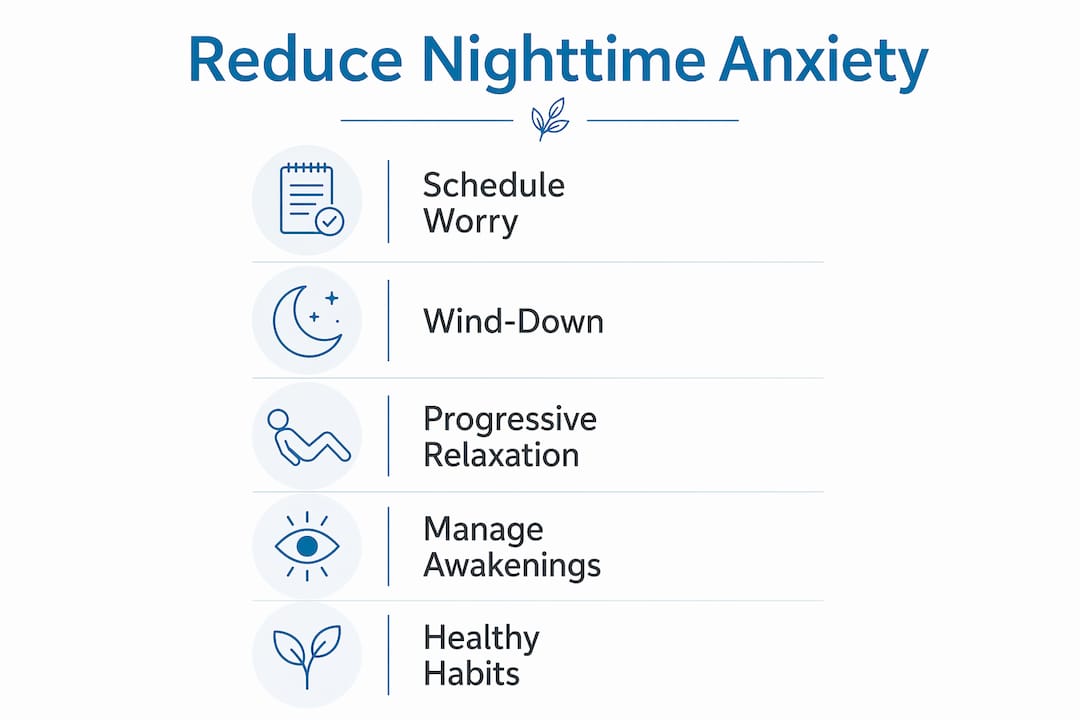
Schedule your worry time earlier in the day
Scheduled worry time means setting aside 10–15 minutes earlier in the day to write down your concerns and any partial solutions. This externalizes worry before it reaches bedtime. A worry log timed 2+ hours before bed prevents your night from becoming a default problem-solving session. When a worry surfaces at 11 p.m., you can tell yourself, “I already handled that at 6 p.m.” and mean it.
Build a 20 to 40 minute wind-down period
On stressful days, a buffer of up to 40 minutes protects a self-soothing window before bed. Wind-down time reduces the pressure of falling asleep immediately. That pressure reduction alone lowers the anxiety spike that hits when sleep doesn’t come fast. Use this window for low-stimulation activities: reading a physical book, light stretching, or listening to calm music.
Here is a practical wind-down sequence you can follow:
- Two hours before bed: Write your worry log. List concerns and one small next step for each.
- One hour before bed: Dim the lights in your home. Bright light suppresses melatonin and keeps your brain in daytime mode.
- 45 minutes before bed: Stop all screens. Blue light from phones and laptops delays sleep onset.
- 30 minutes before bed: Do progressive muscle relaxation or light stretching. Avoid caffeine after 2 p.m. to keep your system clear by bedtime.
- 15 minutes before bed: Move to a cool, dark, quiet room. Use white noise or a fan if outside sounds are disruptive.
Use progressive muscle relaxation
PMR involves tensing and releasing each muscle group from your feet to your face, paired with slow deep breathing. It reduces both physical tension and mental chatter. The key insight from Harvard Health is that PMR does not require a perfectly quiet mind. When a distracting thought appears, you simply return attention to your breathing and continue. Relaxation is a skill built through repetition, not a state you force. You can learn more about how these techniques work in practice through Evergreenbliss’s guide on relaxation device science.
Pro Tip: Record a PMR script on your phone and play it back at bedtime. Hearing instructions removes the mental effort of remembering each step, which keeps your focus on relaxing.
How do you manage nighttime awakenings and anxiety spikes?
Waking at 2 a.m. with a racing mind is one of the most frustrating parts of anxiety-driven insomnia. The instinct is to stay in bed and try harder to sleep. That instinct makes things worse.
The stimulus control rule is direct: if you have been awake and anxious for roughly 20 minutes, get out of bed. Go to another room. Do something calm under dim light. Return only when you feel genuinely sleepy. This approach works because reducing time-in-bed wakefulness is more effective than trying to relax harder while still lying there.
When you wake up anxious, follow these steps:
- Do not check the clock. Clock-watching increases anxiety about lost sleep and makes returning to sleep harder.
- Leave the bed after about 20 minutes of wakefulness. Staying longer strengthens the brain’s association between bed and frustration.
- Choose a calming, low-light activity. Options include reading a physical book, gentle stretching, or listening to a sleep meditation. Avoid screens and anything mentally stimulating.
- Practice slow breathing or a short PMR session. Focus on the physical sensation of breathing rather than trying to solve whatever woke you up.
- Return to bed only when sleepy. Sleepiness is the signal. Tiredness alone is not enough.
This process feels counterintuitive at first. Leaving a warm bed at 3 a.m. seems like giving up. The reality is that every time you stay in bed while anxious, you reinforce the bed-anxiety connection. Every time you leave and return sleepy, you weaken it. The anxiety and arousal loop breaks through consistent behavioral practice, not through force of will.
Understanding how stress impacts sleep quality at a deeper level can help you stay motivated when the process feels slow.
What lifestyle habits support better sleep and less nighttime anxiety?
Daily habits outside the bedroom have a direct impact on how anxious you feel at night. The most important one is a consistent wake-up time.
A fixed wake time anchors your circadian rhythm and builds natural sleep pressure across the day. That pressure makes falling asleep easier and reduces the anxiety that comes from lying awake. Wake at the same time every day, including weekends, even after a poor night.
| Habit | Effect on nighttime anxiety |
|---|---|
| Consistent wake time | Stabilizes sleep pressure and circadian timing |
| Morning natural light | Reinforces daytime alertness and nighttime sleepiness |
| Gentle daytime exercise | Reduces cortisol and promotes deeper sleep |
| No caffeine after 2 p.m. | Prevents stimulant interference with sleep onset |
| No heavy meals within 3 hours of bed | Reduces physical discomfort that triggers wakefulness |
| No strenuous exercise within 2 hours of bed | Avoids elevated heart rate and cortisol near bedtime |
Daytime light exposure is underrated. Morning sunlight for 10–20 minutes signals your brain that the day has started, which sharpens the sleep-wake cycle and makes nighttime sleepiness arrive on schedule. Gentle exercise like walking or yoga reduces cortisol and supports deeper sleep without the stimulating effect of intense late-day workouts.
Mindset matters too. Expecting perfect sleep every night creates performance anxiety around sleep itself. Accepting that sleep varies night to night removes a layer of pressure that feeds the anxiety cycle. CBT-I’s cognitive component directly addresses this by replacing catastrophic sleep thoughts with realistic ones. For a deeper look at building these habits, Evergreenbliss covers sleep hygiene fundamentals in a practical guide worth reading alongside this one.
Key Takeaways
Reducing nighttime anxiety for sleep requires breaking the conditioned bed-anxiety loop through CBT-I principles, structured wind-down routines, and consistent daily habits.
| Point | Details |
|---|---|
| CBT-I is the gold standard | It improves sleep in 7–8 out of 10 people by retraining the brain’s association with bed. |
| Schedule worry time early | Write concerns 2+ hours before bed to stop the night from becoming a problem-solving session. |
| Leave the bed if anxious | After about 20 minutes awake, get up and do a calm activity until sleepy to break conditioned arousal. |
| PMR builds relaxation as a skill | Tense and release muscle groups with slow breathing; redirect attention to breath when thoughts intrude. |
| Consistent wake time anchors sleep | A fixed morning wake time stabilizes circadian rhythm and reduces nighttime anxiety over time. |
What I’ve learned about breaking the bed-anxiety connection
The most common mistake I see is treating nighttime anxiety as a willpower problem. People lie in bed telling themselves to relax, which adds a second layer of pressure on top of the first. The bed becomes a place where you fail at sleeping, and that failure compounds every night.
The CBT-I insight that changed how I think about this is simple: the bed is not neutral. For someone with anxiety-driven insomnia, the bed has been conditioned to trigger alertness. No amount of deep breathing fixes a conditioned response. You have to change the behavior first, and the feelings follow.
The hardest part of implementing these techniques is the short-term discomfort. Getting out of bed at 3 a.m. feels wrong. Restricting your time in bed feels counterproductive when you are already exhausted. But the people who push through that discomfort for two to three weeks consistently report a shift. The bed starts to feel like a place for sleep again, not a place for anxiety.
My honest advice: combine techniques rather than relying on one. Use scheduled worry time to clear your head before bed, PMR to relax your body, and stimulus control to protect the bed’s association with sleep. None of these tools is a quick fix. All of them work when practiced consistently. Patience is not a soft skill here. It is the mechanism.
— Cadence
Sleep tools that support your wind-down routine
Behavioral techniques do the heavy lifting, but the right physical tools make the process easier to maintain.

Evergreenbliss carries a curated selection of sleep and relaxation aids designed to support wind-down routines, from handheld massagers that release physical tension before bed to stress relief sleep supplements that support natural melatonin production. For people who want to address both physical tension and mental stress, the mental wellness and stress-relief collection includes products built specifically around pre-sleep relaxation. Free shipping and easy returns make it low-risk to find what works for your routine.
FAQ
What is the fastest way to calm anxiety before bed?
Progressive muscle relaxation and slow diaphragmatic breathing are the fastest evidence-based methods. Harvard Health recommends tensing and releasing muscle groups from feet to face while focusing on breath to reduce physical and mental tension within minutes.
How long does CBT-I take to work?
Most people see meaningful improvement within 4–8 weeks of consistent CBT-I practice. The Cleveland Clinic reports that 7–8 out of 10 people who adhere to CBT-I experience significant sleep improvement.
Should I take sleep medication for nighttime anxiety?
The 2026 AASM guideline positions medication as a short-term, conditional add-on to CBT-I, not a standalone solution. Medication can provide temporary relief while CBT-I reshapes the conditioned wakefulness response.
Does a consistent wake time really reduce nighttime anxiety?
Yes. A fixed wake time stabilizes circadian rhythm and builds natural sleep pressure, which makes falling asleep easier and reduces the anxiety that comes from lying awake. NPR’s sleep reporting confirms this as one of the most effective single habits for anxiety-related insomnia.
What should I do if I wake up anxious at 3 a.m.?
Leave the bed after about 20 minutes of wakefulness, do a calm activity under dim light, and return only when sleepy. Atlantic Health confirms this stimulus control approach breaks the bed-anxiety association more effectively than staying in bed and trying to force sleep.