Wellness gadgets work best when they function as active coaches, not passive loggers. The most effective digital wellness tools share three core capabilities: self-monitoring, real-time feedback, and incremental goal-setting. Research across 14 randomized controlled trials found that self-monitoring appeared in every successful health-tracking program, with feedback and goal-setting close behind. The result is measurable: people using wearables added extra steps per day compared to those receiving standard care. That kind of shift does not come from data collection alone. It comes from behavior change.
Here is what well-chosen gadgets can support:
- Stress relief: guided breathing prompts, heart rate variability alerts, and mindfulness app reminders
- Sleep improvement: smart lights that shift color temperature at night, sleep trackers that identify disruption patterns
- Overall health: activity tracking, exertion alerts, and recovery scoring that adjust daily plans in real time
- Focus and mental wellbeing: screen-time management apps like Opal, which reported that 94% of users saw improved focus, 93% gained efficiency, and 90% experienced better mental wellbeing
94% of Opal users reported improved focus. 90% reported better mental wellbeing. These numbers reflect what happens when a gadget actively shapes behavior rather than simply recording it.
What makes a wellness gadget actually effective?
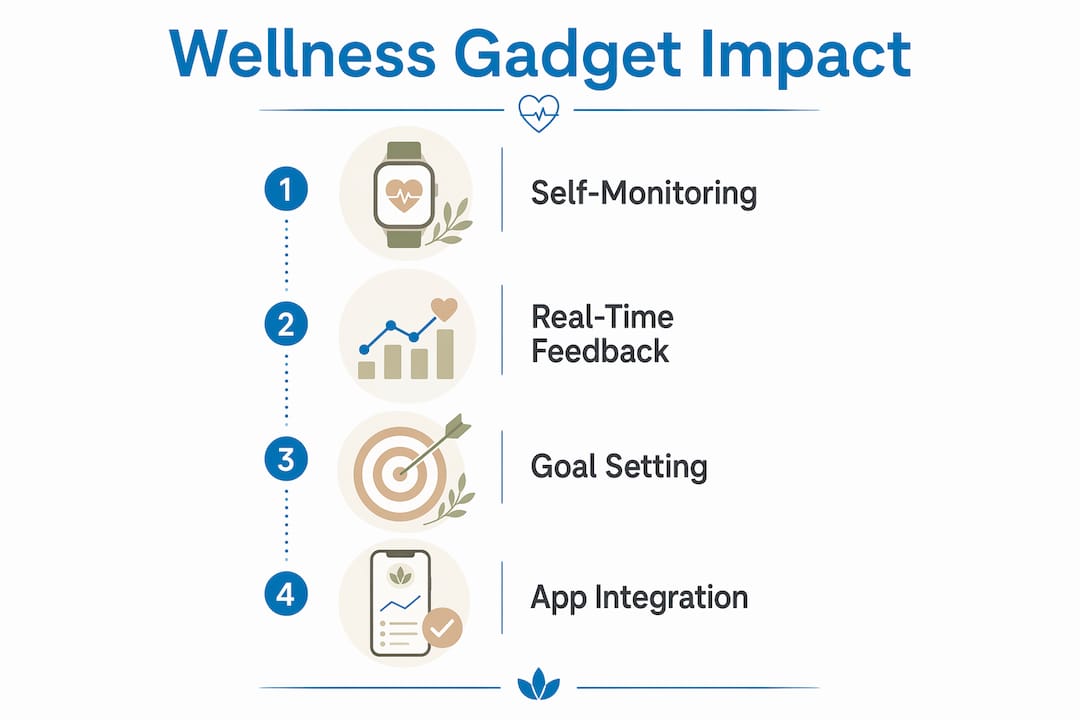
The difference between a gadget that collects dust and one that changes your habits usually comes down to three features working together.
Self-monitoring builds awareness. When you can see your resting heart rate trend over two weeks, or watch your screen time climb past a threshold, the data creates a kind of mirror. You stop guessing and start noticing. This feature appeared in all 14 studies reviewed in the Journal of the American Heart Association research.
Real-time feedback keeps you engaged between check-ins. A nudge mid-afternoon to stand up, a breathing reminder when your heart rate spikes, a sleep score waiting for you at 7:00 AM. These prompts interrupt autopilot and prompt small decisions that compound over time.
Specific goal-setting turns vague intentions into targets you can act on. “Move more” is not a goal. “Add a 10-minute walk after dinner three times this week” is. Gadgets that let you set incremental, measurable targets give you something concrete to respond to.
Beyond these three pillars, app integration multiplies the effect. A wearable that syncs with a wellness app, shares data with a coach, or connects to your home lighting system becomes part of a system rather than a standalone device. That system-level thinking is what transforms wearables from data collectors into behavioral partners.
The behavioral science behind why gadgets change habits
Gadgets do not change habits by themselves. They work by tapping into mechanisms that behavioral science has studied for decades.
Routine triggers are one of the most reliable levers. When a smart light dims automatically at 9:00 PM, it signals your brain that wind-down time has arrived, reinforcing your circadian rhythm without any conscious effort. The University of Utah’s integrative health research describes these environmental cues as anchors that make habit formation far more durable than willpower alone.
Coaching tone matters more than most people expect. A Curion survey of U.S. adults found that users who preferred encouraging, positive coaching reported noticeably higher wellbeing improvement than those who preferred factual feedback or alerts. The device that cheers you on outperforms the one that just reports numbers.
There is a real tension to manage, though. The same survey found that some tracker users reported negative psychological effects, often anxiety about not hitting daily goals, with younger users experiencing this more often than older users. Pairing objective data with a simple subjective log, a sentence or two about how you actually feel, keeps tracking from becoming a source of stress rather than relief. For a deeper look at how wellness habits form, Evergreenbliss covers the science behind sustainable behavior change.
Pro Tip: Add one gadget at a time. Use it for three to four weeks before layering in a second. This mirrors what behavioral scientists call “mindful integration,” and it dramatically reduces the chance of abandoning the whole routine.
Gadget categories that support stress relief, sleep, and health
Different goals call for different tools. Here is how the main categories actually function.
Wearable wellness gadgets track heart rate variability, sleep stages, skin temperature, and activity load continuously. When treated as coaching partners rather than data archives, they help people adjust their day based on real signals. Someone whose HRV drops after a poor night can scale back training intensity before a crash happens, not after.
Focus-management apps like Opal block distracting apps on both phone and desktop, letting you set rules and timers that lock in until the session ends. The Opal Impact Survey found that 94% of users experienced improved focus, 93% felt more efficient, and 90% reported better mental wellbeing, which places it alongside physical wearables as a legitimate wellness tool, not just a productivity hack.

Smart lights are underrated. A tunable bulb set to cool, energizing light in the morning and warm amber in the evening costs less than most wearables and directly supports circadian rhythm. Paired with a sleep tracker, it gives you both the environmental cue and the data to confirm whether it is working. Evergreenbliss covers relaxation devices for insomnia that pair well with this kind of light-based approach.
Sleep trackers identify patterns that are invisible to the naked eye: frequent awakenings, low REM percentage, elevated resting heart rate at 3:00 AM. That data points toward causes, whether caffeine timing, alcohol, or a noisy environment, rather than leaving you guessing. For practical guidance on pairing trackers with sleep hygiene practices, Evergreenbliss has a dedicated guide. You can also find expert tips on building a healthier sleep environment that complements what your tracker reveals.
Recovery and pacing tools serve people managing energy-limiting conditions. Devices with exertion notifications and activity tagging let people track which tasks cost the most energy, making it possible to pace through a day without crashing.
The step counter may be the least therapeutic feature on your wearable. Curion’s research found that users who changed stress management behaviors, the least common change, reported the highest meaningful improvement rate at 57%.
How to incorporate wellness gadgets into routines sustainably
Starting with one gadget aligned to a single measurable goal is the most reliable path. Collect a week of baseline data before changing anything. That baseline becomes your reference point for every experiment that follows.
- Run four-week tests. Change one variable, track the outcome, then decide whether to keep it. This mirrors the approach recommended by sustainable wellness experts who endorse gradual adoption over lifestyle overhauls.
- Anchor gadget use to existing habits. Check your sleep score while coffee brews. Review your HRV before you plan your workout. Attaching new behaviors to established ones dramatically improves consistency.
- Combine tech with behavioral cues. A morning light session plus a 10-minute movement routine creates a compound signal that wakes your body and mind together.
- Guard your health data. Review each app’s privacy policy before connecting. Prefer platforms that minimize data retention and allow export. Health data reveals daily patterns, stress events, and sleep times, information worth protecting with the same care as financial data.
How to evaluate a wellness gadget before you buy
Not every gadget earns its place on your nightstand or wrist. Before committing, run through these criteria.
Metric relevance: Does the device measure something you actually care about? HRV for recovery, sleep stages for rest quality, SpO2 for respiratory health. A device measuring metrics you will never act on adds noise, not insight.
Clinical or peer-reviewed backing: Look for devices whose core claims reference published research or validated measurement methods. Photoplethysmography for resting heart rate is well-established; some proprietary “stress scores” are not.
Ecosystem compatibility: Does it sync with Apple Health, Google Fit, or your preferred wellness app? Devices that export data freely reduce lock-in and make long-term tracking easier.
Coaching quality: Does the app offer encouraging, personalized feedback, or just raw numbers? Given that positive coaching correlates with the highest wellbeing improvement rates, this feature deserves real weight.
Privacy policy: Who owns your data? Can you delete it? Does the company sell aggregated health data to third parties? These questions matter before you hand over months of biometric history.
Common challenges and limitations of wellness gadgets
Gadgets are tools, not cures. Accuracy varies, especially for people with atypical movement patterns or darker skin tones, where optical heart rate sensors can underperform. Sleep staging algorithms differ across devices, so comparing scores between brands is often meaningless.
Goal anxiety is a real pattern, particularly among younger adults. When a daily step target becomes a source of dread rather than motivation, the gadget is working against you. The fix is usually adjusting the goal, not abandoning the device.
Adherence drops sharply after the novelty wears off. Most people engage most intensely in the first few weeks. Building gadget use into an existing routine, rather than treating it as a standalone practice, is the most reliable counter to this.
Do wellness gadgets keep working over the long term?
The honest answer is: it depends on how you use them. A Curion survey found that a large majority of tracker users reported improved wellbeing, including many who changed nothing about their behavior. That suggests the act of continuous self-measurement carries its own benefit. But meaningful, lasting change tends to require active engagement: checking progress, responding to prompts, adjusting goals.
Long-term adherence improves when gadgets are integrated into routines rather than bolted on top of them. People who use wearables to validate rest, to confirm that a recovery day was warranted, tend to sustain the habit longer than those chasing performance metrics. The goal is not to optimize every number. It is to build a relationship with your own data that informs rather than controls.
Find the right tools at Evergreenbliss
Evergreenbliss curates wellness gadgets built around the same principles covered here: real feedback, practical design, and support for the habits that matter most. Whether you are focused on stress relief, better sleep, or physical recovery, the collections cover the full range.
- Stress relief gadgets for mental wellness and daily calm
- Sleep and relaxation aids for deeper, more consistent rest
- Personal care gadgets for everyday self-care routines
Free shipping, easy returns, and a curated selection built for people who take their wellness seriously.
Key Takeaways
Wellness gadgets drive lasting change through self-monitoring, personalized feedback, and specific goal-setting, not through data collection alone.
| Point | Details |
|---|---|
| Self-monitoring is universal | It appeared in all 14 studies reviewed; tracking behavior builds the awareness that drives change. |
| Coaching tone shapes outcomes | Users preferring encouraging feedback reported meaningful wellbeing improvement at 57%. |
| 84% report improved wellbeing | This held even among users who changed no behaviors, suggesting continuous measurement has its own effect. |
| Mindful integration beats overhaul | Adding one gadget at a time, with a four-week test period, produces more durable habits than rapid adoption. |
| Balance data with how you feel | Some tracker users reported anxiety; pairing objective data with a subjective daily log keeps tracking healthy. |