Stress relief gadgets are defined by how they affect your nervous system, ranging from simple tactile tools to sophisticated devices that modulate your body’s physiological stress response directly. The three core types of stress relief gadgets are distraction and tactile tools, breathing and biofeedback devices, and direct neuromodulation gadgets. Each category works through a different biological mechanism, which means the right choice depends on your stress severity, lifestyle, and willingness to commit to a practice. This guide breaks down every category with real examples, scientific evidence, and honest trade-offs so you can pick what actually works for you.
1. types of stress relief gadgets: the three core categories
Stress relief gadgets fall into three distinct categories based on their physiological effect. Distraction gadgets engage your senses to redirect attention. Biofeedback devices train your nervous system through guided breathing and real-time data. Neuromodulation gadgets stimulate the parasympathetic nervous system directly using electrical signals. Understanding this framework before you buy saves you money and frustration. A fidget cube will not calm a panic attack, and a vagus nerve stimulator is overkill for mild desk restlessness.
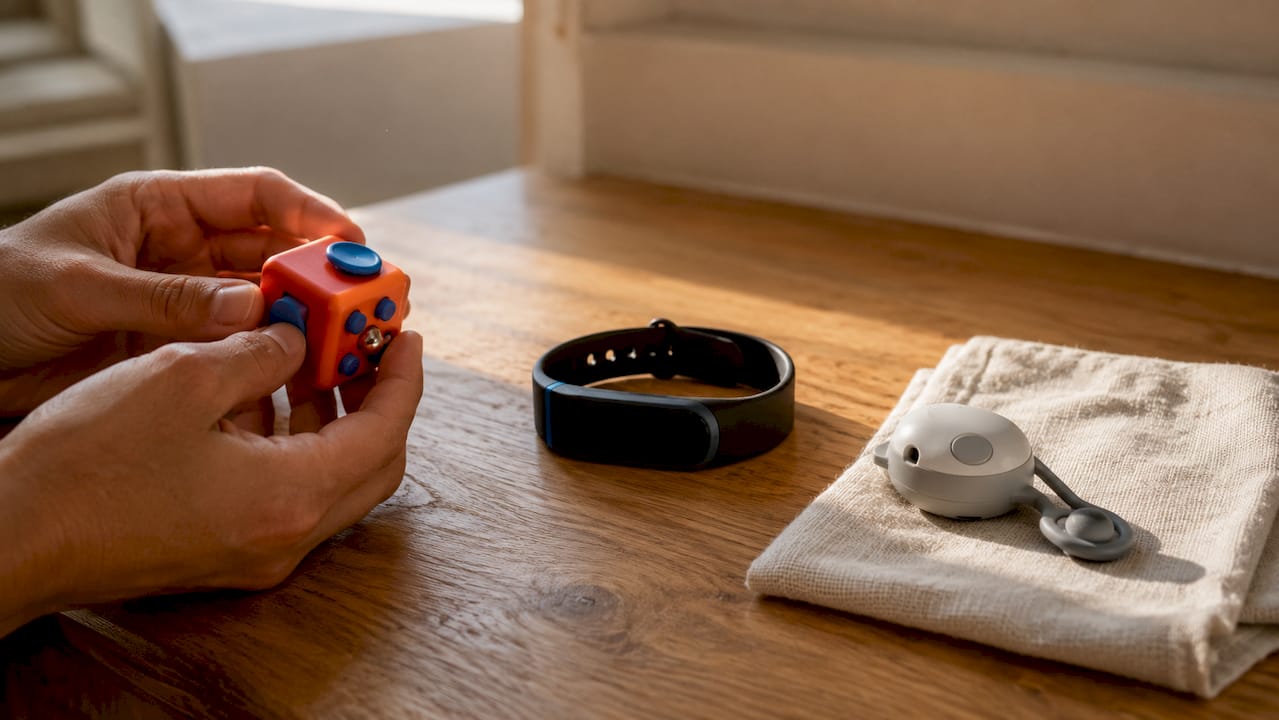
2. distraction and tactile gadgets: what they are and how they work
Distraction-based gadgets provide tactile sensory input that redirects your attention away from stressors without altering your biological stress response. They are the most accessible entry point into stress management tools. Common examples include:
- Fidget cubes with buttons, switches, and dials for hands-on stimulation
- Stress balls that engage grip strength and release muscle tension
- Sensory rings and textured hand rollers for repetitive tactile feedback
- Fidget spinners for rhythmic, low-effort motion
These gadgets work best for mild restlessness, situational anxiety, or focus issues during meetings and study sessions. They are inexpensive, portable, and require zero setup. You can pull a stress ball out of your bag and use it in 10 seconds flat. The trade-off is real: tactile tools do not lower cortisol, slow your heart rate, or activate your parasympathetic nervous system in any measurable way. For moderate or severe stress, they provide surface-level relief without addressing the underlying biological response. Explore sensory relaxation tools if you want a broader look at what fits this category.
Pro Tip: Match the tactile gadget to your sensory preference. If you dislike soft textures, a stress ball will feel irritating rather than calming. Try a rigid fidget cube or a smooth metal hand roller instead.
3. breathing and biofeedback gadgets: how they relieve stress
Breathing and biofeedback gadgets are stress relief devices that use real-time physiological data to guide you toward a calmer nervous system state. They measure signals like heart rate variability (HRV) and feed that data back to you through an app or display, coaching you to breathe in patterns that activate your parasympathetic response. HeartMath’s emWave and Inner Balance devices are the most established examples in this category. The emWave technology delivers real-time HRV feedback with a multi-level coaching workflow designed to build emotional self-regulation and resilience over time.
The science behind this category is solid. Coherent breathing protocols produce a statistically significant increase in parasympathetic activity, stabilize cortisol response, reduce inflammation, and improve sleep duration. That result matters because it means breathing gadgets can produce measurable biological change, not just a feeling of calm. Research also shows that biofeedback reduces anxiety during acute stress events, with one study recording a pulse rate decrease of 3.61 bpm and significantly lower anxiety scores after dental procedures.
Key benefits of breathing and biofeedback gadgets include:
- Measurable physiological change through HRV training and cortisol stabilization
- Guided sessions that teach you a skill you can use without the device
- Sleep improvement as a secondary benefit from consistent parasympathetic activation
- Scalable difficulty with multi-level programs that grow with your practice
The limitation is user commitment. Structured sessions and adherence drive the results, not the device itself. If you buy an emWave and use it twice, you will not see meaningful change. These gadgets also require mental bandwidth to operate correctly, which is a real barrier when anxiety is already high. Learning to breathe better before relying on the device helps you get more out of your sessions from day one.
Pro Tip: Schedule biofeedback sessions at the same time each day, ideally in the morning before stress accumulates. Consistent session timing, not session length, is what builds long-term resilience.
4. direct neuromodulation gadgets: are they worth it?
Direct neuromodulation gadgets are stress relief devices that deliver mild electrical stimulation to the vagus nerve, triggering a parasympathetic response without requiring you to control your breathing or focus your attention. Pulsetto and Truvaga are two of the most recognized devices in this category. They clip to the neck and deliver transcutaneous vagus nerve stimulation (tVNS) through brief, low-intensity electrical pulses.
The appeal is clear. Unlike biofeedback gadgets, neuromodulation devices do not require mental effort during use. You apply the device, run a session, and your nervous system responds to the stimulation directly. This makes them theoretically useful for people whose anxiety is too high to execute breathing exercises effectively.
The evidence is promising but not definitive. At-home vagus nerve stimulators show benefit with twice-daily short sessions, but the research base is still emerging compared to the decades of clinical data behind HRV biofeedback. Practical constraints are also significant:
- App-dependent activation means you need your phone and the app open before each session
- Gel application is required on some devices before use, adding preparation time
- Mental readiness is still needed to initiate the workflow during acute stress moments
- Cost is considerably higher than tactile or entry-level biofeedback tools
“User adherence to the activation workflow of vagus nerve stimulators significantly impacts real-world effectiveness, especially during acute stress.” — Healthline Review
The honest assessment is this: neuromodulation gadgets are the most biologically direct option, but their usability during a real stress episode is often worse than a breathing app. They work best as a daily maintenance tool rather than an on-demand rescue device.
5. how do these gadget types compare? a side-by-side look
Choosing between gadget categories comes down to four factors: cost, required effort, physiological impact, and portability. The table below maps each category against these factors to help you match the right tool to your situation.
| Category | Cost Range | User Effort | Physiological Impact | Best For |
|---|---|---|---|---|
| Distraction / Tactile | $5–$30 | Very low | Minimal (attention only) | Mild restlessness, focus support |
| Breathing / Biofeedback | $100–$300 | Moderate to high | Significant (HRV, cortisol, sleep) | Moderate stress, daily practice users |
| Direct Neuromodulation | $200–$500+ | Low to moderate | Direct parasympathetic activation | Severe or resistant stress, daily maintenance |
First-time buyers should start with a tactile tool or an entry-level biofeedback device. Tactile gadgets cost almost nothing and carry no learning curve. Biofeedback devices like the HeartMath Inner Balance deliver real physiological results if you commit to consistent use. Neuromodulation devices are best suited for people who have already tried biofeedback and want a less cognitively demanding option, or for those whose stress levels make breathing exercises difficult to execute.
The best stress relief gadgets 2026 guides consistently emphasize one finding: consistency beats intensity. Short daily sessions with any of these tools outperform occasional long sessions. That principle applies whether you are squeezing a stress ball for five minutes every morning or running a 10-minute emWave session before bed. Pairing gadgets with personalized bio-optimization strategies can further sharpen your results by aligning device use with your individual physiological patterns.
A true biofeedback device combines sensors, real-time feedback, and structured coaching. A wearable that only tracks HRV without guiding you to change it is a monitor, not a stress relief tool. That distinction matters when you are comparing products and evaluating whether a device will actually move the needle on your stress levels.
Key takeaways
The most effective stress relief gadget is the one that matches your stress severity, requires a level of effort you will actually sustain, and produces the physiological change your situation demands.
| Point | Details |
|---|---|
| Three core gadget categories | Distraction, biofeedback, and neuromodulation each work through a different biological mechanism. |
| Tactile tools have real limits | Fidget gadgets relieve mild restlessness but do not lower cortisol or activate the parasympathetic nervous system. |
| Biofeedback requires commitment | HeartMath emWave and similar devices produce measurable results only with consistent, structured daily sessions. |
| Neuromodulation is not on-demand | Vagus nerve stimulators like Pulsetto work best as daily maintenance tools, not acute stress rescues. |
| Consistency beats intensity | Short daily sessions with any gadget type outperform irregular intense use for long-term stress relief. |
What i’ve learned after testing every category
I have spent time with all three gadget categories, and the pattern I keep seeing is that people buy up when they should start simple. Someone with mild work stress buys a $400 vagus nerve stimulator because it sounds more scientific, uses it three times, and decides gadgets do not work. The device was not the problem. The mismatch was.
My honest observation is that biofeedback devices are the sweet spot for most people. They are demanding enough to build a real skill, but the feedback loop keeps you engaged. The HeartMath Inner Balance changed how I think about stress management because it made the invisible visible. Watching your HRV shift in real time as you breathe is genuinely motivating in a way that a stress ball never will be.
The neuromodulation category is genuinely exciting, but the app-dependent workflow kills it for acute stress moments. I have never successfully opened an app, applied gel, and started a Pulsetto session during a real anxiety spike. I use it in the morning as a preventive tool, and that is where it earns its place.
The advice I give everyone: start with a tactile tool to build the habit of reaching for something when stress hits. Add a biofeedback device once you are ready to commit 10 minutes a day. Consider neuromodulation only after you have a consistent practice in place. Stack the categories rather than jumping straight to the most advanced option.
— Cadence
Find your stress relief gadget at Evergreenbliss
Evergreenbliss carries a curated selection of stress relief and wellness gadgets covering every category in this guide, from tactile sensory tools to sleep and relaxation aids. Whether you are starting with something simple or looking for a more advanced device, the collection is built around products that actually support your mental well-being rather than just looking good on a shelf.
Browse the full personal care gadgets collection to find tools matched to your stress level and lifestyle. Evergreenbliss offers free shipping, easy returns, and a secure checkout, so finding the right gadget for your routine is straightforward. The Deep Sleep Neck Massager and sleep relaxation aids are strong starting points if stress is affecting your sleep quality.
FAQ
What are the main types of stress relief gadgets?
The three main types are distraction and tactile gadgets, breathing and biofeedback devices, and direct neuromodulation gadgets. Each works through a different mechanism, from sensory redirection to direct parasympathetic nervous system activation.
Which stress relief gadget works best for severe anxiety?
Biofeedback devices like the HeartMath emWave and vagus nerve stimulators like Pulsetto are the most effective for moderate to severe stress because they produce measurable physiological change. Tactile tools alone are not sufficient for high-intensity anxiety.
How often should you use a stress relief gadget?
Short daily sessions consistently outperform occasional long sessions for any gadget type. Research from the 2026 stress relief guides confirms that routine use drives better long-term calm and resilience than irregular intense use.
Do biofeedback gadgets actually work?
Yes, when used consistently with structured sessions. Coherent breathing protocols guided by biofeedback devices produce significant increases in parasympathetic activity, lower cortisol, and improve sleep duration, according to published clinical research.
Are vagus nerve stimulators safe to use at home?
At-home vagus nerve stimulators like Truvaga and Pulsetto are designed for consumer use and show a promising safety profile in current reviews. The main practical challenge is the app-dependent activation workflow, which can be a barrier during acute stress episodes.